
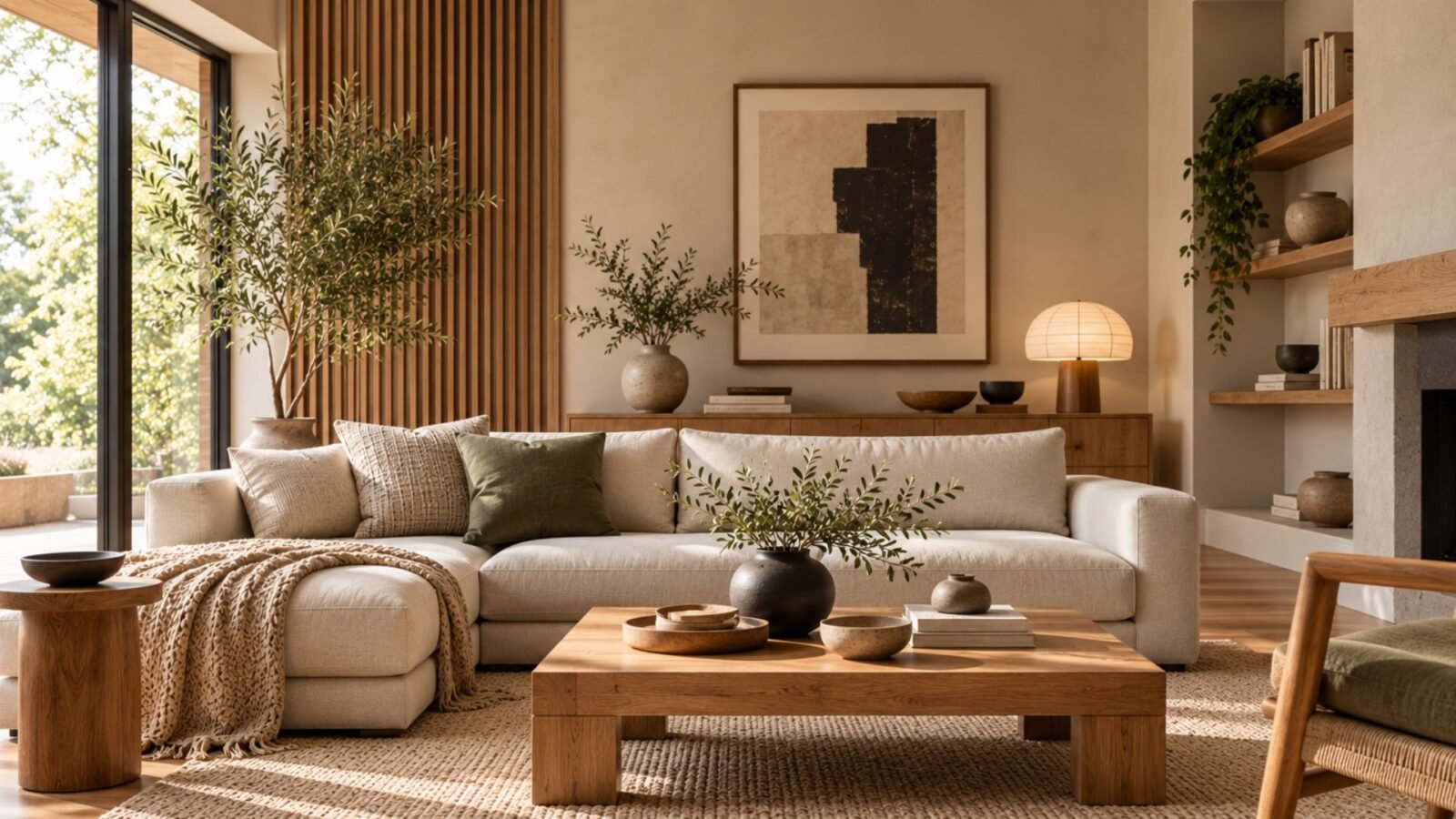

Japandi living rooms combine restraint, function, natural materials and craftsmanship without reducing the room to beige minimalism.
A Japandi living room brings Japanese and Scandinavian design influences together through qualities they already share: simplicity, useful objects, natural materials and respect for craftsmanship.
But the combination is more specific than a neutral sofa, pale wood and a few ceramic vases. A convincing Japandi room needs breathing space, material variation and comfortable furniture without unnecessary visual noise. It can be light or dark, polished or imperfect, as long as each element earns its place.
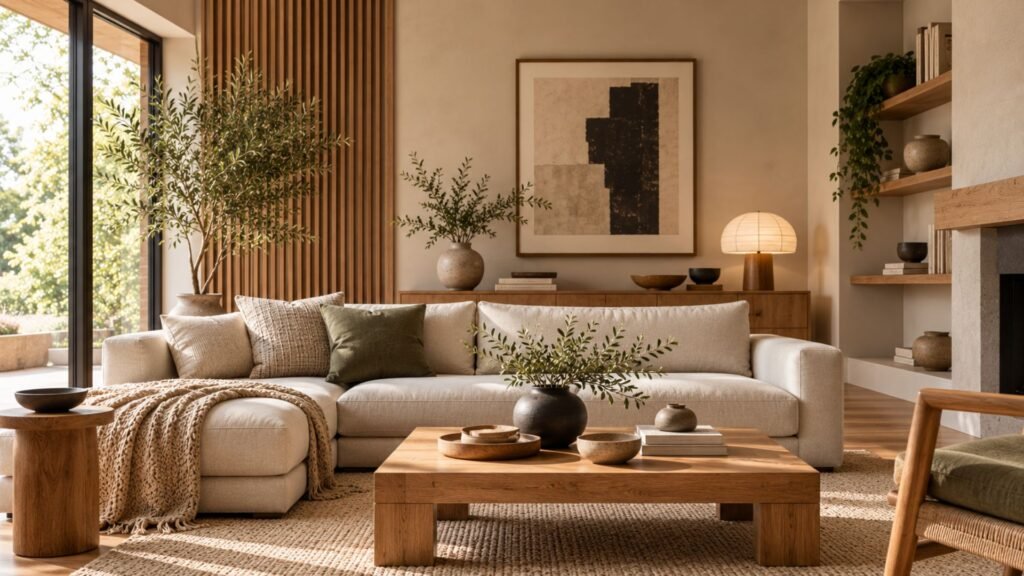
What actually makes a living room Japandi?
Japandi is a contemporary design label combining elements associated with Japanese and Scandinavian interiors. Both traditions value simplicity, natural materials, functionality and craftsmanship, which gives them substantial common ground despite their different cultural histories.
Architectural Digest describes Japandi as a mixture of Japanese and Scandinavian design, noting their shared emphasis on simplicity, quality natural materials and craftsmanship. Livingetc similarly identifies craftsmanship, minimalism and natural materials as important points of overlap.
That shared ground matters more than assembling a checklist of objects.
A room doesn’t become Japandi because it contains a paper lantern, bonsai tree or pale oak coffee table. It reads as Japandi when the furniture, materials, empty space and decorative restraint work together.
This also means there isn’t one rigid Japandi formula. A room can lean lighter and more Scandinavian or darker and earthier while retaining the same underlying logic.
Where Japanese and Scandinavian design meet
The overlap begins with restraint.
Both design traditions can favor uncluttered interiors, practical furniture, natural materials and objects made to last. Their combination allows a living room to stay visually quiet without becoming uncomfortable.
The differences are useful too.
Scandinavian-influenced interiors often bring lighter woods, pale surfaces and an emphasis on everyday domestic comfort. Japanese-influenced interiors can introduce darker woods and earthier colors alongside greater material variation and a more restrained composition. These are tendencies rather than rigid national rules.
That is why good Japandi interiors don’t need to split neatly into “half Japanese, half Scandinavian.” The room should feel coherent before anyone tries to identify which influence produced which object.
What about wabi-sabi and hygge?
These terms are frequently used to explain Japandi, but neither should be reduced to a styling trick.
Wabi-sabi is a Japanese aesthetic tradition associated with accepting imperfection, impermanence and natural change. In an interior, that can help explain an appreciation for irregular ceramics, visible wood grain, patina and materials that do not look mechanically identical.
Hygge is associated with Danish ideas of comfort and conviviality. Its relevance to Japandi is less about adding blankets and candles than ensuring restraint doesn’t remove the comfort required for everyday living.
They can help explain parts of the Japandi sensibility, but they are not a decorating equation.
Japandi vs. Organic Modern
Japandi and Organic Modern overlap substantially. Both can use wood, stone, linen, wool, restrained colors and relatively simple furniture.
The difference is what organizes those ingredients.
Organic Modern begins with contemporary form and softens it through natural material variation. Japandi adds another layer: restraint in how objects occupy the room, greater emphasis on purposeful simplicity and craftsmanship, and a design vocabulary informed by both Japanese and Scandinavian traditions.
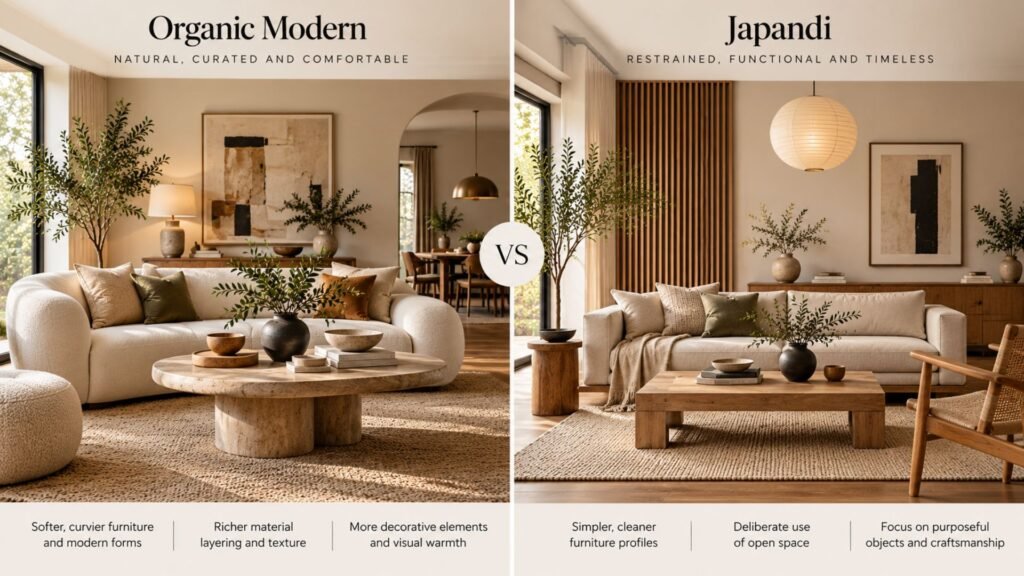
This distinction becomes clearest when accessories disappear.
An Organic Modern room can support generous curves, substantial upholstery and more decorative material layering. A Japandi room usually benefits from editing harder. Empty space becomes part of the composition rather than an area waiting to be decorated.
If the natural-material side of this distinction is what interests you most, our Organic Modern living room guide develops that approach separately.
Start with breathing room, not beige
Beige is not what makes Japandi work.
A more useful starting point is deciding what the room can do without.
Look at the spaces between furniture, not only the furniture itself. A coffee table does not need objects covering its entire surface. Every wall does not need art. An empty corner does not automatically require a plant, basket or floor lamp.
This is different from making the room empty for its own sake.
Negative space gives important pieces room to register individually. A well-made timber chair becomes easier to notice when it isn’t competing with three side tables, multiple baskets and a crowded gallery wall.
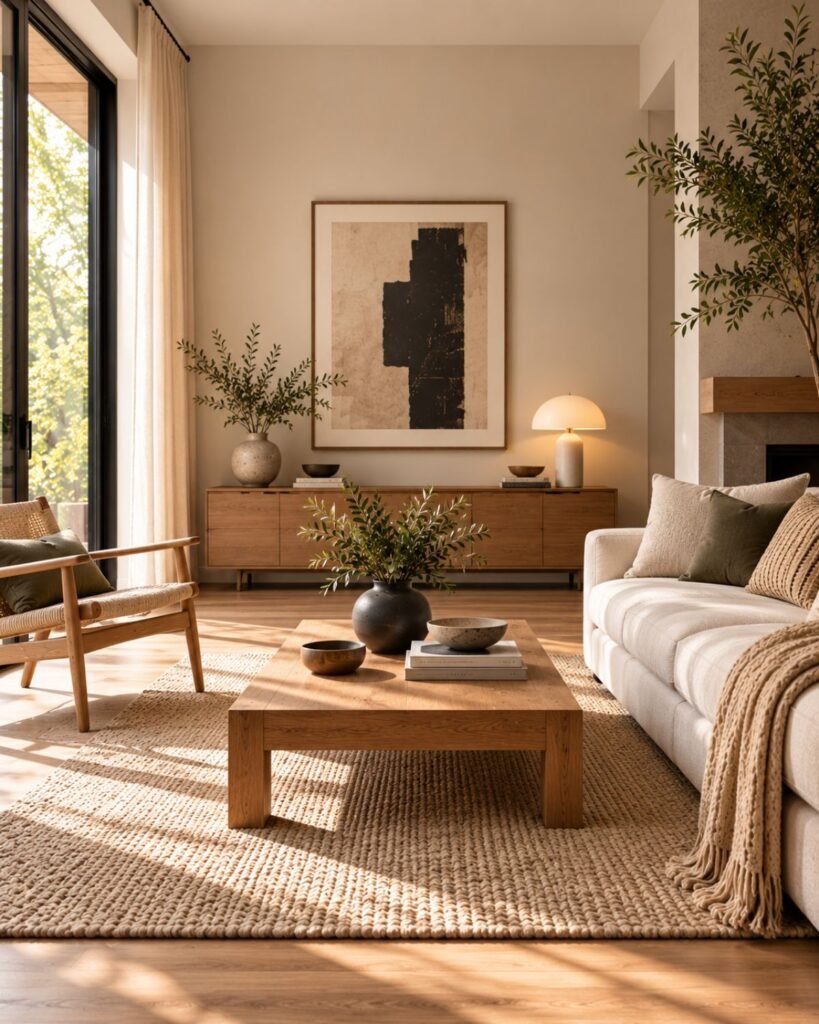
The practical test is straightforward: remove an object and look again. If the room still functions and the remaining composition becomes clearer, that object may not have been necessary.
Furniture should be simple, but still comfortable
Japandi furniture tends to work best when its form is easy to understand.
That can mean clean profiles, exposed timber, restrained upholstery and fewer decorative details. Some Japandi interiors also use lower furniture, which reduces visual mass and leaves more uninterrupted wall area above it.
Low does not mean impractical.
You do not need floor-level seating or furniture that is uncomfortable to stand up from. A standard-height sofa with a relatively low back can create much of the same visual effect while remaining suitable for everyday use.
Comfort matters because Japandi is not austerity.
A deep enough sofa, supportive chair and tactile rug can make the room pleasant to use without requiring piles of cushions and throws. The aim is to make each comfort layer deliberate rather than multiplying them automatically.
Materials should show what they are
Wood is central to many Japandi interiors, but matching every wood tone is unnecessary.
Pale oak can pull a room toward its Scandinavian side. Walnut, stained oak and other darker woods can introduce greater visual weight and an earthier character. Mixing them can work when the undertones relate and one wood does not accidentally look like a failed match for another.
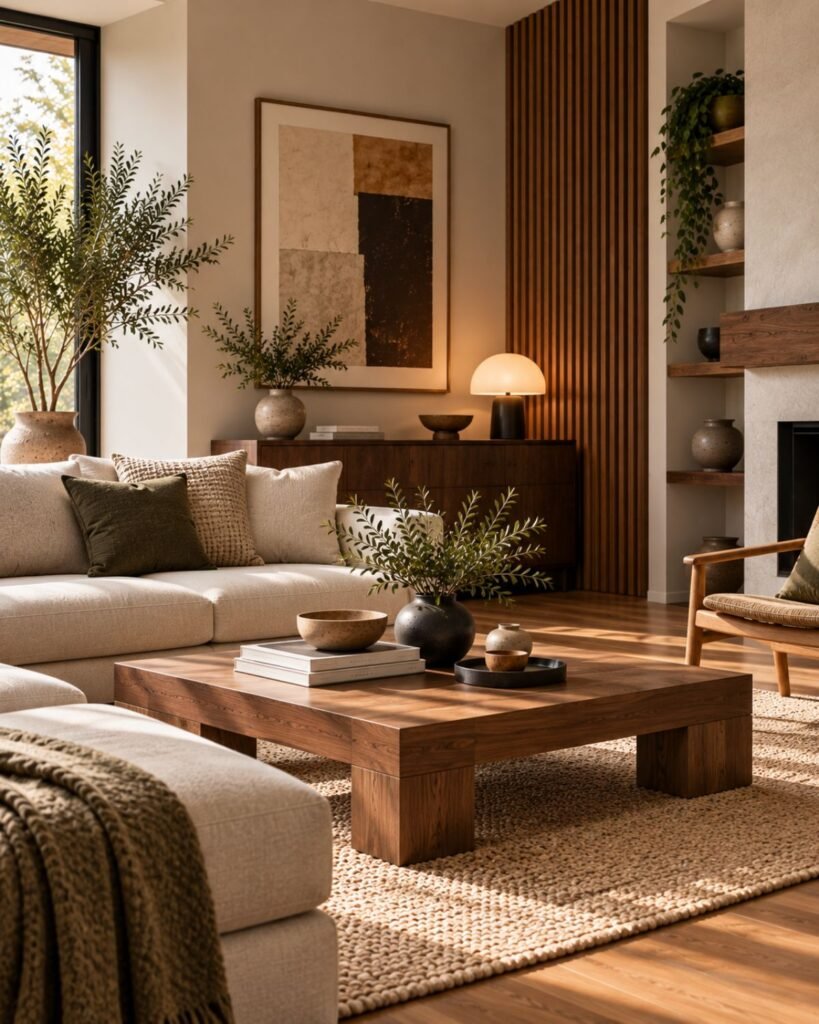
Natural variation is useful here.
Visible grain, woven fibers, irregular ceramic surfaces and subtle variations in stone prevent a restrained room from becoming mechanically smooth. These differences replace some of the visual activity that pattern and stronger color would provide in another style.
That does not mean everything needs to look handmade or distressed.
One irregular ceramic vessel beside a precisely constructed timber table can be more effective than filling the room with deliberately rough objects. Too much manufactured “imperfection” quickly turns restraint into a theme.
Does Japandi have to be beige?
No. Beige is common, but it isn’t a requirement.
Architectural Digest notes that Japanese interiors often include darker and earthier tones while Scandinavian interiors commonly lean toward lighter colors and woods. Japandi can draw from both, which gives it considerably more range than the pale-beige version often reproduced online.
A useful base might include warm white, stone, oatmeal or taupe. From there, dark brown, charcoal, black, muted green or restrained clay tones can create depth without making the room visually busy.
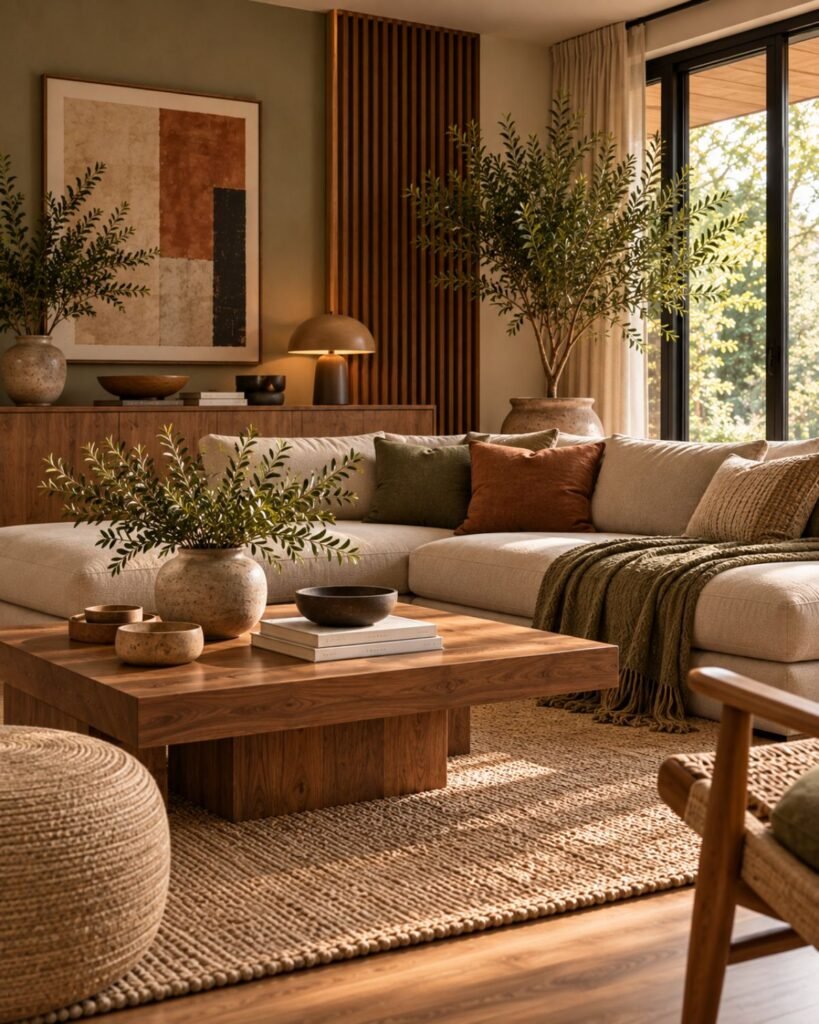
Color works best when it behaves as part of the material composition rather than as a collection of accents.
A muted green chair, for example, can carry enough color for an otherwise neutral room. It does not need matching green cushions, artwork and accessories scattered around the space to justify itself.
Four Japandi living room directions
There is no single correct Japandi palette. These four directions show how the same underlying principles can produce quite different rooms.
1. Light Japandi
Start with warm white or soft off-white walls, pale timber and a restrained neutral sofa.
The lighter palette makes the Scandinavian influence more visible, while careful spacing, simple furniture and limited decoration prevent the room from becoming generic Nordic styling.
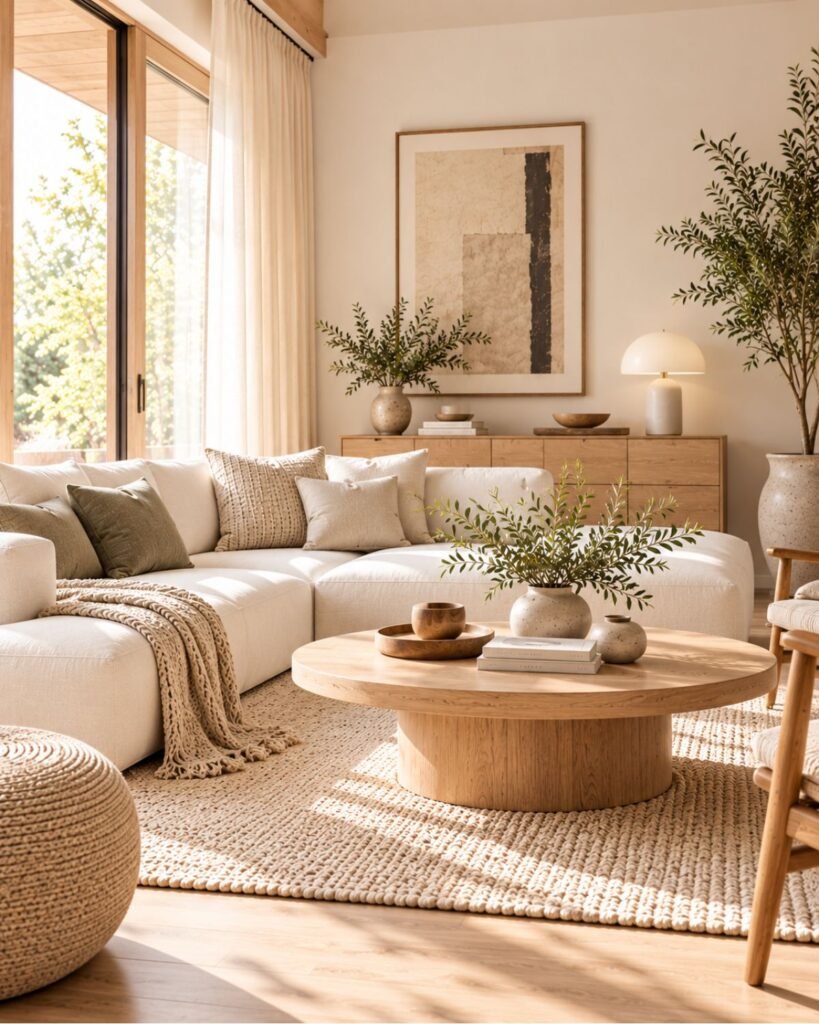
Texture becomes particularly important here. Linen, wool, visible timber grain and a small amount of handmade ceramic keep pale surfaces from merging into one smooth beige field.
What can go wrong: making every surface cream, smooth and similar in value. The result may look neutral, but it loses the material definition that gives Japandi depth.
2. Dark Japandi
Japandi does not require pale oak.
Dark wood, charcoal, warm brown and black can produce a quieter, more grounded room while still retaining simple forms and generous breathing space.
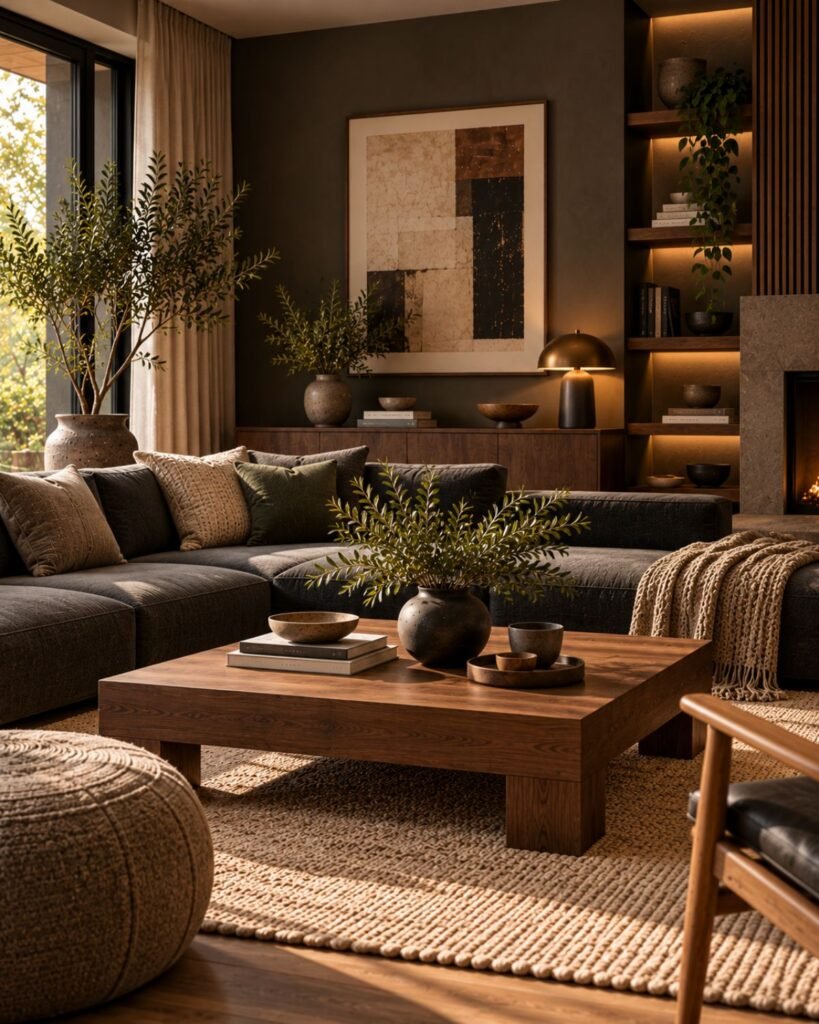
The key is controlling visual weight. A dark timber table or cabinet can anchor the room without requiring every major surface to become dark.
Lighter upholstery, walls or flooring can provide relief.
What can go wrong: filling every surface with dark wood and black until the room becomes heavy rather than restrained.
3. Earthy Japandi
Muted earth tones can sit comfortably within Japandi when they remain subordinate to the room’s materials and structure.
Think warm wood with clay, muted olive, soft brown or another low-intensity natural tone rather than multiple competing accent colors.
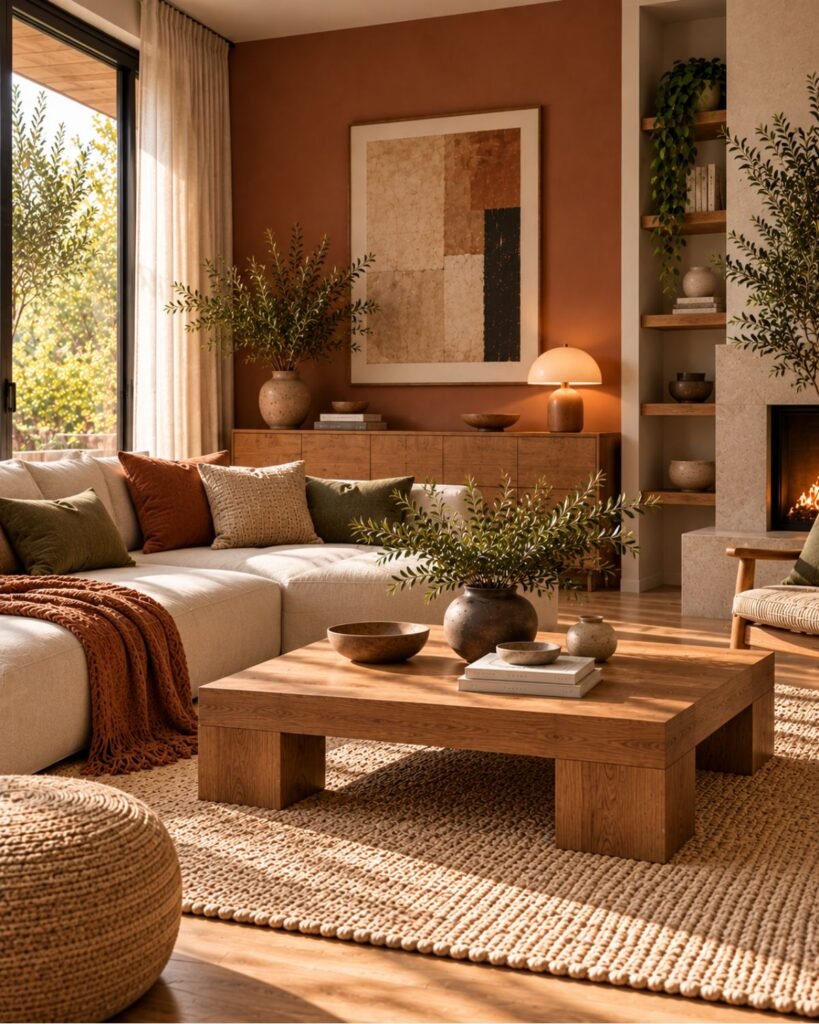
This direction is particularly useful for anyone who likes Japandi’s restraint but finds predominantly cream interiors too pale.
What can go wrong: adding so many baskets, rustic ceramics, rough woods and earthy accessories that the room drifts toward rustic or bohemian styling.
4. Compact Japandi
A small living room can benefit from Japandi principles because the style does not require many pieces.
Start with the functions the room actually needs. A sofa, useful table, appropriate lighting and one storage solution may be enough before decoration enters the conversation.
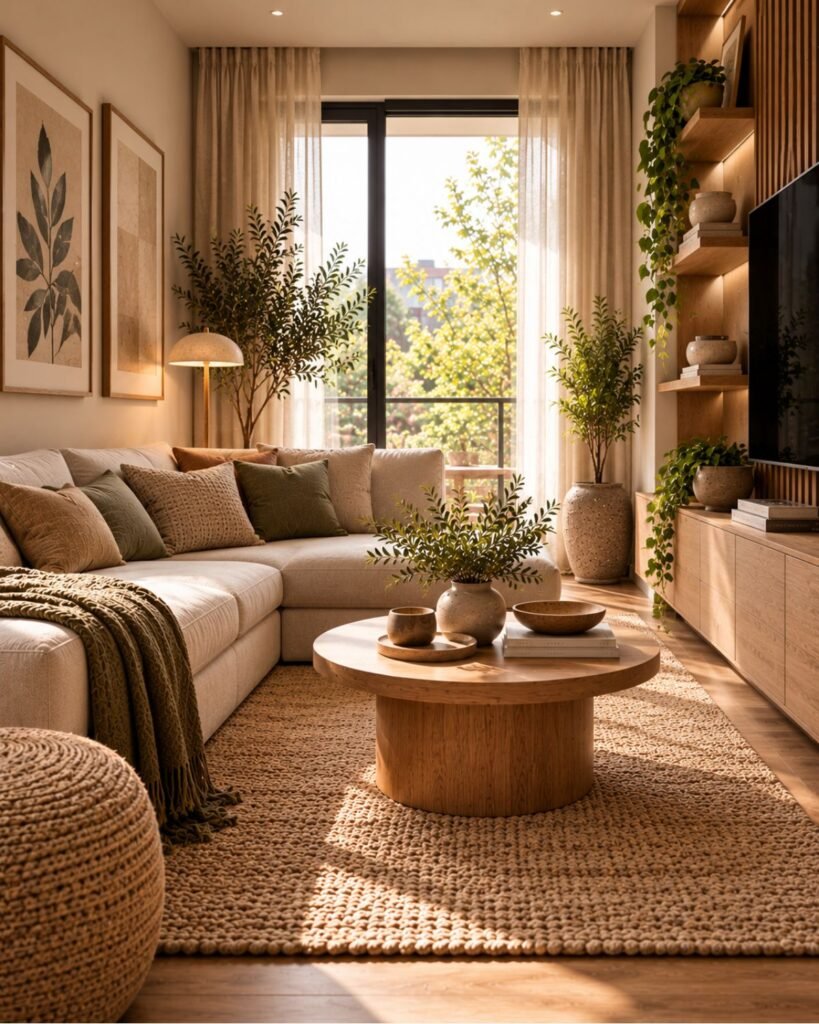
Furniture with a quieter visual profile can help preserve visible wall and floor area, but don’t shrink every piece indiscriminately. One correctly scaled sofa is usually more useful than several undersized seats.
For the broader layout problem, use our small living room guide. Japandi should determine how the room feels and is edited, not override sensible furniture planning.
Why Japandi living rooms go wrong
The style looks simple, which makes its failures surprisingly visible.
Too beige
A beige sofa, beige rug, beige walls and pale timber do not automatically create Japandi.
If everything shares approximately the same value and finish, the room loses definition. Introduce contrast through wood tone, texture, dark details or material variation rather than simply adding another shade of beige.
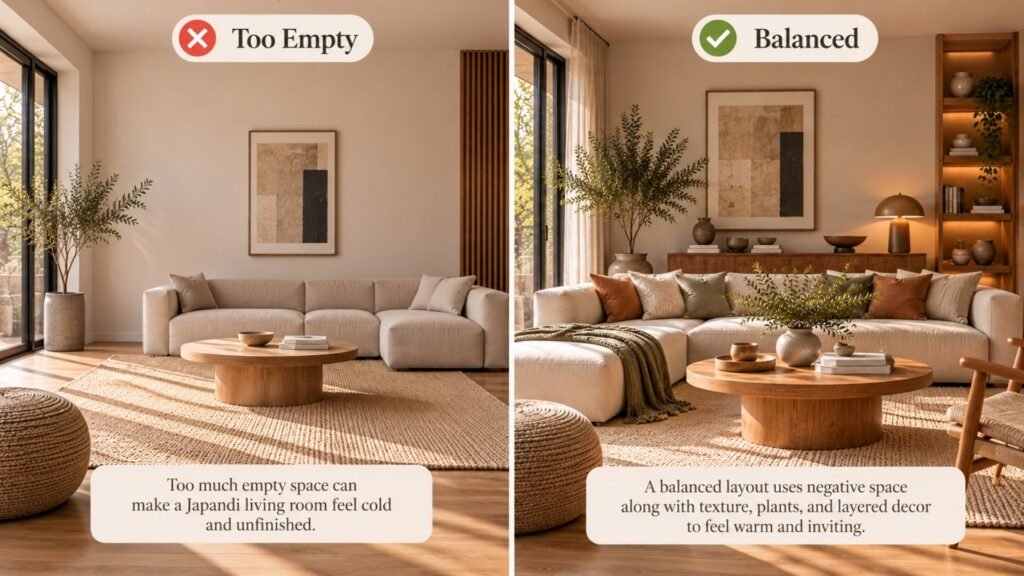
Too empty
Negative space and emptiness are not the same thing.
Useful negative space gives furniture and materials room to breathe. An under-furnished room simply lacks what it needs to function comfortably.
A chair that is actually used belongs in the room even if removing it would make the photograph look more minimal.
Too Scandinavian
A very light room filled with pale timber, soft textiles and familiar Nordic forms can read predominantly Scandinavian.
Japandi allows that influence, but greater restraint, darker grounding, material irregularity or a more deliberate use of open space can shift the balance.
Too Japanese-themed
This is the mistake to avoid most deliberately.
Adding a bonsai, shoji-style screen, floor cushion, lantern and Japanese-looking artwork does not automatically produce Japandi. It can instead turn a contemporary design synthesis into themed decoration.
Use design principles rather than cultural props.
Too rustic
Natural material does not mean every object needs a rough surface.
Heavy distressed timber, abundant woven baskets, intentionally crude ceramics and excessive raw texture can overwhelm Japandi’s cleaner structural side.
Keep some precision beside the irregularity.
Too perfect
The opposite failure happens when everything is flawlessly matched, smooth and mass-produced.
Japandi benefits from material character. Visible grain, an irregular ceramic surface, a woven textile or an older timber piece can interrupt uniformity without creating clutter.
How to create Japandi without replacing everything
Do not start by shopping for products labelled “Japandi.”
Start by editing.
Remove decorative objects that have no clear relationship to the room. Then assess the largest pieces you already own. A simple sofa does not need replacing merely because it wasn’t marketed as Japandi.
Next, identify where the room lacks material character. That might be solved by one timber table, a wool rug, linen curtains or a ceramic object rather than an entirely new furniture set.
Then examine contrast.
If everything is pale, a darker wood or charcoal detail may be enough. If the room is visually heavy, lighter textile or more open space around the largest furniture can restore balance.
Finally, add only what the room still needs.
That sequence is more reliable than buying a collection of objects associated with the style and trying to make them coexist afterward.
Where this leaves you
A Japandi living room does not depend on finding the correct beige, buying Japanese-looking accessories or replacing your furniture with a matching collection.
Start with function. Preserve breathing room around the pieces that matter. Use natural materials with enough variation to reward closer inspection, and combine restraint with genuine comfort.
Then decide where you want the balance to sit.
A lighter room can lean more Scandinavian. Darker wood, earthier tones and greater material irregularity can shift the character in another direction. Neither needs to become a costume of the culture influencing it.
The strongest Japandi rooms feel edited, useful and comfortable before they feel styled.
Japandi living room FAQs
What is a Japandi living room?
A Japandi living room combines Japanese and Scandinavian design influences through simplicity, functionality, natural materials, craftsmanship and restrained decoration. The exact balance can vary, so Japandi can range from light and Scandinavian-leaning to darker and earthier.
What’s the difference between Japandi and Organic Modern?
Both use natural materials and relatively simple forms. Organic Modern primarily combines contemporary structure with organic material variation, while Japandi draws specifically from Japanese and Scandinavian design traditions and generally places stronger emphasis on restraint, purposeful objects, craftsmanship and breathing space.
Does Japandi have to be beige?
No. Warm neutrals are common, but Japandi can include dark brown, charcoal, black, muted green, clay and other restrained earth tones. Darker woods can also move the room away from the pale Scandinavian end of the spectrum.
Can you use dark wood in a Japandi living room?
Yes. Dark wood can give a Japandi room stronger grounding and reflects the broader range of darker and earthier tones associated with Japanese-influenced interiors. Balance it with lighter surfaces or textiles if the room begins to feel visually heavy.
Is Japandi the same as minimalism?
No. They overlap in their use of restraint, but Japandi is specifically informed by Japanese and Scandinavian design traditions. Natural materials, craftsmanship, material variation and domestic comfort are important parts of the style rather than consequences of simply owning fewer things.
Do you need plants for Japandi style?
No. A connection to nature is frequently associated with Japandi, but plants are only one way to express it. Wood, stone, natural fibers, daylight and views outside can establish that relationship without filling the room with greenery.
How do you make a Japandi living room feel warm?
Use tactile materials and furniture that is genuinely comfortable. Wood, wool, linen and warm lighting can soften a restrained room, while controlled darker tones can add depth. Warmth should come from the room’s materials and usability rather than layers of unnecessary decoration.
References
- Architectural Digest. “Japandi Style: Everything You Need to Know.”
https://www.architecturaldigest.com/story/japandi-style-101 - Livingetc. “Japandi Style in Interior Design Explained, Plus How to Style This Minimalist Look.” https://www.livingetc.com/features/japandi-style
- House Beautiful. “What to Know About Japandi Style, According to Designers.” https://www.housebeautiful.com/room-decorating/a45851530/japandi-interior-design-style/
About the author
Emma Carter writes about interior color, home décor, and practical styling for Wallsaide. She focuses on helping readers combine colors, materials, textiles, and decorative elements into rooms that feel balanced and cohesive.