
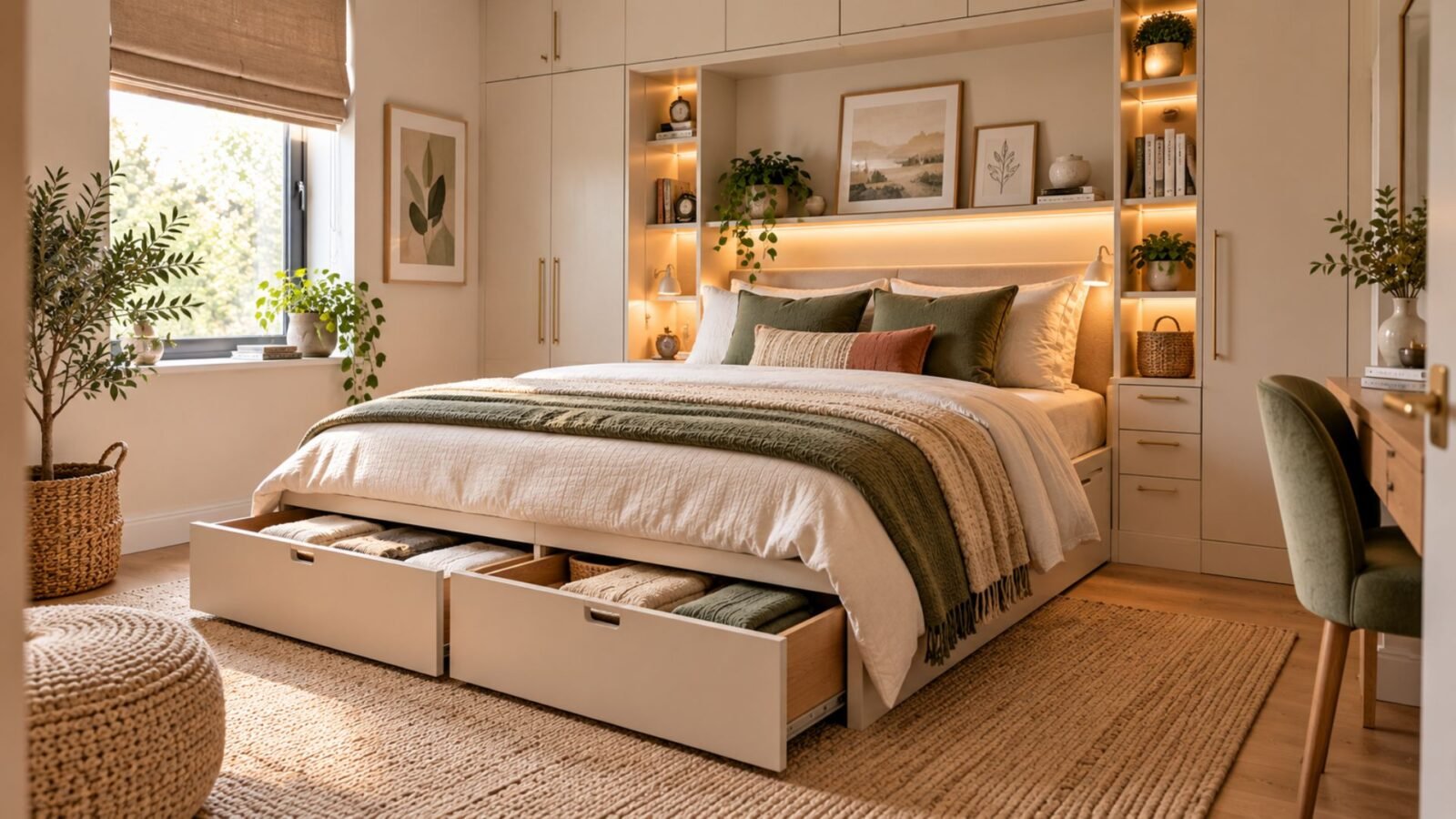

Use overlooked walls, hidden spaces and multifunctional furniture to gain storage without making a compact bedroom feel even smaller.
Small bedroom storage ideas work best when they create useful capacity without consuming the open space that makes a bedroom comfortable. Before adding another cabinet, look beneath the bed, above existing furniture, behind doors and toward the ceiling. These areas can often hold more without narrowing the room’s main circulation paths.
The goal is not to fit storage into every available gap. A small bedroom still needs daylight, accessible furniture and visual breathing room. The strongest storage plan concentrates belongings in a few efficient places and allows the rest of the room to stay relatively quiet.
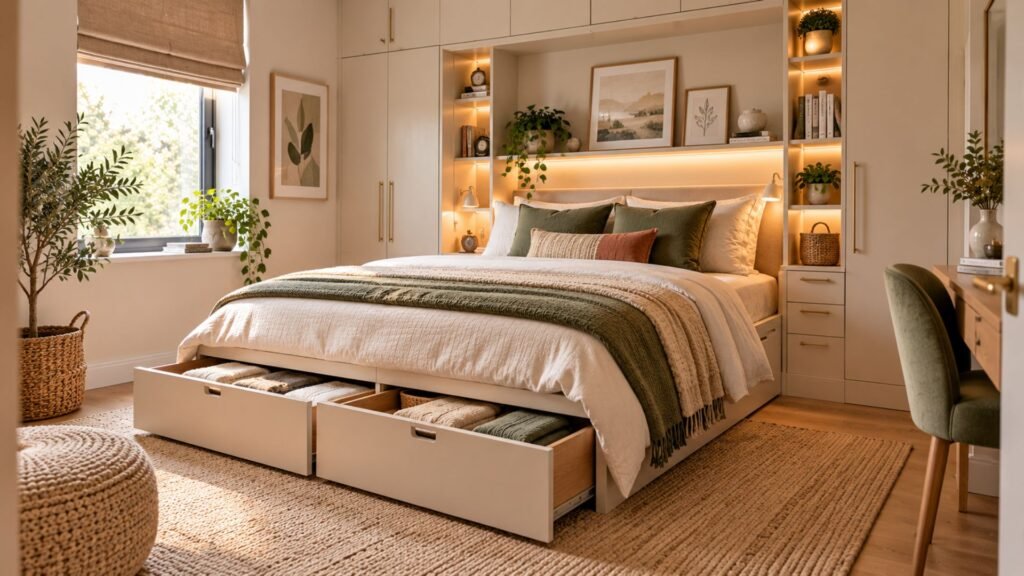
Where to start when a small bedroom lacks storage
Before buying organizers, work out what actually needs a home.
Separate belongings into everyday items, occasionally used items and things that do not need to remain in the bedroom. Clothes worn every week deserve the easiest access. Spare bedding, luggage and seasonal clothing can occupy less convenient spaces.
Next, inspect the room vertically as well as horizontally. Look at the space under the bed, above the wardrobe, over the headboard, behind the door and inside awkward recesses. This approach is consistent with professional small-space guidance that emphasizes using under-bed and vertical storage before consuming more floor area. Architectural Digest’s small-bedroom storage guide.
Then consider circulation. A storage solution that makes it difficult to enter the room, open a wardrobe or move around the bed has solved one problem by creating another.
If the furniture arrangement itself is causing trouble, settle that first. Our guide to small bedroom layout ideas explains how to position the bed and other essential furniture before assigning the remaining space to storage.
21 small bedroom storage ideas worth considering
These solutions range from simple renter-friendly changes to more permanent built-ins. The right combination depends on what you own, the shape of the room and which surfaces you can realistically use.
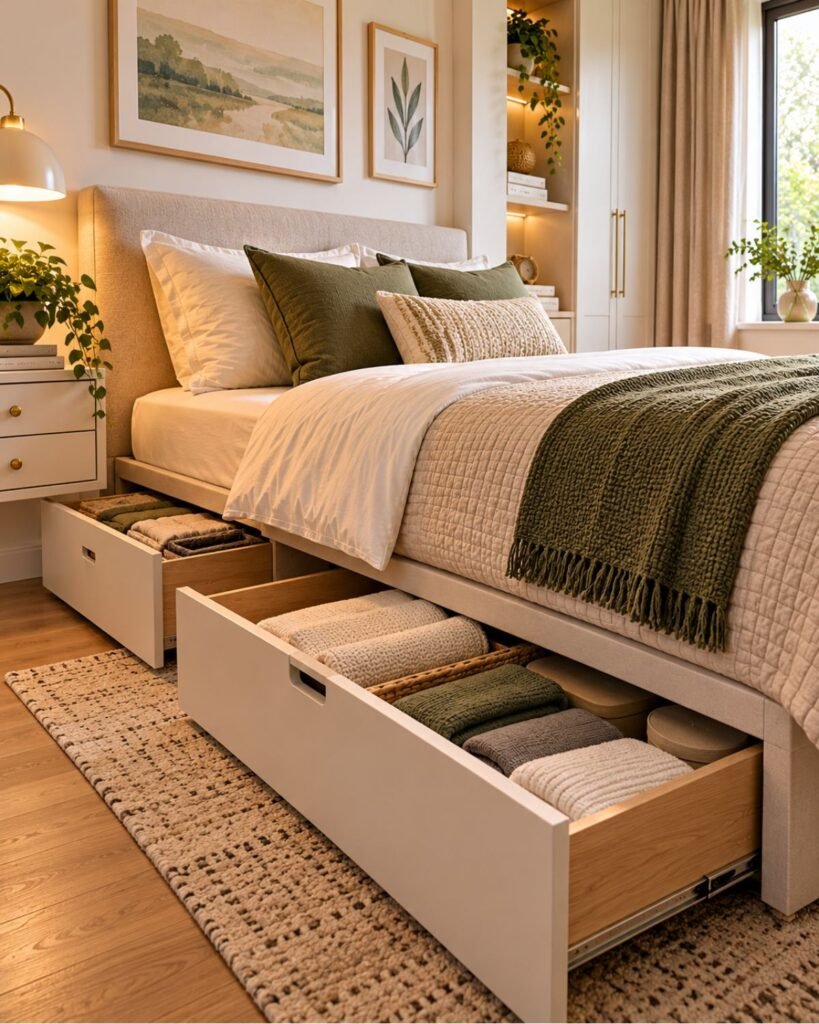
1. Use drawers underneath the bed
Under-bed storage is particularly useful because it increases storage capacity without introducing another freestanding piece of furniture into the room.
Built-in bed drawers can hold folded clothes, spare bedding, shoes or other items that would otherwise require another chest. If you already own a standard bed, low rolling boxes or fitted under-bed containers can achieve a similar result.
The important detail is access. Before choosing side-opening drawers, make sure there is enough room to pull them out fully without hitting a wall, nightstand or other furniture.
Keep frequently used items toward the most accessible side. Storage is only useful when retrieving something does not require dismantling half the bedroom.
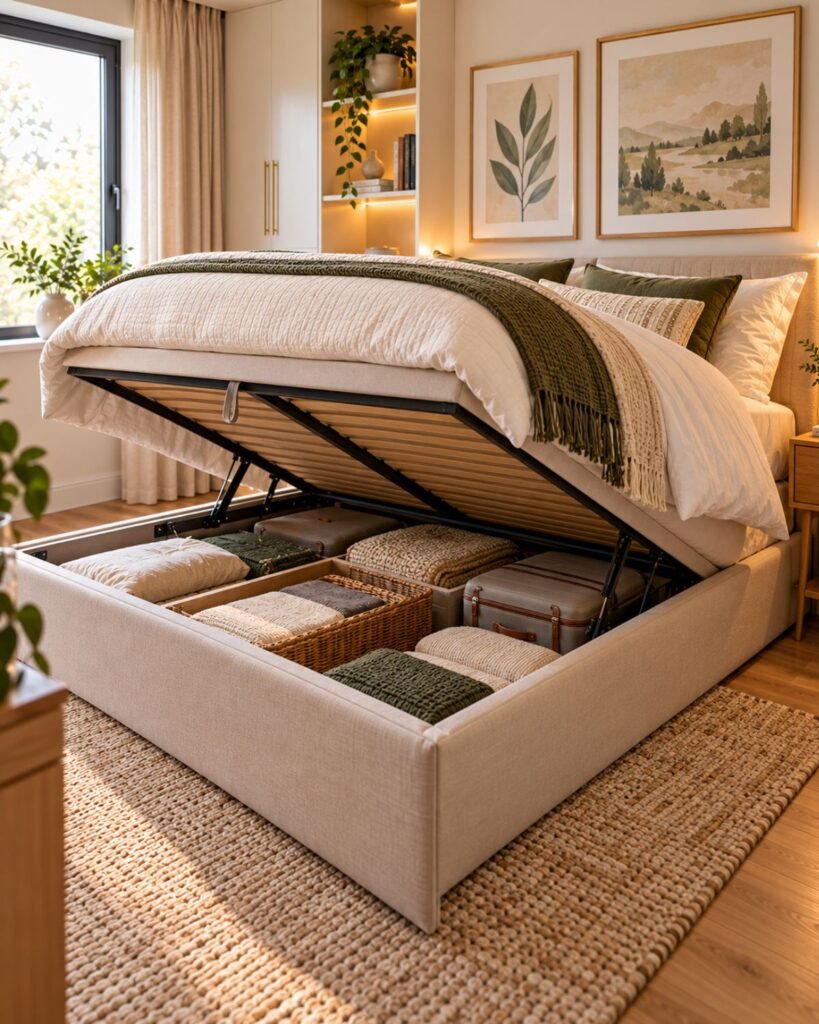
2. Choose a lift-up storage bed when side clearance is limited
Drawers need horizontal clearance. A lift-up storage bed accesses the same general area from above instead.
That can make it particularly useful in a narrow bedroom where the bed sits close to a wall or other furniture. The large compartment is well suited to bulky or less frequently used belongings such as spare duvets, seasonal clothing and luggage.
There is a trade-off. Lift-up storage is less convenient for things you reach for several times a day, and the mechanism should be easy for the intended user to operate.
Use it for deep storage rather than treating it as a substitute for every type of bedroom organization.
3. Build storage around the headboard
The headboard wall often contains more usable space than it first appears.
Shallow cabinets, recessed niches or shelving can frame the bed while providing space for books, bedside essentials and less frequently used items. In a carefully designed built-in, the bed and storage become one composition rather than several separate pieces competing for room.
Avoid making the arrangement unnecessarily heavy. Deep cabinets projecting over the bed can make a small room feel enclosed.
A better approach is usually to combine closed storage with a limited amount of open space around the headboard.
4. Take wardrobes all the way to the ceiling
A freestanding wardrobe that stops well below the ceiling can leave a substantial strip of difficult-to-use space above it.
The same principle applies beyond wardrobes: when floor space is limited, using walls and vertical storage can preserve more usable space at ground level.
Floor-to-ceiling cabinetry uses the full wall height and can move occasional-use belongings into upper cupboards while keeping everyday clothes within easy reach.
Visually, one tall continuous storage wall can also look calmer than a wardrobe topped with exposed boxes and unrelated containers.
Custom cabinetry is not the only way to achieve the principle. If built-ins are outside the budget, a tall freestanding wardrobe combined with coordinated closed storage above it can make better use of the same vertical zone.
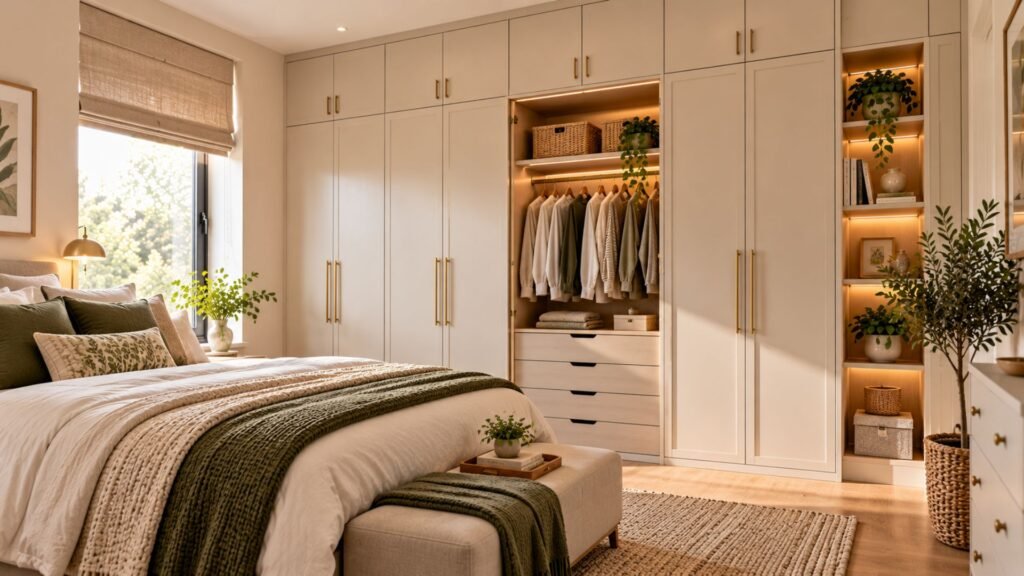
5. Use the wall above the bed selectively
The wall above a bed can accommodate storage without taking another piece of floor.
A shallow shelf may hold books or decorative objects. Properly planned wall cabinets can provide more substantial storage where the room genuinely needs it.
But this is a place where restraint matters.
Filling every inch above the headboard with heavy cabinetry can make the sleeping area feel boxed in. Consider the visual weight from the bed as well as the amount of storage gained.
If only a little additional capacity is required, a narrow shelf may be enough.
6. Replace bulky nightstands with floating drawers
A conventional nightstand can be surprisingly deep relative to what it stores.
A compact wall-mounted drawer provides space for glasses, a book, chargers and other bedside essentials while keeping more of the floor visible. The effect is particularly useful when the space beside the bed is narrow.
Add a wall-mounted sconce and the top surface no longer needs to accommodate a table lamp.
Renters who cannot mount furniture can apply the same principle with a narrow bedside table or compact stool. The important decision is reducing unnecessary furniture depth, not using a particular type of nightstand.
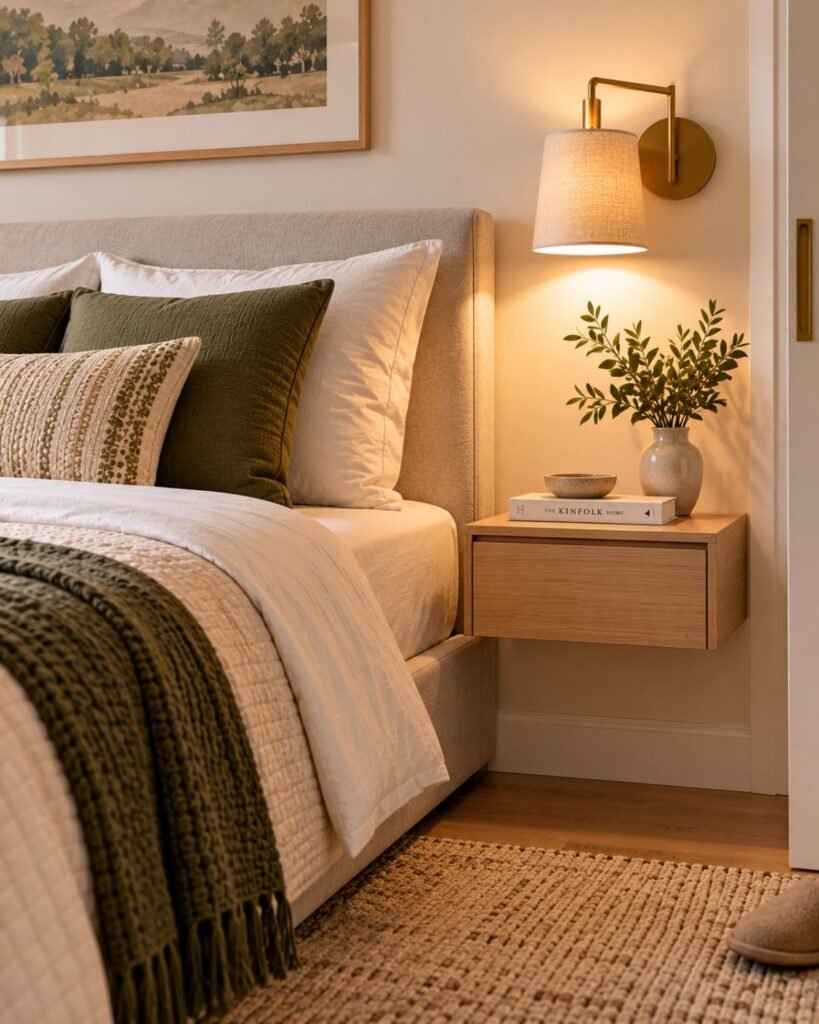
7. Install narrow floating shelves where a cabinet would be too deep
Not every wall can support full-depth storage without affecting circulation.
A shallow shelf can use otherwise empty wall space for books, small containers or selected objects while projecting far less into the room than a bookcase.
Good locations can include the wall above a desk, a narrow section beside a wardrobe or an alcove too shallow for conventional furniture.
Keep open shelves edited. Once they become crowded with unrelated belongings, the storage may be physically efficient but visually noisy.
8. Use the back of the bedroom door
The back of a door is easily overlooked because it disappears whenever the door is open.
Hooks or a slim hanging organizer can hold lightweight everyday items without requiring another cabinet. Depending on your needs, that might include bags, scarves, accessories or a robe.
Check that anything attached to the door does not interfere with the handle, wall, door swing or surrounding furniture.
This is particularly useful for renters because many over-door systems require little or no permanent alteration.
9. Turn an awkward alcove into purposeful storage
A recess that is too narrow for normal furniture can become one of the most useful areas in a small bedroom.
Depending on its proportions, an alcove might accommodate shallow shelves, hanging space, drawers, a narrow dresser or a compact combination of storage and display.
Built-ins can produce the cleanest result, but they are not essential. Carefully sized freestanding pieces can make use of the same architecture.
Measure the recess at several points rather than assuming the walls are perfectly square, particularly in older properties.
10. Create storage beneath a window seat
If the bedroom has an appropriate window wall, a built-in or freestanding storage bench can combine seating with concealed capacity.
Drawers are useful where there is enough space in front of the seat. A lift-up top can work where lateral clearance is limited.
This solution makes the most sense when the room genuinely benefits from seating. Do not add a large window seat simply to create storage if it narrows an important walkway.
In a very small bedroom, under-bed storage may provide the same capacity with less furniture.
11. Use a storage ottoman only when the foot of the bed has room
An ottoman or storage bench can hold blankets, pillows or occasional-use items while providing somewhere to sit.
The danger is its position.
The foot of the bed is often part of a small bedroom’s primary circulation route. Adding a deep bench there can make the room noticeably harder to navigate.
Before buying one, mark its dimensions on the floor with painter’s tape. If you immediately find yourself walking around it, choose another storage location.
12. Add shallow storage behind the headboard
A headboard does not necessarily need to sit directly against the wall.
In the right room, a shallow built-out section can create a ledge, niches or concealed compartments behind the sleeping area. This can replace separate bedside surfaces or provide discreet storage for smaller belongings.
This idea requires careful measurement because every inch added behind the bed reduces space elsewhere.
It works best when the room has enough length to sacrifice a little depth without compromising circulation at the foot of the bed.
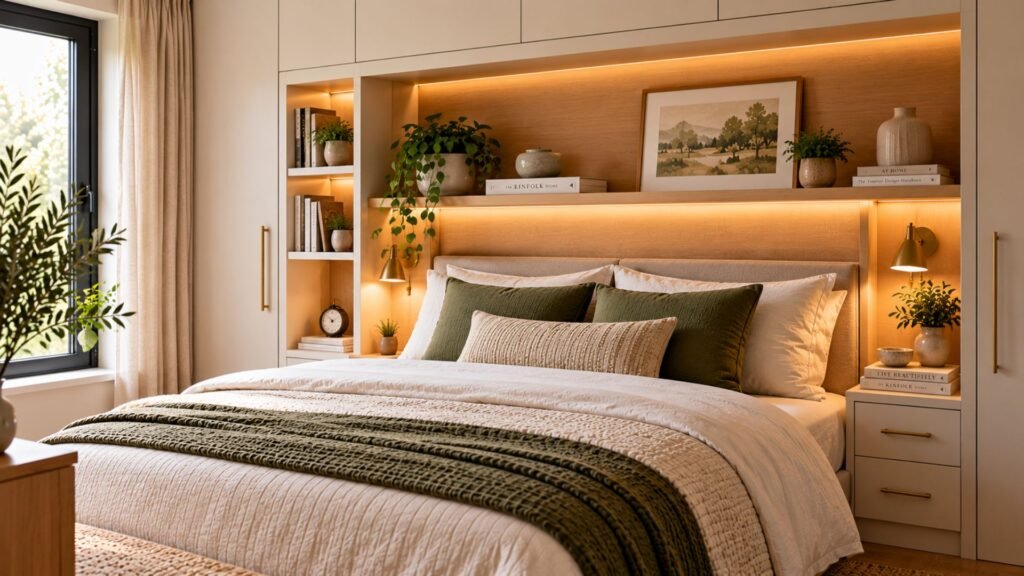
13. Turn an unused corner into storage
Corners frequently collect small furniture that does not contribute much.
Instead, consider whether one awkward corner could hold a tall narrow cabinet, fitted shelves or a compact hanging system.
Vertical solutions usually make more sense here than broad pieces that spread across the floor.
Do not assume every corner needs filling, though. If adding storage interrupts the entrance view or makes circulation tighter, leaving the corner open may improve the room more.
14. Choose a tall dresser instead of a wide one
When floor width is scarce, furniture proportions matter.
A tall chest of drawers can provide useful closed storage with a smaller footprint than a broad low dresser. This can preserve more wall length for the bed, desk or circulation.
Height should remain practical for the user, and tall furniture should be secured appropriately according to the manufacturer’s instructions.
Also consider drawer depth. A narrower piece that projects too far into a walkway can still create a layout problem.
15. Combine a desk and storage system
A small bedroom that also functions as a workspace does not necessarily need separate desk, bookcase and storage units.
A compact desk integrated with drawers and shelving can concentrate those functions along one wall. Keeping the furniture visually related makes the arrangement feel more deliberate.
If you only use a laptop, question whether you need a full-size desk. A shallower work surface may leave substantially more circulation space.
Closed drawers can handle visual clutter while a limited amount of open shelving keeps frequently used items accessible.
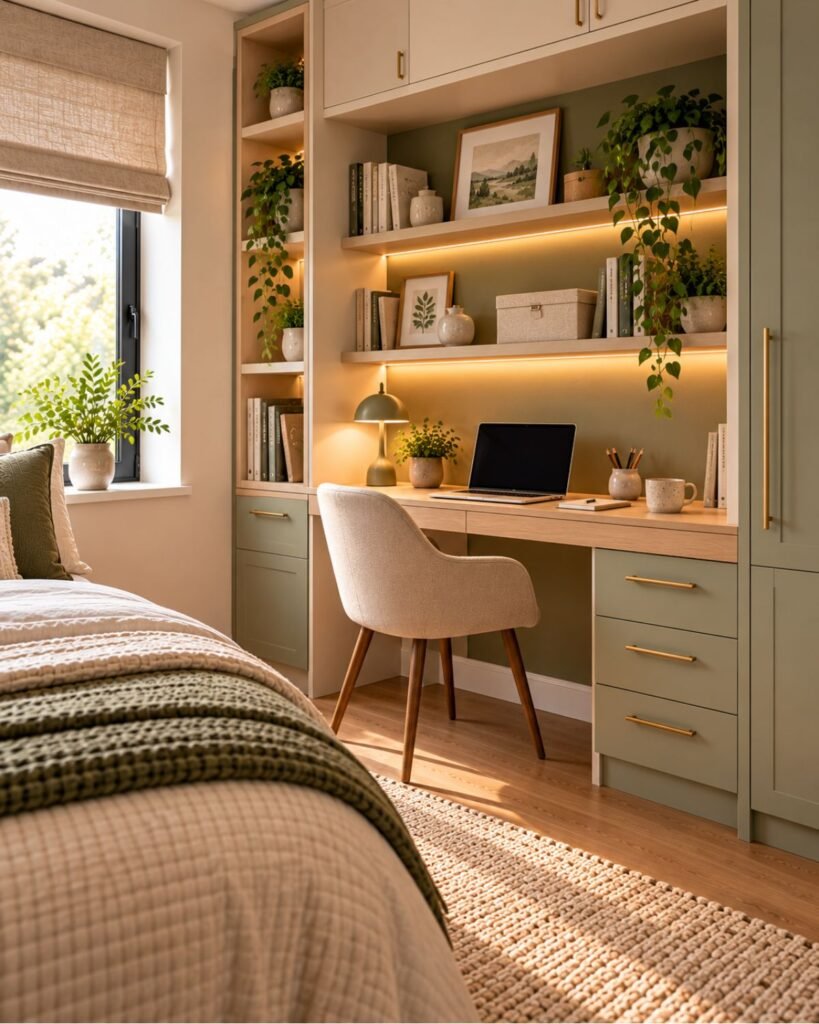
16. Move bedside lighting onto the wall
Lighting is not technically storage, but relocating it can release useful storage space.
A wall-mounted sconce removes the lamp base from the nightstand, leaving the surface available for the things you actually need beside the bed.
In an especially narrow room, this can also make it possible to replace a conventional nightstand with a smaller floating drawer or shelf.
Renters can look for plug-in wall lights or other non-hardwired options where appropriate rather than assuming new electrical work is required.
17. Use the wall above a desk
A desk often occupies valuable floor space while leaving the wall above it largely unused.
Add a few shallow shelves, a compact wall cabinet or an organized rail system to move supplies away from the work surface.
Keep the lower portion comfortable to use. Shelves that project too far above a seated position can feel intrusive.
The objective is to extend storage upward without turning the workspace into a dense wall of objects.
18. Use baskets strategically rather than everywhere
Baskets can make awkward spaces more usable, but too many create their own form of clutter.
Use them when they give a defined category of belongings a clear home. A basket for spare throws or one on an upper shelf for seasonal accessories can work well.
Avoid scattering mismatched baskets across every available surface simply because they are marketed as storage.
The room should still look organized when the containers themselves are visible.
19. Move seasonal belongings higher
The easiest storage should be reserved for the things you use most often.
Upper wardrobe cupboards and high shelves are better suited to seasonal clothing, spare bedding, travel bags and other occasional-use belongings.
This creates a useful storage hierarchy:
- Everyday: easiest-to-reach drawers, rails and shelves
- Occasional: under-bed storage and higher shelves
- Seasonal: highest cupboards and deepest storage areas
Organizing by frequency of use can improve a small bedroom without adding a single new storage unit.
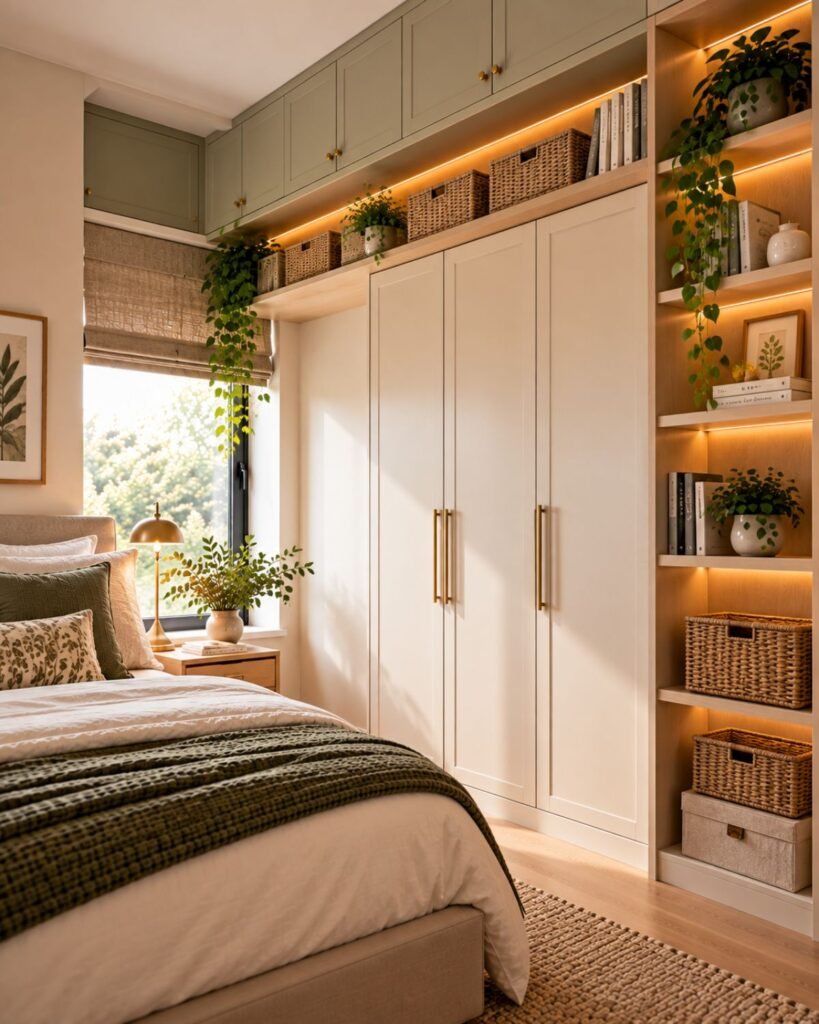
20. Design one full storage wall
Sometimes concentrating storage is more effective than distributing it around the room.
A single wall containing wardrobes, drawers, shelving and perhaps a desk can handle several functions while allowing the remaining walls to stay quieter.
This is particularly effective when cabinetry can use the full height of the room.
For a renter or a lower budget, the same concept can be recreated with a coordinated group of freestanding pieces rather than custom joinery.
The principle is concentration. One hardworking wall can feel calmer than storage furniture occupying every side of the bedroom.
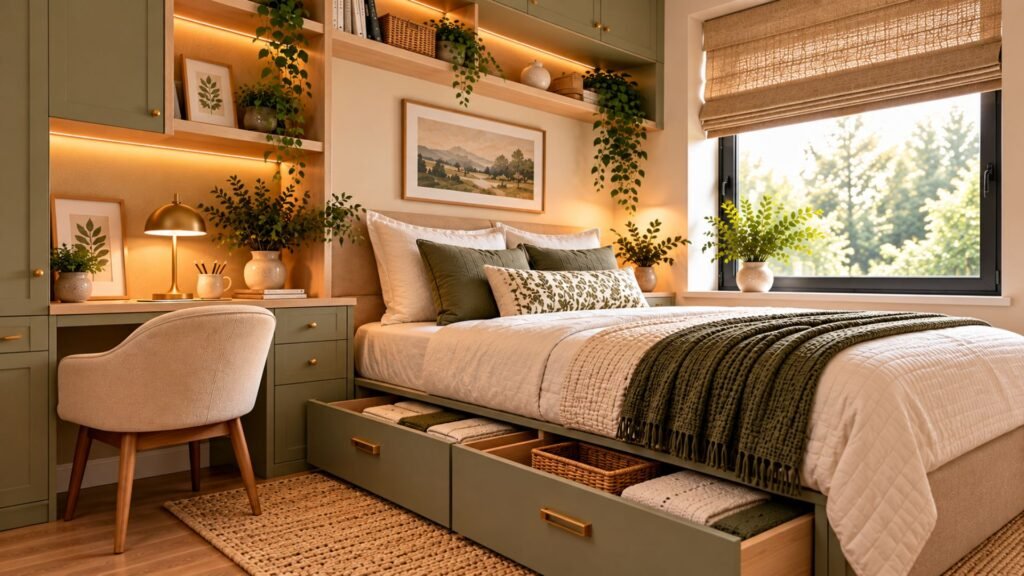
21. Keep visible storage visually quiet
A small bedroom can technically be organized and still look cluttered.
Open shelves display every book, cable, container and accessory. Closed storage hides visual information, which is particularly valuable in a compact room.
Concealed storage can also create a calmer visual field; IKEA, for example, recommends discreet closed storage and other methods of keeping everyday belongings out of sight when a cleaner bedroom appearance is the goal.
That does not mean everything should disappear behind doors. A small amount of open storage can make the room feel personal and provide convenient access.
The balance matters.
Keep everyday clutter behind doors or in drawers, then allow open shelves to hold a smaller number of useful or decorative objects. The result is storage that contributes to the room rather than dominating it.
Vertical storage or more furniture?
When storage is inadequate, the instinctive response is often to add another piece of furniture.
In a small bedroom, first ask whether the existing storage can extend upward instead.
Professional organizers and designers similarly recommend making furniture work harder in compact bedrooms, including using multifunctional pieces, tall storage, floating shelves and under-bed space.
A tall wardrobe, shelves above a desk or upper cabinets can add capacity without claiming another section of floor. That helps preserve the walking routes around the bed and between the entrance and wardrobe.
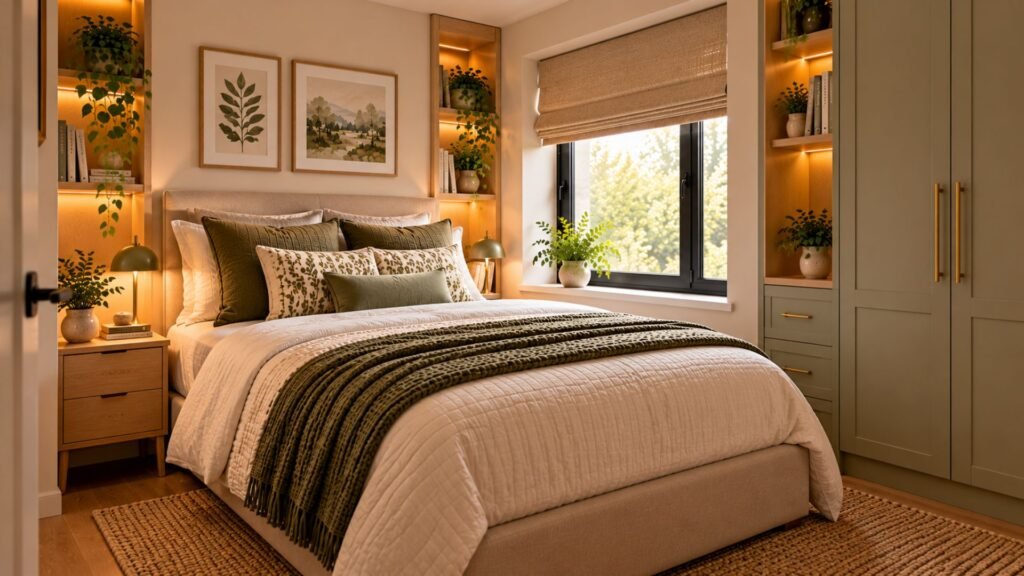
There is still a limit. Filling every wall from floor to ceiling can make a small bedroom feel enclosed even when the floor remains clear.
The better question is not “Where can I add storage?”
It is “Where can I concentrate storage so I need less furniture elsewhere?”
Hidden storage vs open shelving
Both have a role, but they solve different problems.
Hidden storage works best for visual clutter
Drawers, wardrobes, boxes and closed cabinets are useful for clothing, bedding, cables, personal items and anything that creates visual noise.
In a small room, closed storage can make a substantial amount of belongings visually disappear.
Open storage works best for easy access
Shelves are useful for books, a few everyday objects and items you want to display.
They can also feel lighter than deep cabinetry.
The problem starts when every available wall becomes open storage. The eye has to process each object, which can make a compact bedroom feel busier.
For most small bedrooms, a combination works best: more concealed storage, with selective open storage where accessibility or display matters.
Small bedroom storage ideas for renters
Renting changes what you can alter, but it does not eliminate useful options.
Start with reversible solutions: under-bed containers, freestanding tall wardrobes, narrow drawer units, over-door organizers and furniture that combines more than one function.
Where your rental agreement permits wall fixings, shallow shelving and plug-in wall lights can free additional surfaces. If mounting is restricted, use tall freestanding furniture and storage that works with the architecture rather than modifying it.
Avoid buying a large collection of temporary organizers before measuring. Portable storage can overcrowd a bedroom just as easily as permanent cabinetry.
The renter-friendly goal is the same: use existing dead space before sacrificing additional floor area.
What if the bedroom has no closet?
A bedroom without a built-in closet needs a stronger storage hierarchy.
Begin with the clothing that actually needs hanging. A compact wardrobe may be more efficient than trying to create hanging space for every item you own.
Foldable clothing can move into drawers or under-bed storage. Shoes can use the bottom of a wardrobe or another contained zone instead of spreading across the floor.
Then use height for less frequently accessed belongings.
If everything cannot fit comfortably, editing the quantity stored in the bedroom may produce a better result than adding another piece of furniture.
Storage planning cannot compensate indefinitely for more belongings than the room can reasonably hold.
What makes a small bedroom look cluttered?
Clutter is not determined only by how many possessions you own.
It is also influenced by how many individual objects remain visible and how many unrelated storage pieces compete for attention.
A room containing five small storage units may look busier than one containing a single well-planned wardrobe wall with greater capacity.
Watch for:
- Containers sitting permanently on top of furniture
- Clothing visible on several different rails or hooks
- Too many open shelves
- Storage furniture in unrelated finishes and dimensions
- Items stored on circulation routes
- Boxes stacked above wardrobes without a visual system
- Multiple small organizers solving problems that one larger unit could handle
The solution is often consolidation rather than additional organization products.
Small bedroom storage mistakes to avoid
Filling every available wall
Unused wall space is not automatically wasted.
A bedroom needs visual pauses. If every wall carries shelves, cabinets, hooks or rails, the room can feel smaller despite having more storage.
Buying storage before measuring
Always record width, depth and height.
Depth is especially important because a cabinet that looks narrow from the front can project too far into a circulation route.
Forgetting how drawers and doors open
Measure furniture in use, not only when closed.
A dresser may physically fit opposite the bed but become frustrating if opening its drawers blocks the walkway.
Making everyday belongings difficult to reach
Do not place frequently worn clothing in the highest cabinet simply because it fits there.
Easy-access storage should correspond to frequency of use.
Using too much open storage
Open shelves can appear light in photographs while becoming visually crowded in daily life.
If the belongings themselves are not attractive or consistently organized, closed storage may be the better choice.
Choosing storage that duplicates another piece
Before adding a chest, bench or cabinet, ask whether the bed, wardrobe or desk could perform the same storage function.
Removing one unnecessary furniture piece can improve a small bedroom more than adding several clever organizers.
Sacrificing circulation for capacity
This is the most important mistake.
Storage should support the bedroom’s function, not overwhelm it. If you have to turn sideways to reach the bed or move furniture to open a wardrobe, the room has crossed the line from efficient to overfilled.
A simple order for planning small bedroom storage
If you are starting from scratch, use this sequence:
- Decide what genuinely needs to remain in the bedroom.
- Measure the room and existing furniture.
- Finalize the bed and major furniture layout.
- Protect the main circulation routes.
- Use the space beneath the bed.
- Improve the main wardrobe or clothing-storage zone.
- Look upward for occasional-use storage.
- Add shallow wall storage where useful.
- Combine functions such as desk + drawers or bed + storage.
- Add small organizers only for specific remaining problems.
This prevents the common pattern of buying organizers first and trying to find places for them afterward.
Frequently asked questions
How do I maximize storage in a very small bedroom?
Start with storage that does not require additional floor area. Under-bed compartments, taller wardrobes, upper cabinets and selective wall storage can increase capacity while protecting circulation. Concentrating storage in one or two areas usually works better than placing small storage furniture throughout the room.
How can I add bedroom storage without a closet?
Use a compact freestanding wardrobe for clothing that must hang, then combine drawers, under-bed storage and higher shelves for folded and occasional-use items. Keeping the system concentrated can prevent a closet-free bedroom from becoming visually fragmented.
What should I store under my bed?
Under-bed space works particularly well for spare bedding, seasonal clothing, shoes and other items that do not require constant access. Use enclosed containers or built-in drawers so belongings remain organized rather than becoming loose storage beneath the bed.
Are open shelves good for small bedrooms?
They can be. Shallow shelves use wall space efficiently and keep frequently used objects accessible, but too much exposed storage can make a compact bedroom look busy. Combine a limited amount of open shelving with closed storage for less visually appealing belongings.
How do you organize a small bedroom with too much stuff?
Begin by separating what must remain in the bedroom from what can be relocated, donated or discarded. Then assign the easiest storage to everyday belongings and less accessible spaces to occasional items. If the room remains overcrowded after efficient storage is used, adding more furniture is unlikely to solve the underlying problem.
How can renters add bedroom storage without built-ins?
Use reversible options such as storage beds, under-bed boxes, tall freestanding wardrobes, narrow drawer units, over-door organizers and multifunctional furniture. Where wall mounting is permitted, shallow shelves and plug-in wall lights can also free useful surfaces without requiring permanent built-ins.
Is a storage bed worth it in a small bedroom?
It can be particularly useful when it replaces another storage unit. Choose drawers when there is adequate side clearance or a lift-up design when the bed sits close to walls or furniture. The best option depends on how frequently you need to access what is stored inside.
Where this leaves you
The best small bedroom storage ideas do not turn every available surface into storage. They identify the spaces that can work harder, such as beneath the bed, above existing furniture and within one concentrated storage wall, while protecting the open areas that make the bedroom usable.
Start with what you need to store, settle the layout, and then add capacity in that order. A small bedroom with slightly less storage and comfortable circulation will usually function better than one packed with cabinetry simply because it fits.
References
- Architectural Digest. 25 Organizer-Approved Small Bedroom Storage Ideas.
https://www.architecturaldigest.com/story/best-small-bedroom-storage-ideas. - Architectural Digest. Small-Bedroom Storage: The Best Places to Stash All Your Stuff.
https://www.architecturaldigest.com/story/best-small-bedroom-storage-locations. - Architectural Digest. The Best Under-Bed Storage Thinks Past a Simple Plastic Bin.
https://www.architecturaldigest.com/story/best-underbed-storage. - IKEA. A Small Home Where Vertical Storage Matters.
https://www.ikea.com/us/en/rooms/bedroom/gallery/a-small-home-where-vertical-storage-matters. - IKEA. Sleek Storage Ideas for a Minimalist Bedroom Look. https://www.ikea.com/us/en/rooms/bedroom/how-to/sleek-storage-ideas-for-a-minimalist-bedroom-look
About the Author
Daniel Brooks writes about space planning, furniture layouts, and functional interiors for Wallsaide. He focuses on proportion, circulation, storage, and practical design decisions that help readers make better use of their available space.