
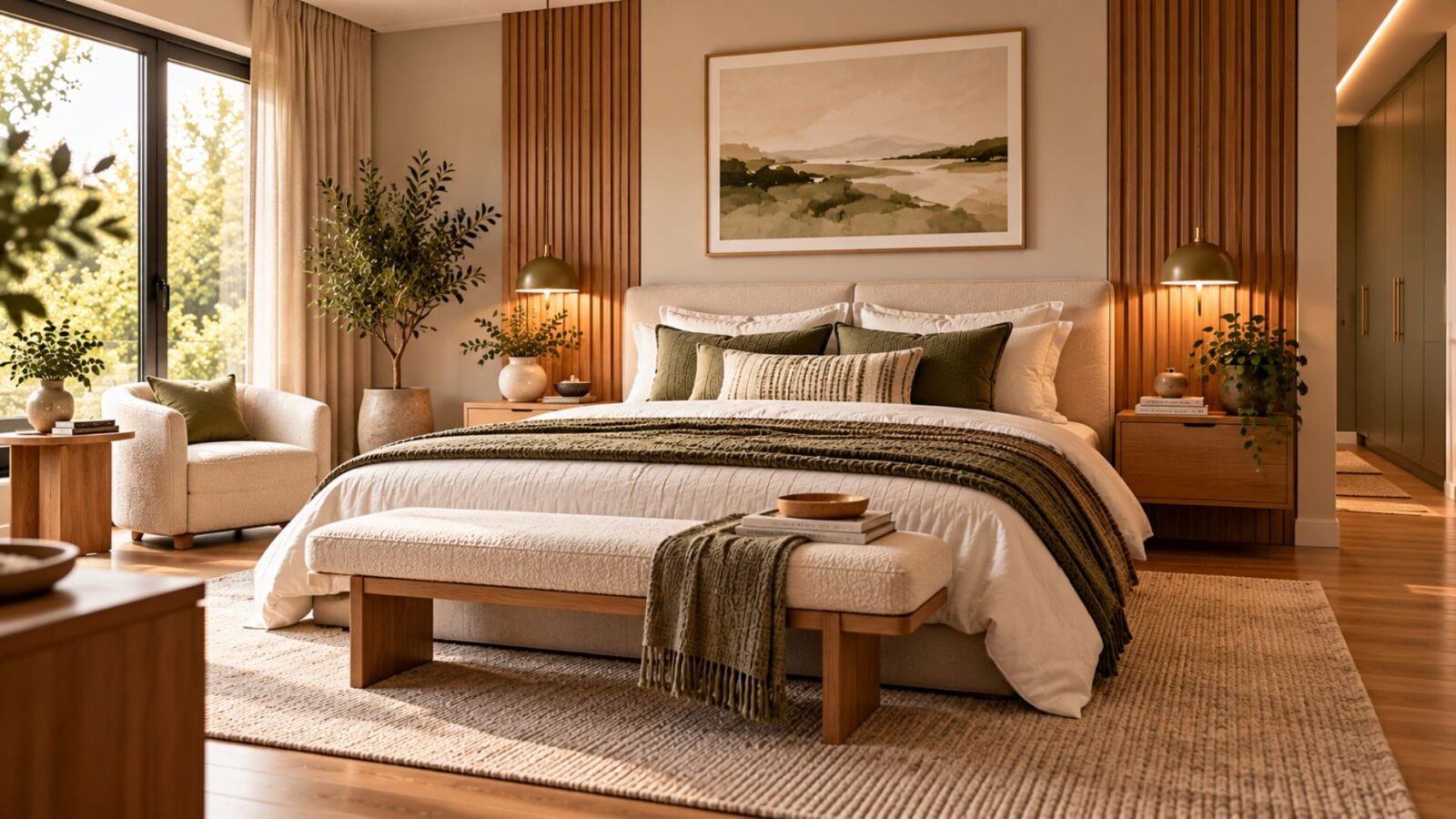

Use clean structure, warm materials, thoughtful lighting and controlled contrast to create a modern bedroom that feels refined without becoming cold.
Modern bedroom ideas work best when simplicity is balanced with warmth. Clean-lined furniture and a restrained palette establish the modern foundation, but wood, upholstery, natural textiles and layered lighting keep the room from feeling sterile. The goal is not to remove personality. It is to make every major design choice feel intentional.
A useful way to approach the style is the Wallsaide Modern Bedroom Formula: clean structure + restrained palette + material warmth + controlled contrast. Get those four elements working together and you can change the colors, furniture and finishes considerably while retaining a distinctly modern character.
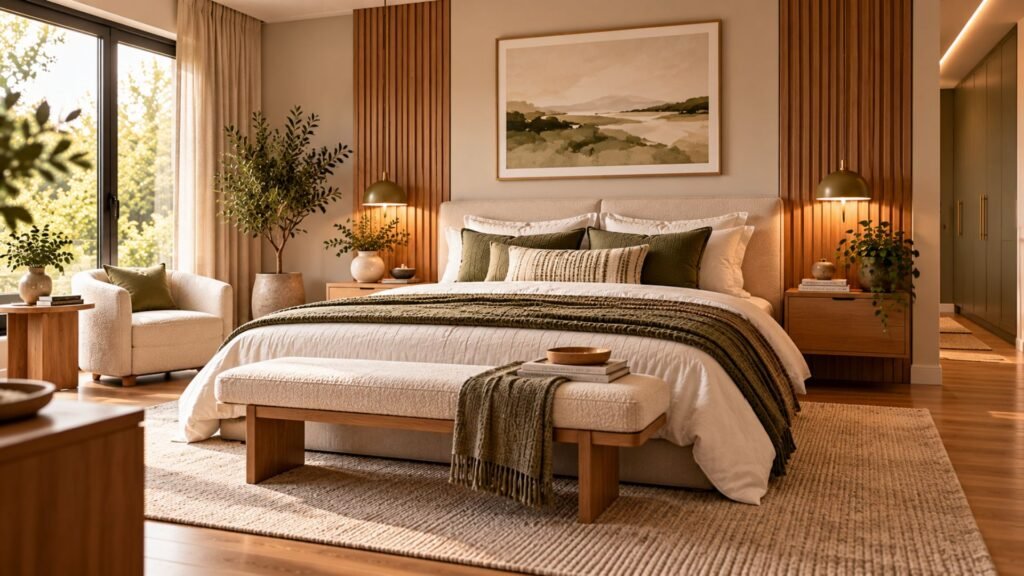
What actually makes a bedroom look modern?
Modern bedroom design is less about buying furniture labeled “modern” and more about controlling the visual structure of the room.
Start with simple forms. Beds, nightstands, wardrobes and lighting can still be sculptural, but their silhouettes should be clear enough that the room does not depend on excessive ornamentation.
Then control the number of competing materials and colors. A modern bedroom can contain oak, linen, stone, metal and wool, for example, while still looking coherent when those materials repeat deliberately.
This emphasis on clean lines, restrained color, materiality, appropriate furniture proportions and intentional editing also appears in designer guidance collected by .
The result should feel edited rather than empty.
The Wallsaide Modern Bedroom Formula
Before choosing individual pieces, think about four connected decisions.
Clean structure
Establish an obvious visual hierarchy. Usually the bed is the primary element, with storage, lighting and smaller furniture supporting it rather than competing for attention.
Restrained palette
This does not mean beige everywhere. It means limiting the number of dominant colors so that the materials and shapes have room to register.
Material warmth
Wood grain, linen, wool, upholstery, woven fibers and other tactile surfaces counterbalance harder modern elements such as glass, metal and stone.
Controlled contrast
Dark against light, smooth against textured, straight against curved or matte against reflective can create depth. The key is repeating contrast deliberately rather than introducing a new visual idea with every object.
That framework gives us a useful test for each of the following ideas.
21 modern bedroom ideas that balance simplicity and warmth
1. Start with a low-profile bed
A lower bed immediately changes the proportions of a bedroom.
It creates more visual space above the furniture and can make a clean architectural wall or large artwork feel more prominent. Simple upholstered platforms and streamlined timber frames work particularly well.
But low does not have to mean floor-level. Choose a height that remains comfortable to use and works with the scale of your nightstands.
A tall mattress on an ultra-low frame can look visually disconnected, so judge the complete bed rather than the frame alone.
2. Use warm neutrals instead of stark white everywhere
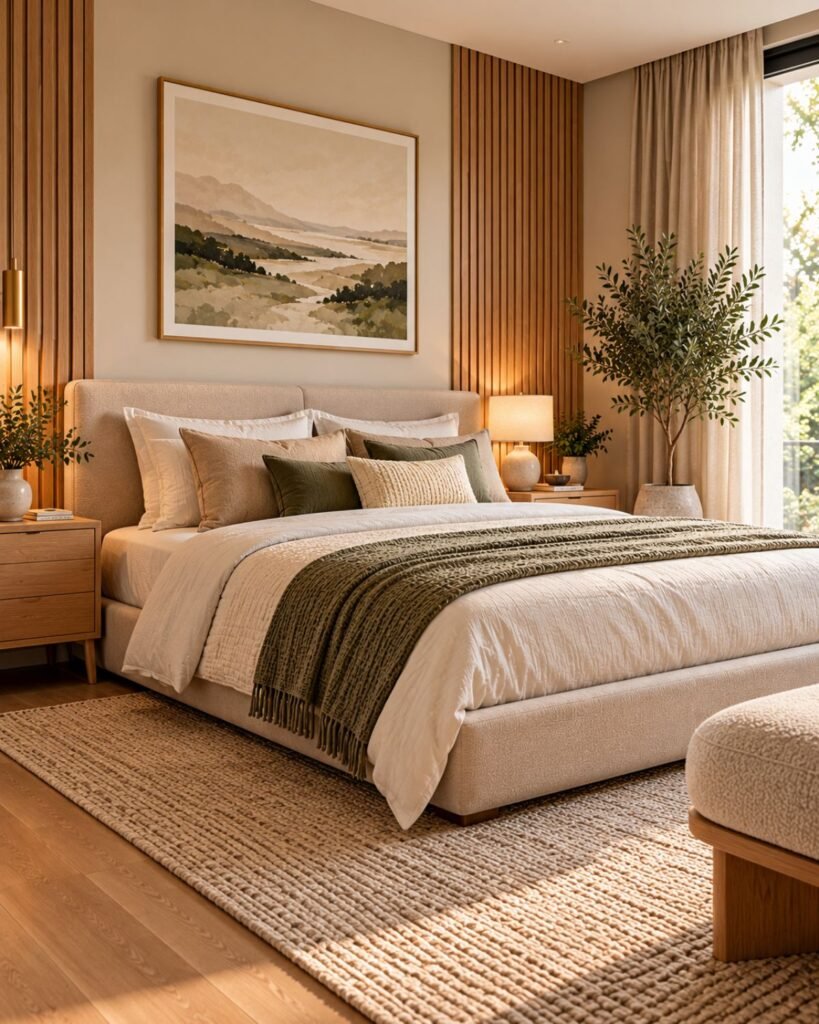
White can work beautifully in a modern bedroom, but an entirely bright-white room often needs careful material layering to avoid feeling clinical.
Warm white, oatmeal, mushroom, taupe, sand and muted greige create a softer starting point.
The important detail is undertone. Put paint, flooring, bedding and upholstery samples beside one another before committing. A yellow cream beside a cooler gray-beige can make both look less intentional.
A neutral palette should be treated as a family of related tones, not a collection of random pale colors.
3. Let natural wood do some of the warming
Modern rooms benefit from the visual clarity of simple furniture, but those forms can feel harder when every surface is painted, lacquered or metallic.
Natural wood introduces variation through grain without requiring additional pattern.
Oak can keep a pale scheme light. Walnut can create richer contrast. Darker woods can anchor a room with light walls and bedding.
You do not need every timber finish to match exactly. Aim for finishes that look related enough to coexist rather than assembling an identical bedroom suite.
4. Build the room around one strong headboard
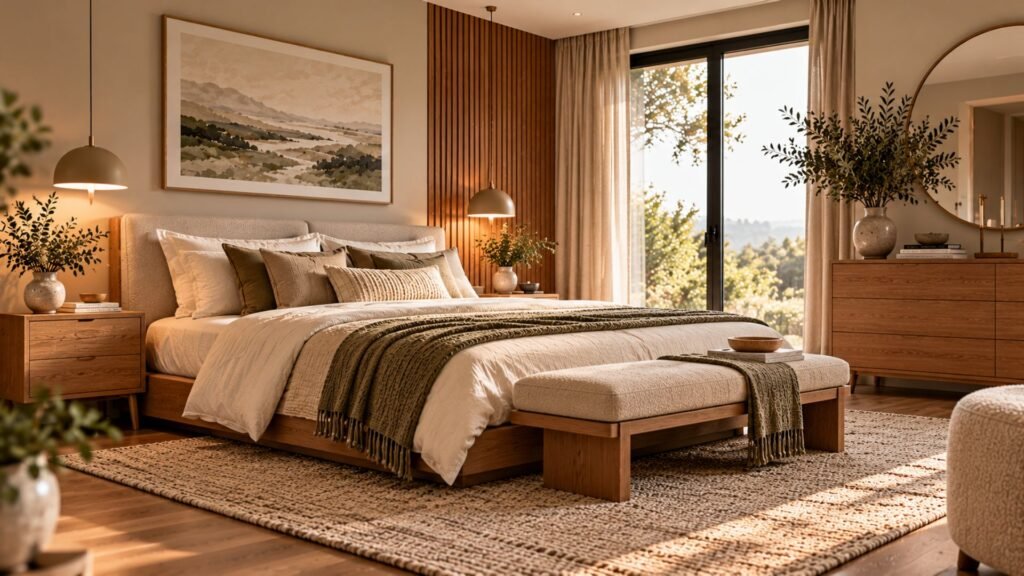
A modern bedroom does not need many decorative focal points if the bed wall already has presence.
An oversized upholstered headboard can add softness. Timber paneling can introduce architectural rhythm. A wide headboard extending behind the nightstands can visually connect separate furniture pieces.
This is particularly effective when the rest of the room remains quiet.
Avoid combining an elaborate headboard, dramatic wallpaper, oversized artwork and multiple statement lights unless they have been deliberately composed together. One clear focal decision is often stronger.
5. Layer texture before adding more color
If a neutral modern bedroom feels flat, color is not necessarily what is missing.
Compare the textures first.
A smooth cotton sheet, washed linen duvet, wool throw, upholstered bed, timber nightstand and textured rug can all sit within a narrow color range while reflecting light differently.
That variation creates depth without visual clutter. Designer guidance similarly emphasizes tonal textile layering and tactile materials as a way to warm modern bedrooms without undermining their restraint.
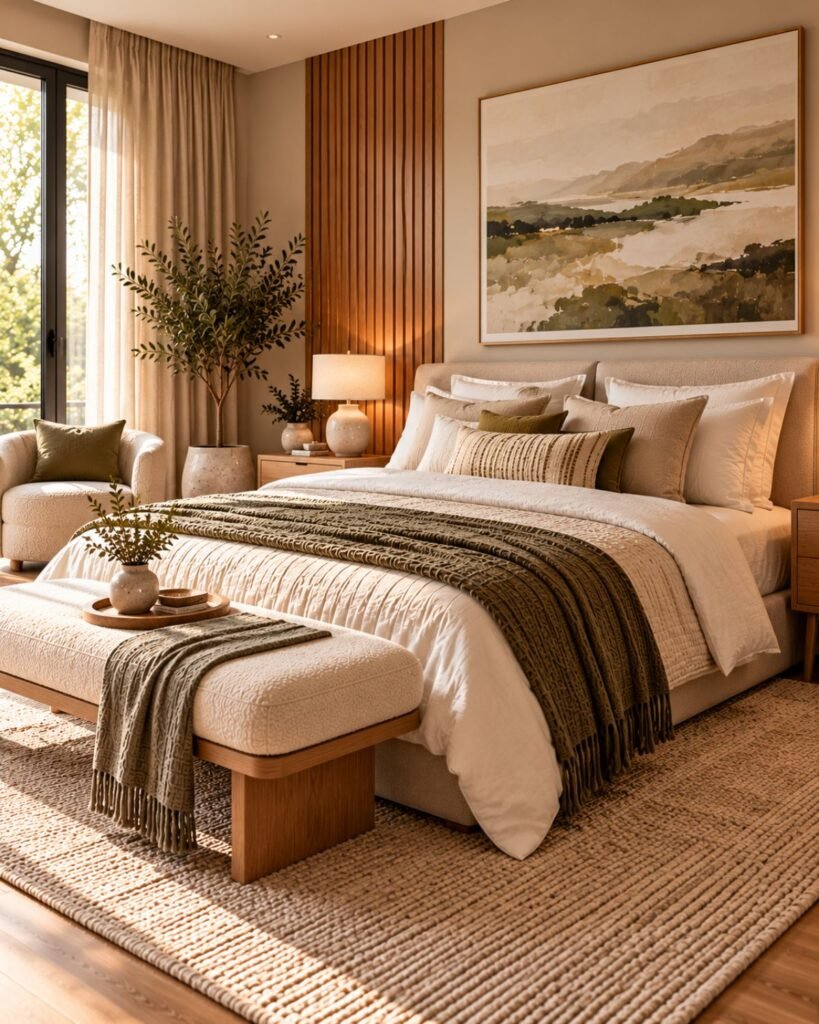
6. Treat the bedside lights as part of the architecture
Instead of automatically placing a lamp on each nightstand, consider pendants or wall-mounted sconces.
They release bedside surface space and can reinforce the geometry of the bed wall.
For a softer room, use opal glass, fabric shades or warm metal finishes. For a sharper contemporary look, choose a simpler directional fitting.
Whatever the style, position reading lights according to how the bed is actually used rather than centering them only for visual symmetry.
7. Use floating nightstands when visual lightness matters
Floating bedside furniture can expose more floor and reduce the visual weight around the bed.
It works particularly well with a wide architectural headboard or wall panel because the individual components can appear integrated.
A drawer is often more practical than a simple floating shelf because it hides chargers, medication and other small objects.
If wall mounting is impractical, choose slim nightstands with visible legs to create a similar sense of openness.
8. Add one dark element to anchor a pale room
A pale modern bedroom can lose definition when every surface sits at approximately the same value.
A charcoal bed frame, black window frame, dark timber nightstand or deep bronze light can provide enough contrast to sharpen the composition.
The trick is repetition.
If you introduce black in one small object and nowhere else, it can look accidental. Repeat the dark tone two or three times in controlled amounts so it becomes part of the design language.
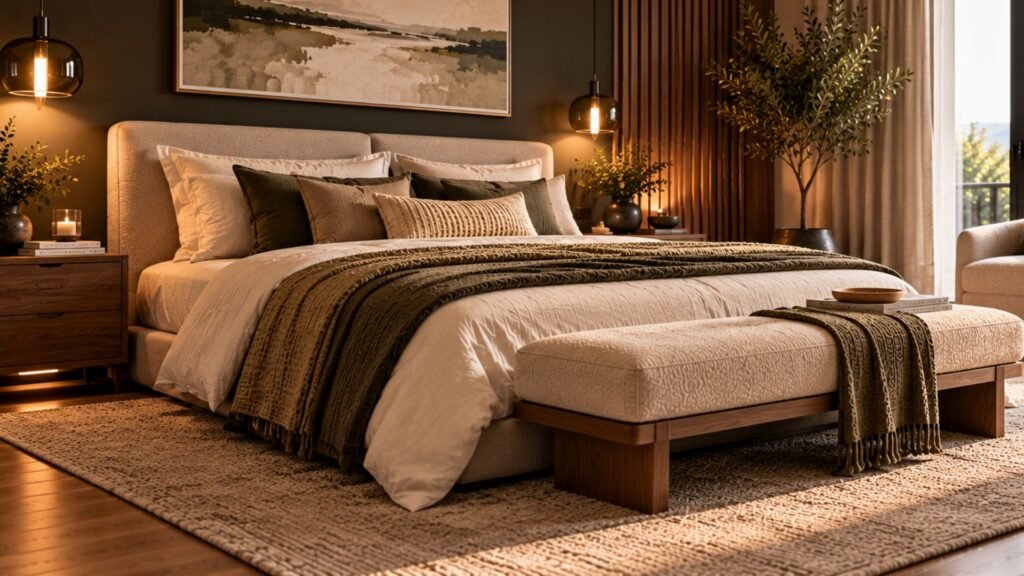
9. Soften straight lines with one or two curves
Modern does not have to mean rectangular.
A curved lounge chair, rounded nightstand, arched mirror or softly shaped headboard can interrupt a room dominated by straight architectural lines.
That contrast often makes both forms more noticeable.
Avoid turning every piece into a curve simply because rounded furniture is fashionable. The effect is strongest when the curved element has something straighter to play against.
10. Keep the bedding visually quiet
The bed occupies a large percentage of the visible surface area in most bedrooms, so bedding has disproportionate influence.
Solid colors, subtle weaves and restrained patterns usually integrate easily into a modern scheme. Build interest through layers rather than covering the bed with many unrelated cushions.
A useful formula is simple sheets, one duvet or coverlet, one contrasting or textural layer and a limited number of pillows.
The bed should look inviting rather than staged beyond practical use.
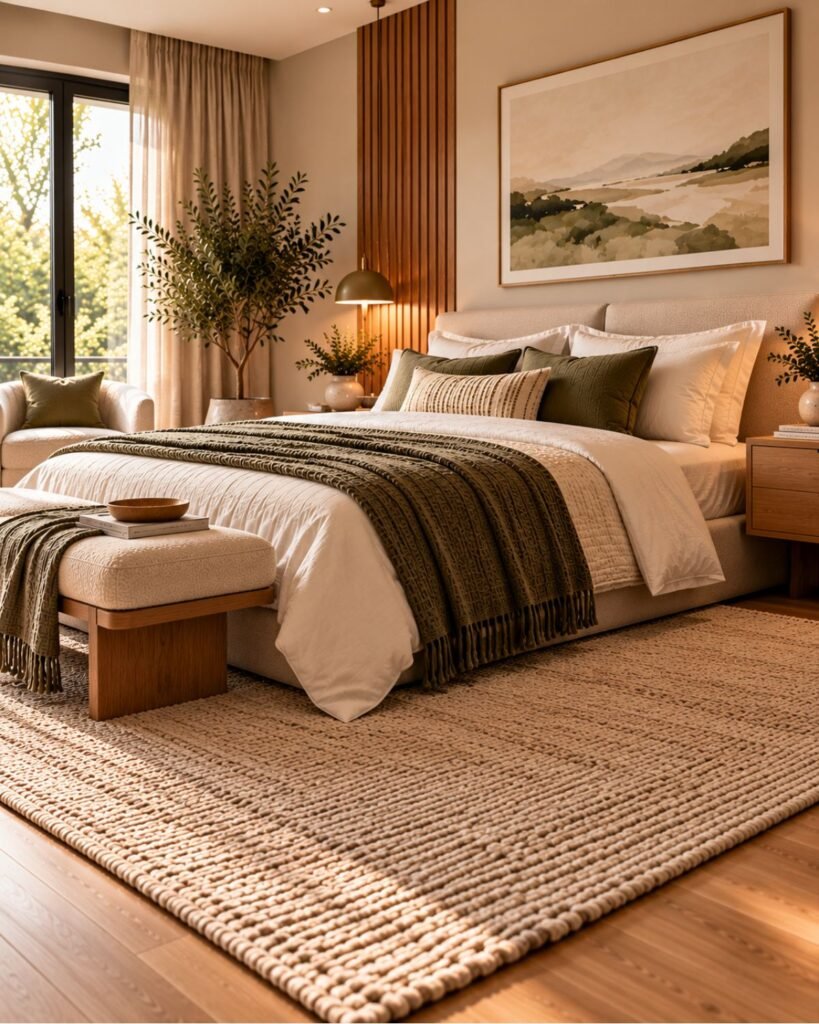
11. Give the rug enough scale
A small rug floating at the foot of a large bed can make the furniture look disconnected.
Use a rug large enough to relate meaningfully to the bed and surrounding floor area. Depending on the layout, it might extend beneath much of the bed or begin farther forward while still projecting generously around the sides and foot.
Texture can matter more than pattern here.
Wool, flatweave and other tactile finishes introduce softness across a large surface without requiring another dominant color.
12. Layer the lighting instead of relying on one ceiling fixture
A modern bedroom should look different at night than it does in daylight.
Use the ceiling fixture for broad illumination, then add bedside lighting for reading and a softer secondary source where the room benefits from it. That might be a floor lamp beside a chair, discreet joinery lighting or a low table lamp.
Designers interviewed by Architectural Digest recommend bedroom lighting at multiple heights, while diffused and shaded sources can reduce glare and create a softer atmosphere.
This is one area where function and atmosphere are essentially the same design problem.
13. Use curtains to soften hard architecture
Modern rooms often contain large expanses of wall, glass and cabinetry.
Fabric can soften those surfaces.
Full-length curtains create vertical continuity and add movement that hard furniture cannot. Linen-look and other textured fabrics work particularly well where the room already has clean-lined furniture.
Consider both appearance and light control. A bedroom window treatment needs to work when the room is being used, not merely frame the window attractively during the day.
14. Make storage visually disappear
Storage becomes especially successful in a modern bedroom when it feels integrated into the architecture.
Full-height wardrobes in a wall-adjacent finish can create a calmer plane than several freestanding cabinets. Flush fronts and restrained hardware can further reduce visual fragmentation.
Custom joinery is not essential. A coordinated run of simple wardrobes can achieve much of the same effect when the proportions suit the wall.
If the room is compact, our small bedroom storage ideas show additional ways to gain capacity without surrounding the bed with furniture.
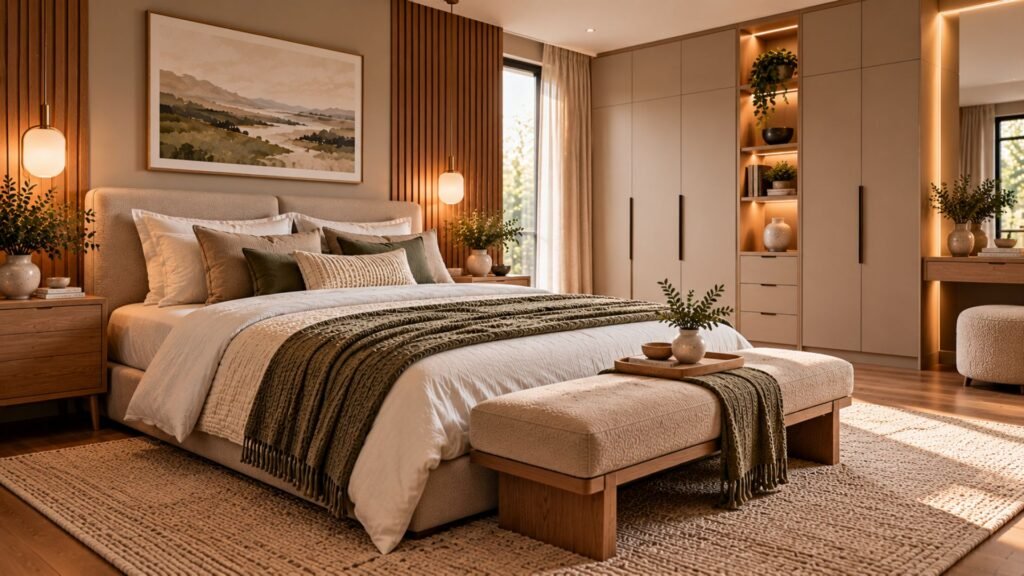
15. Choose one piece of oversized art instead of many small objects
Modern interiors often benefit from fewer pieces with greater visual presence.
One substantial artwork above the bed or on an otherwise open wall can introduce color and personality without requiring a gallery of smaller accessories.
Scale it in relation to the furniture beneath it.
Artwork that is too small can appear stranded on a large wall, while a larger piece can visually connect with the bed or console and become part of the room’s overall composition.
It does not need to be expensive. Size and placement matter independently of price.
16. Mix stone with softer materials
Stone can introduce subtle movement and a more substantial finish to a modern bedroom.
A travertine-look nightstand, marble top or stone ledge can work well beside upholstered fabric and wood because the materials provide contrasting tactile qualities.
Use it selectively.
Too many hard polished surfaces can shift a bedroom toward a colder, hospitality-style aesthetic. One stone element is often enough to create the contrast.
17. Keep furniture proportions balanced
A modern room exposes proportion problems quickly because there is less decorative clutter to distract from them.
An oversized bed with tiny nightstands can feel top-heavy. A huge dresser in a modest room can dominate the architecture. A small rug beneath substantial furniture can make everything look disconnected.
Designers cited by Architectural Digest specifically identify furniture proportion as important to modern bedroom design: pieces should relate to one another as well as to the room.
If you’re working with limited dimensions, resolve the furniture arrangement before styling. Our small bedroom layout ideas focus specifically on bed placement, circulation and furniture geometry.
18. Introduce muted color instead of assuming modern means neutral
Modern design can support color.
The difference is usually how the color is controlled.
Instead of distributing five saturated shades around the room, choose one dominant muted color and allow the surrounding materials to support it. Olive, dusty blue, clay, muted burgundy or deep teal can all work within a modern scheme.
A colored upholstered bed against quieter walls can become the anchor. Alternatively, keep the large surfaces neutral and repeat a muted accent through bedding, artwork and one smaller furniture piece.
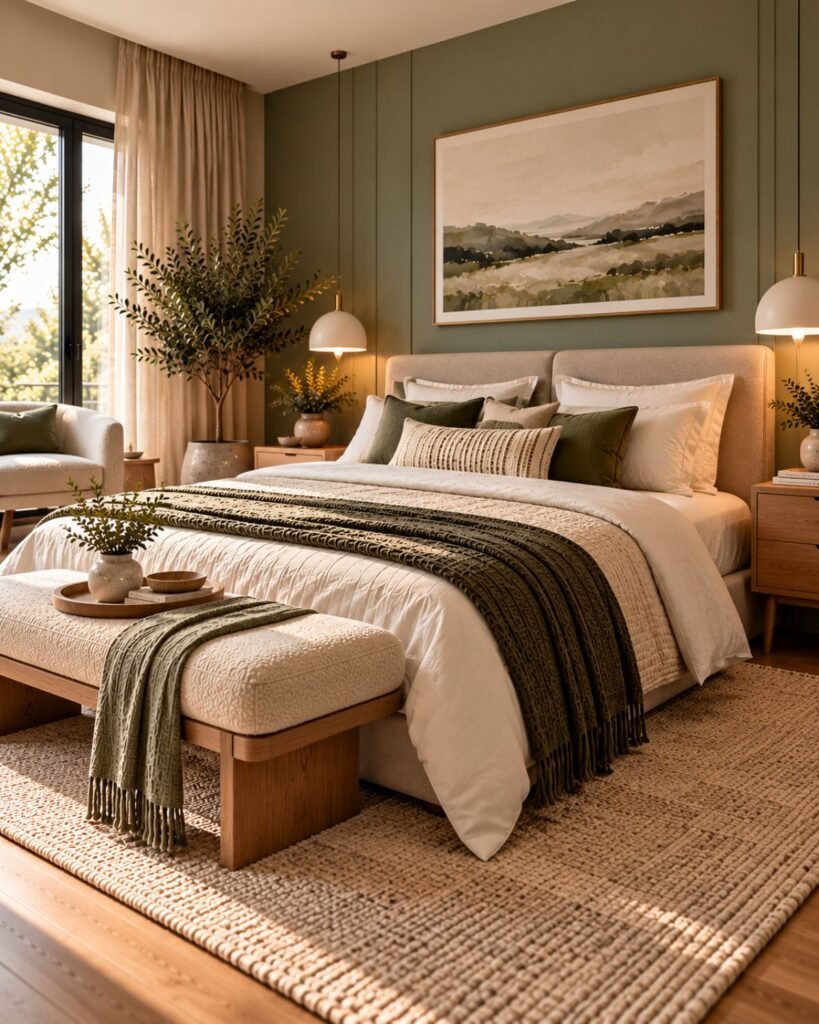
19. Create luxury through finish, not decoration
A modern bedroom does not need a collection of visibly expensive objects to feel sophisticated.
Focus on the elements that occupy the most visual space: well-fitted curtains, substantial bedding, a properly sized rug, balanced lighting and furniture with convincing proportions.
Then refine the details.
A consistent metal finish, aligned cabinetry, concealed cables and clean junctions between materials can contribute more to a polished result than adding decorative accessories.
This approach also makes modern design easier to recreate at different budgets because the principle depends on composition rather than brand names.
20. Leave some space intentionally empty
Negative space is part of the design.
You do not need a bench because there is room at the foot of the bed. You do not need artwork on every wall. You do not need a chair in an empty corner if nobody will use it.
An open section of wall can make an adjacent artwork stronger. Clear floor around furniture can make its silhouette more apparent.
This is particularly valuable in smaller rooms. For broader compact-room solutions beyond modern style, see our small bedroom ideas.
Empty space should look deliberate, not unfinished.
21. Let one feature lead the room
The easiest way to lose the calm quality of modern design is to give everything equal visual importance.
Choose the element that should lead.
It might be a timber headboard wall, sculptural pendant, dark upholstered bed, large artwork, dramatic window or architectural ceiling.
Then reduce the intensity of the supporting elements.
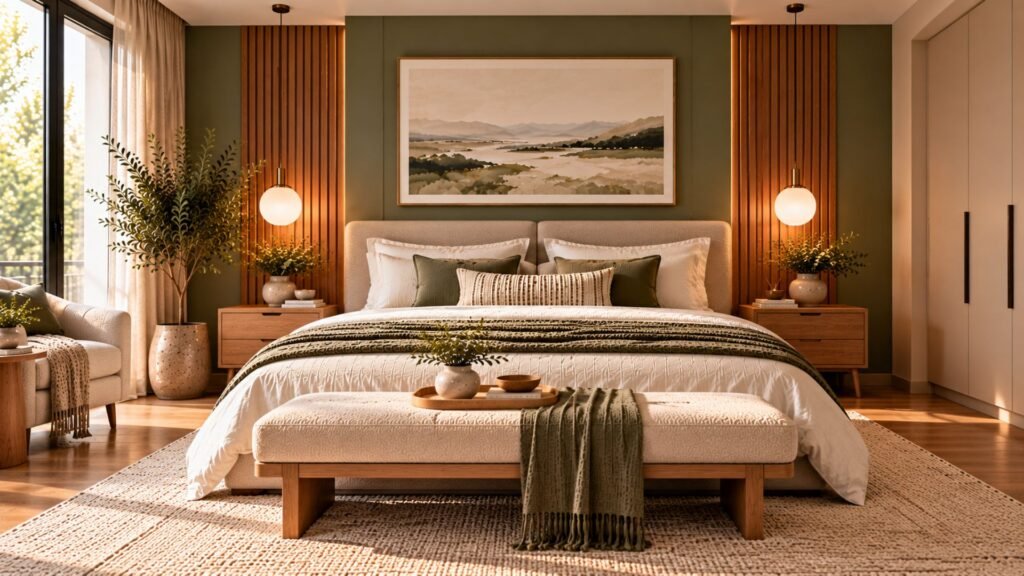
The room becomes easier to read because the eye knows where to settle first.
Modern vs contemporary bedroom design
The terms are often used interchangeably in everyday decorating, but they are not quite identical.
Modern design can refer to design traditions associated with modernism and their later interpretations: reduced ornament, clear forms, functional planning and attention to materials.
Contemporary design is more fluid. It describes design happening now, so its appearance changes as current preferences change.
In practice, a contemporary bedroom might borrow modernist simplicity while also incorporating current furniture shapes, colors and materials.
For Wallsaide, the distinction matters less than the design decision behind it. If your room uses clean structure, controlled materials and intentional proportions, you can incorporate contemporary pieces without losing its modern foundation.
How to make a modern bedroom feel warm
If a modern bedroom feels cold, do not immediately add more decoration.
Check the material balance first.
A room containing white walls, glossy cabinetry, metal furniture, bare glass and hard flooring may simply have too many hard surfaces. Introduce tactile materials where they have practical value: an upholstered bed, large rug, curtains, timber furniture or layered bedding.
Architectural Digest’s modern-bedroom guidance similarly notes that modern rooms can remain inviting through elements such as warm wood, soft textures and carefully selected color rather than relying on sterility as a marker of modernity.
Then examine the lighting.
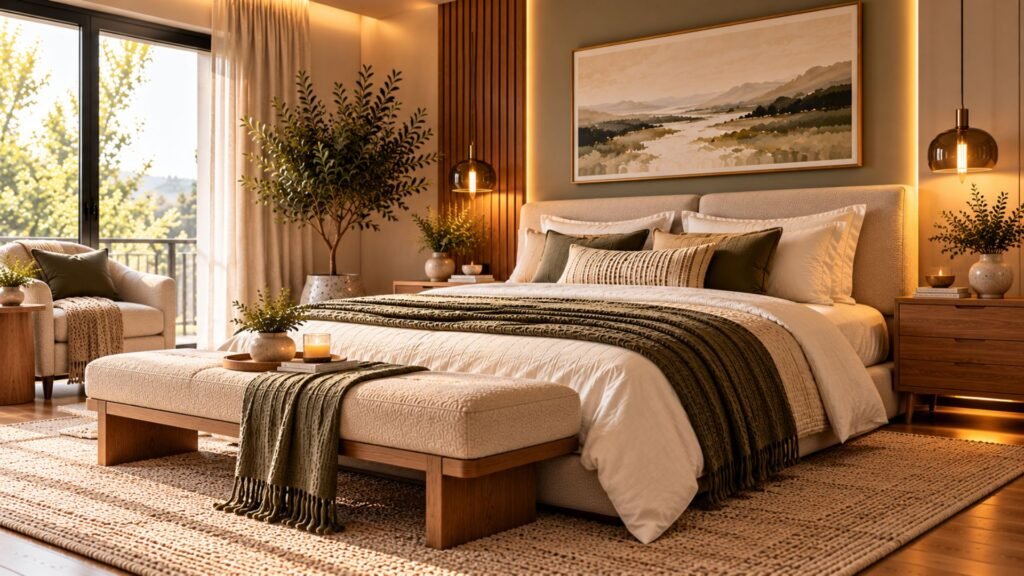
One bright overhead source can flatten even a well-designed bedroom. Multiple softer sources create different pools of light and reveal material texture after dark.
Finally, add a small amount of irregularity. A handmade ceramic lamp, timber with visible grain or one vintage object can prevent a tightly controlled room from feeling like a showroom.
Modern bedroom colors that work
There is no single modern-bedroom palette, but some combinations make the underlying design logic easier to control.
Warm white + oak + charcoal
This is one of the clearest combinations. Warm white creates the backdrop, oak adds natural variation and charcoal establishes definition.
Taupe + walnut + cream
This creates a richer and slightly more enveloping room. Keep enough tonal difference between the taupe and walnut so the furniture remains legible.
Soft gray + natural wood + black
A cooler option that works best when wood and textiles provide sufficient warmth.
Olive + cream + oak
Muted green gives the bedroom more identity without overwhelming the clean forms.
Clay + beige + dark timber
Earthier and more expressive, this combination works well when the terracotta or clay tone is treated as the dominant color rather than one of several accents.
The palette is only the starting point. Light changes how every color reads, while flooring, furniture and textiles alter the relationships between them.
How to create a modern bedroom on a smaller budget
Do not begin by replacing everything.
First, remove furniture and accessories that are making the composition unnecessarily busy. Reposition the bed if the current layout lacks balance, then decide which existing pieces can stay.
Next, concentrate spending on the largest visual surfaces.
Paint, bedding, curtains and a properly scaled rug can change the room substantially without replacing every piece of furniture. Updating a lampshade or switching to a simpler bedside light may have more impact than adding several decorative objects.
If existing wood furniture has compatible proportions, allow it to remain. Modern design does not require a matching new furniture set.
A room becomes coherent through relationships between pieces, not because everything was purchased at the same time.
Common modern bedroom mistakes
Making minimalism the entire strategy
Removing clutter is useful, but an empty room is not automatically a well-designed modern room.
You still need proportion, texture, light and hierarchy.
Using only one material
A room dominated by painted MDF, for example, can feel flat regardless of how streamlined the cabinetry is.
Mix a limited number of complementary materials.
Choosing furniture that is too bulky
Large furniture can undermine the openness that makes many modern rooms successful.
Measure the room and preserve circulation before choosing pieces.
Making every object a statement
A sculptural bed, dramatic light, bold rug, patterned curtains and oversized artwork can all work individually. Together, they may compete.
Decide what leads and what supports.
Using cool lighting everywhere
Lighting affects the way colors and materials are perceived after dark. Bedrooms generally benefit from softer, layered sources rather than depending entirely on a bright central fixture.
Hiding all personality
Modern does not mean anonymous.
Books, art, photographs, ceramics and meaningful objects can belong in the room. Edit their placement instead of removing every sign that somebody lives there.
A simple order for designing a modern bedroom
If you are starting from scratch, make decisions in this order:
- Resolve the layout. Decide where the bed and essential storage belong.
- Choose the dominant palette. Consider walls, flooring and existing fixed finishes together.
- Select the bed. Its scale and material will influence almost everything around it.
- Add proportional bedside furniture.
- Plan lighting at more than one height.
- Solve storage before adding decorative furniture.
- Introduce material warmth through wood and textiles.
- Establish controlled contrast.
- Choose one primary focal point.
- Edit accessories last.
This sequence prevents decoration from compensating for unresolved layout or proportion problems.
Frequently asked questions
What makes a bedroom look modern?
Modern bedrooms typically rely on clear furniture forms, intentional proportions, a controlled palette, limited visual clutter and careful material selection. Warm wood, upholstery and textured textiles can soften those elements without compromising the clean structure.
How do I make my bedroom modern without replacing all the furniture?
Start by editing the room, improving the layout and simplifying the palette. Updating bedding, lighting, curtains, paint or a rug can establish a stronger modern direction while compatible existing furniture remains in place.
What colors are best for a modern bedroom?
Warm whites, taupes, grays and other neutrals provide flexible foundations, but modern bedrooms can also use muted green, blue, clay and deeper colors. Cohesion matters more than choosing a particular fashionable shade.
Can a modern bedroom be cozy?
Yes. The clean forms associated with modern design can be balanced with upholstered furniture, natural wood, large rugs, curtains, layered bedding and softer lighting. Warmth comes largely from material and light rather than additional clutter.
What furniture works best in a modern bedroom?
Look for pieces with clear silhouettes and proportions appropriate to the room. Low-profile beds, simple nightstands, integrated storage and streamlined dressers are common choices, but no single furniture type is mandatory.
How do you make a small bedroom look modern?
Use fewer appropriately scaled pieces, preserve visible floor space, simplify the color palette and concentrate storage rather than distributing cabinets around the room. Our dedicated small bedroom ideas cover the compact-room problem in greater depth.
Does modern bedroom furniture have to match?
No. Matching every piece can actually make a room feel more like a furniture showroom. Different pieces can work together when their scale, materials, color temperature or design language gives them a clear relationship.
The best modern bedrooms are edited, not empty
The strongest modern bedroom ideas are not about stripping a room down until nothing remains. They are about deciding which elements deserve attention and giving them enough space to work.
Return to the Wallsaide Modern Bedroom Formula: clean structure + restrained palette + material warmth + controlled contrast. Use it to evaluate the room as a whole, and modern design becomes much less dependent on trends.
A bedroom can then feel current without becoming disposable, simple without becoming sterile, and polished without losing the personality that makes it yours.
References
- Architectural Digest. How to Decorate a Bedroom, According to Interior Designers. https://www.architecturaldigest.com/story/how-to-decorate-bedrooms
- Architectural Digest. 37 Modern Bedroom Design Ideas With Sleek and Serene Style. https://www.architecturaldigest.com/gallery/contemporary-bedroom-ideas-inspiration
- Architectural Digest. 27 Bedroom Lighting Ideas to Set a Serene Mood. https://www.architecturaldigest.com/gallery/bedroom-lighting-ideas
About the Author
Lauren Johnson writes about interior design, home décor, color, and practical room styling for Wallsaide. She focuses on helping readers understand why design choices work and how to recreate beautiful, functional spaces at home.