
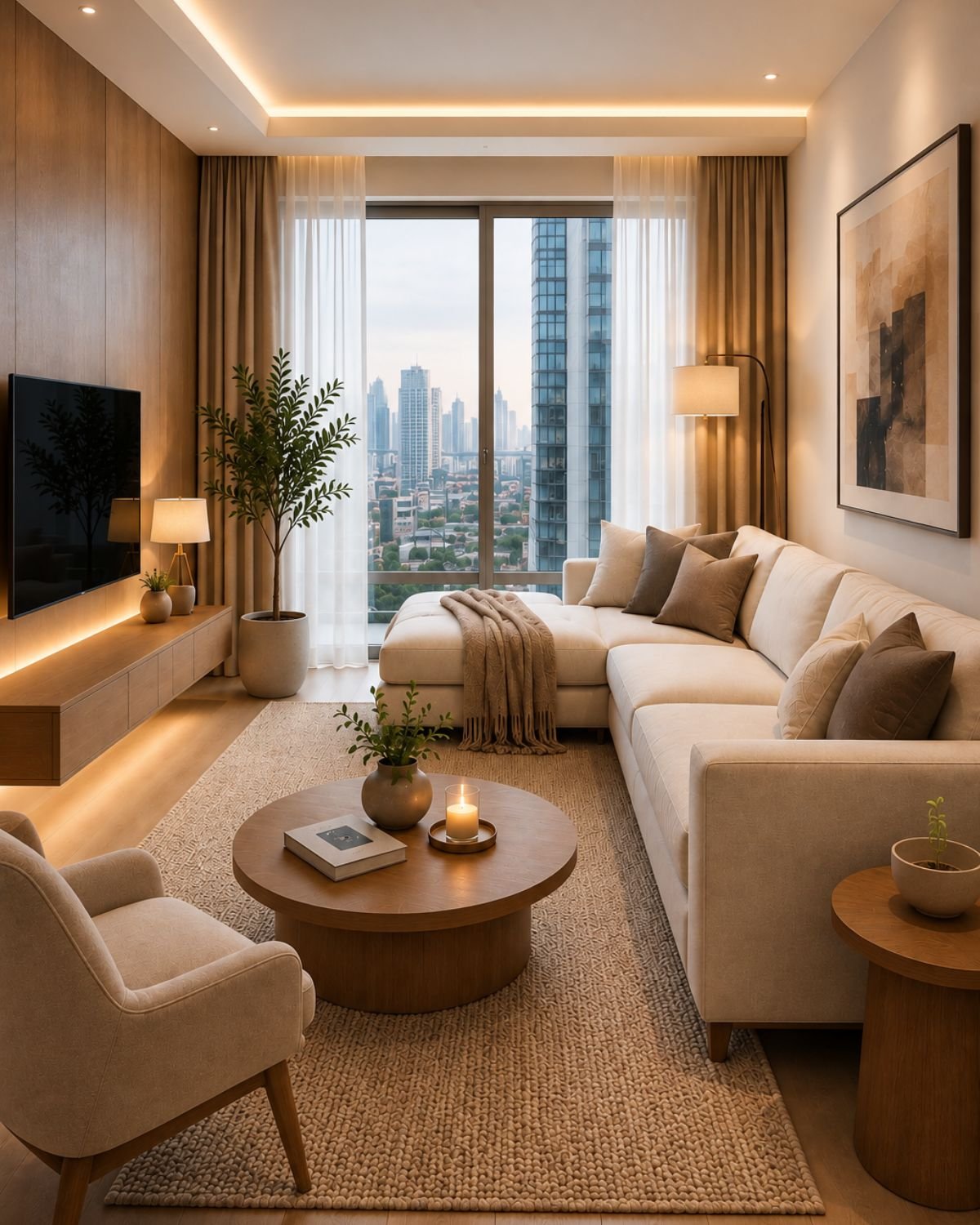

A luxury minimalist apartment feels refined because every visible element earns its place—not because the room is filled with expensive-looking objects.
Luxury minimalism works particularly well in apartments because both ideas depend on control. Minimalism reduces visual noise, while luxury comes through proportion, material, lighting, finish, and attention to detail.
The result shouldn’t feel empty or sterile. The most convincing luxury minimalist apartment ideas use fewer pieces, but make those pieces work harder: a substantial sofa instead of several small chairs, warm wood instead of imitation finishes, layered lighting instead of one harsh ceiling fixture, and carefully repeated materials rather than a collection of unrelated décor.
The goal is not simply to own less. It is to make the apartment feel deliberate.
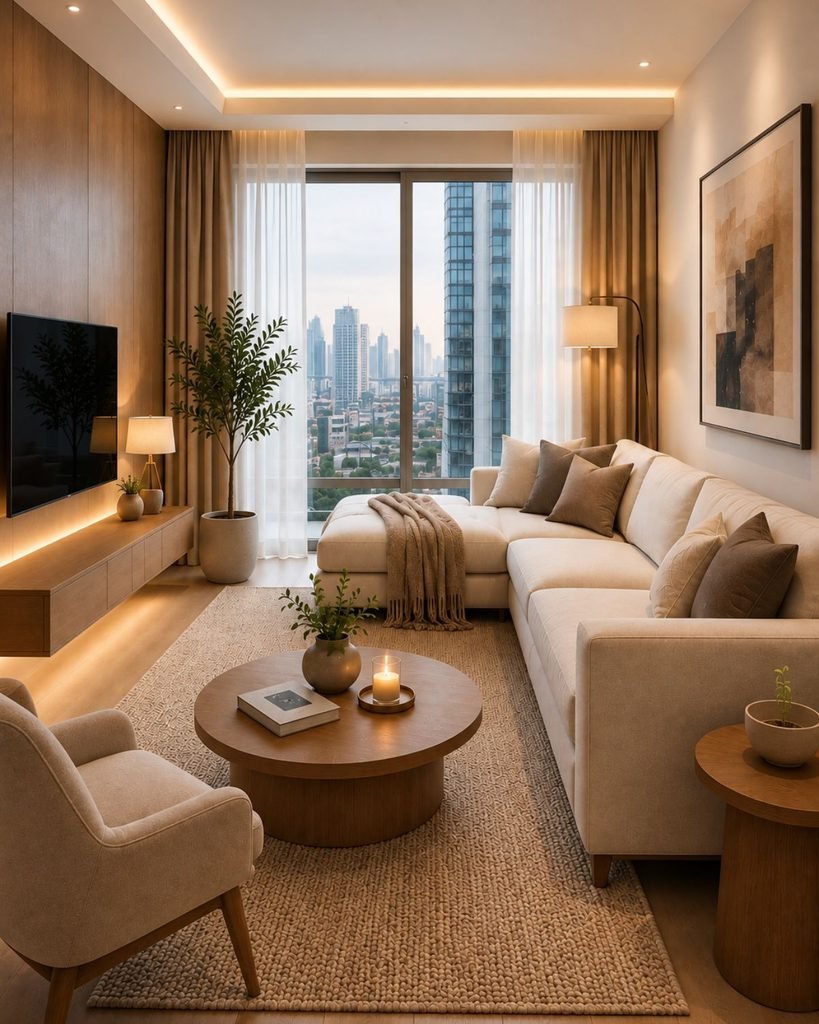
What makes a minimalist apartment feel luxurious?
A minimalist apartment begins to feel luxurious when restraint is paired with quality and visual consistency.
Removing objects alone doesn’t create luxury. In fact, an under-furnished room can look unfinished. The difference is whether the remaining furniture, materials and lighting create enough visual substance to carry the space.
Wallsaide uses six elements as a practical way to assess this look:
- Scale — fewer pieces with enough presence to anchor the room.
- Restraint — open surfaces and deliberate negative space.
- Material — visible wood grain, stone, woven textiles, glass and metal used purposefully.
- Lighting — several soft sources rather than relying entirely on bright overhead light.
- Repetition — recurring colors, woods and metals connecting one area to another.
- Finish — clean joins, tailored textiles and carefully resolved details.
Think of this as the Wallsaide Luxury Minimalist Formula rather than an interior-design rule. It is a simple editorial framework for understanding why some sparse apartments look sophisticated while others simply look empty.
Start with a restrained warm-neutral palette
Luxury minimalist interiors often benefit from a limited palette because fewer competing colors allow materials and forms to become more noticeable.
That doesn’t require making everything beige.
A practical starting point is one light foundational neutral, one slightly deeper supporting neutral and one grounding material or dark accent. An apartment might combine warm white walls, oatmeal upholstery and medium oak, for example, with small amounts of black or aged brass providing definition.
Variation should come from value and texture as much as color.
Cream upholstery against an ivory wall can still create depth when one surface is woven, another matte and another softly reflective. The room remains visually quiet without becoming flat.
If you need to establish the palette before choosing furniture and finishes, Wallsaide’s interior color ideas guide explains how to build colors around the fixed elements already present in a room.
Choose fewer pieces with stronger proportions
One of the easiest ways to lose the luxury-minimalist effect is to fill an apartment with many undersized pieces.
A living room containing a small sofa, two tiny chairs, several side tables, a narrow console and numerous decorative objects may technically contain less expensive furniture, but visually it creates more information to process.
Instead, establish a hierarchy.
A substantial sofa can become the primary mass in the living area. One appropriately scaled coffee table can anchor it. An occasional chair should have a clear reason for being there rather than simply filling an empty corner.
This doesn’t mean buying oversized furniture. Apartment furniture still needs sufficient circulation space.
The principle is fewer, better-proportioned forms.
Let natural materials provide the decoration
Minimalist rooms have fewer decorative objects, so surfaces themselves become more important.
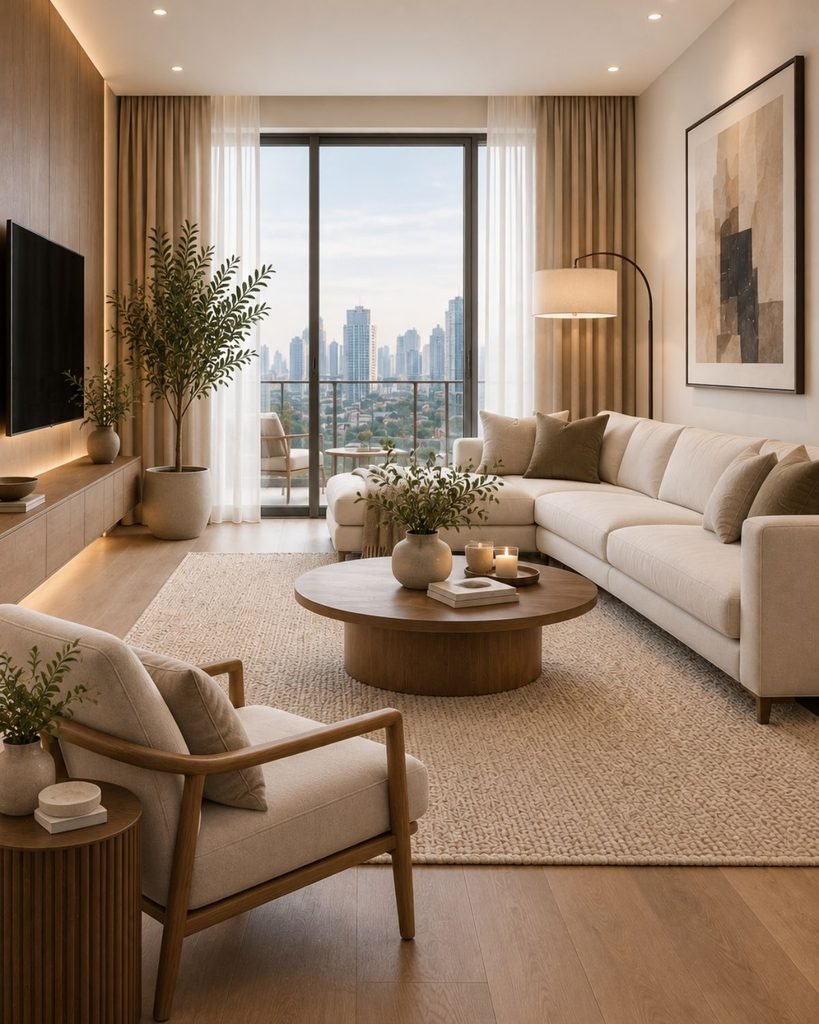
Wood grain introduces natural variation. Stone adds subtle veining. Linen creates irregular texture. Wool gives a large floor area tactile depth. Brushed metal can provide controlled contrast.
That is why a round walnut coffee table can contribute more to this style than several decorative accessories placed on a cheaper, visually anonymous table.
Look closely at a successful luxury minimalist room and you may find relatively little “decoration.” Much of what initially reads as richness is actually material variation.
A useful combination might include:
- warm oak or walnut;
- wool or another visibly textured rug;
- linen or textured upholstery;
- stone or stone-look surfaces;
- a restrained metal finish such as brass or blackened metal.
You don’t need all five. Repeating two or three convincingly is usually more coherent than introducing a different finish on every surface.
Use lighting as part of the architecture
Lighting has disproportionate influence in a minimalist apartment because there are fewer objects competing for attention.
Start with daylight wherever possible, then build an evening lighting scheme at different heights.
Ceiling lighting provides general illumination. A floor lamp can create a softer pool of light beside seating. Table lamps introduce another level. Concealed or integrated lighting can emphasize cabinetry, shelving or architectural lines when used sparingly.
The mistake is assuming that “luxury” means installing light strips around every available edge.
It doesn’t.
Integrated lighting works when it clarifies architecture—beneath a floating cabinet, inside a restrained display unit or along a genuine ceiling recess. Used everywhere, the effect quickly becomes decorative rather than architectural.
Aim for soft layers, not maximum brightness.
Keep the living room visually quiet, not empty
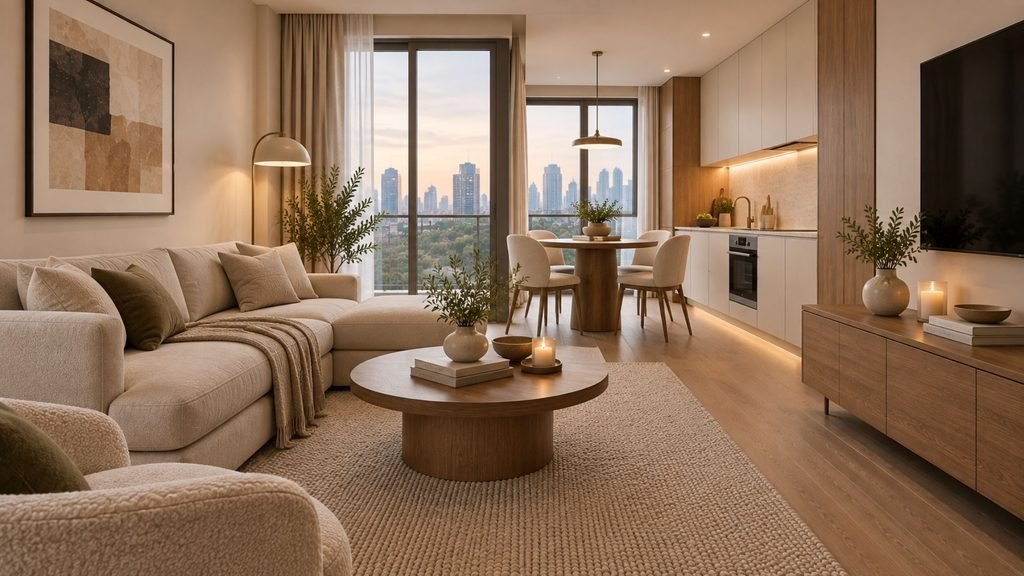
The living room usually carries most of the visual weight in an apartment, so it is the best place to establish the design language.
Start with the largest surfaces: walls, floor, sofa, rug and curtains. If those elements already work together, very little additional decoration is required.
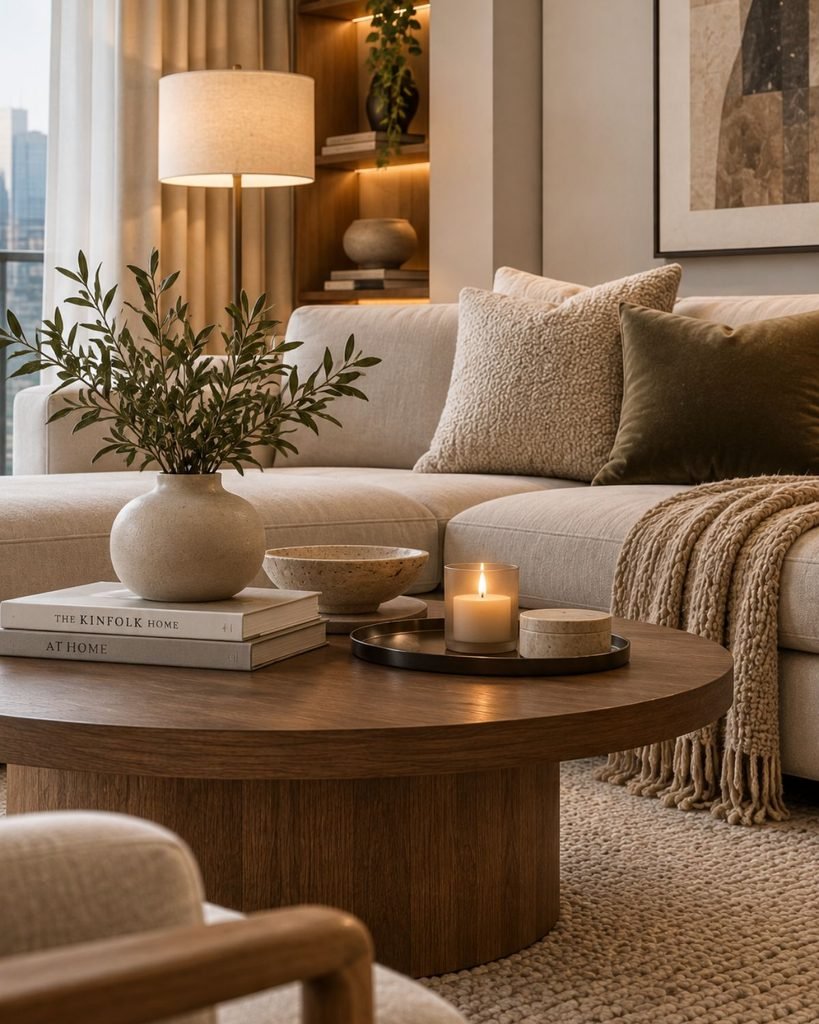
A warm luxury minimalist living room might combine an off-white sectional, textured neutral rug, medium-tone wood coffee table, simple floor lamp and one substantial artwork. A plant can introduce organic shape without adding another manufactured object.
Notice what isn’t necessary: several decorative trays, numerous cushions, multiple pieces of wall art and every corner filled with furniture.
Negative space is part of the composition.
If your apartment living room is particularly compact, use the principles in our small living room ideas guide to resolve furniture scale and circulation before adding decorative layers.
Make the kitchen feel integrated rather than visually busy
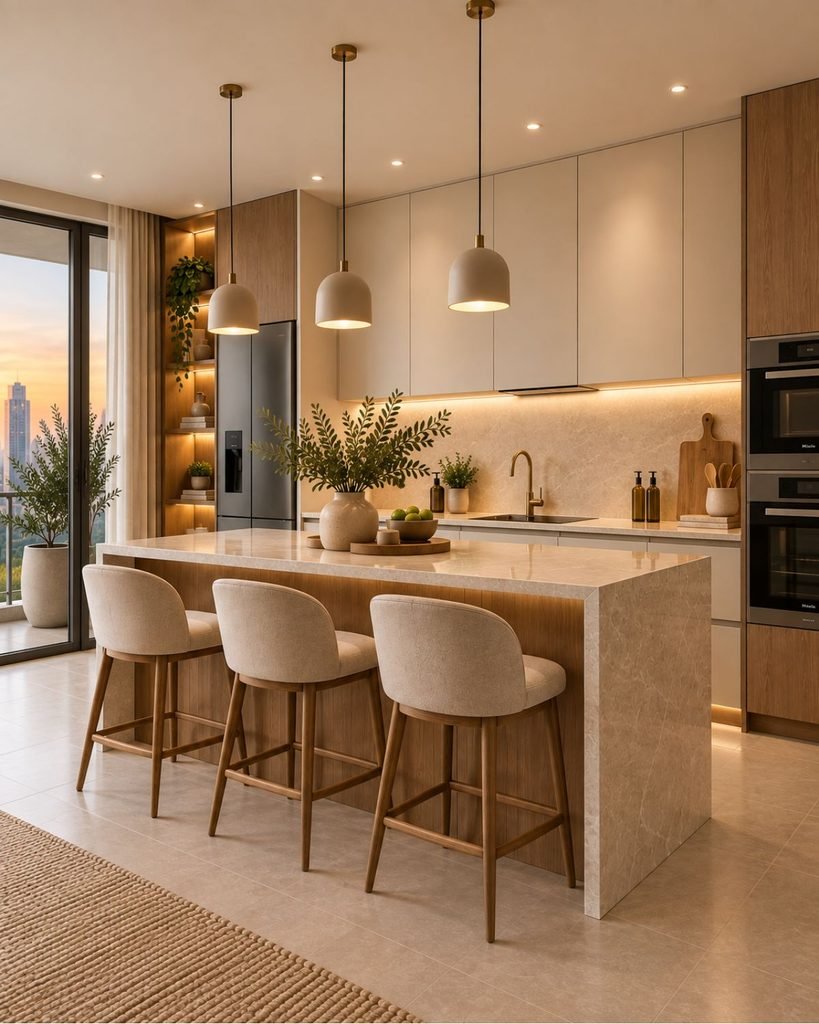
A luxury minimalist kitchen works best when the functional complexity of the room is visually simplified.
Flat or restrained cabinet fronts can create broad, uninterrupted surfaces. Integrated appliances reduce visual fragmentation where practical. Limiting the number of visible finishes helps the kitchen read as one composition rather than a collection of cabinets, appliances and accessories.
The kitchen image above demonstrates the principle particularly well: pale cabinetry establishes the quiet background, warm wood provides contrast, stone gives the island visual weight, and restrained metal details introduce a finer layer.
The lighting is also doing significant work.
Pendant lights create a focal rhythm above the island, while integrated illumination gives depth to the cabinetry without requiring additional decorative objects.
For countertops, restraint matters more than complete emptiness. A cutting board, bowl, plant or vase can make the room feel inhabited. A collection of unrelated appliances and containers creates a different visual message.
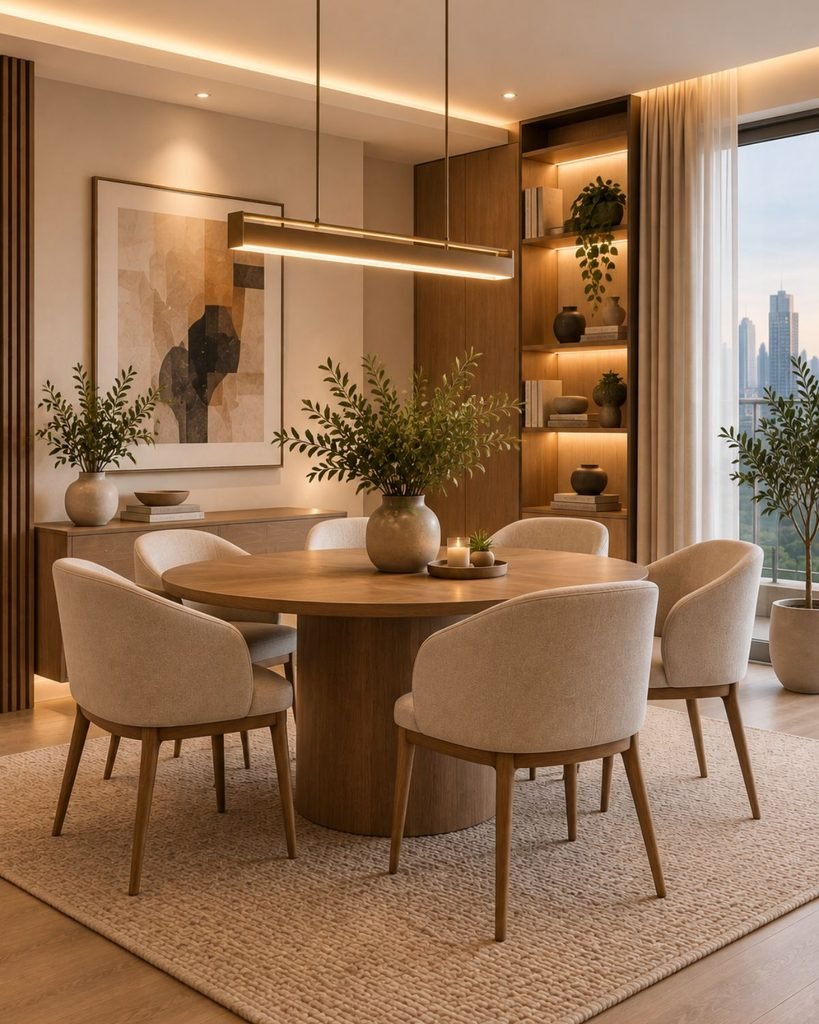
Carry the same materials into the dining area
An open-plan apartment can quickly feel fragmented when the living room, kitchen and dining area are designed as separate projects.
They don’t need to match exactly.
Instead, repeat selected materials.
If the living room uses warm walnut, allow a related wood tone to appear in the dining table. If the kitchen uses restrained brass hardware, a nearby pendant can echo that finish. If oatmeal upholstery dominates the seating area, dining chairs can pick up a related neutral without using identical fabric.
Repetition creates continuity.
This is particularly valuable in apartments where several functional zones are visible simultaneously.
Give the bedroom softness rather than more decoration
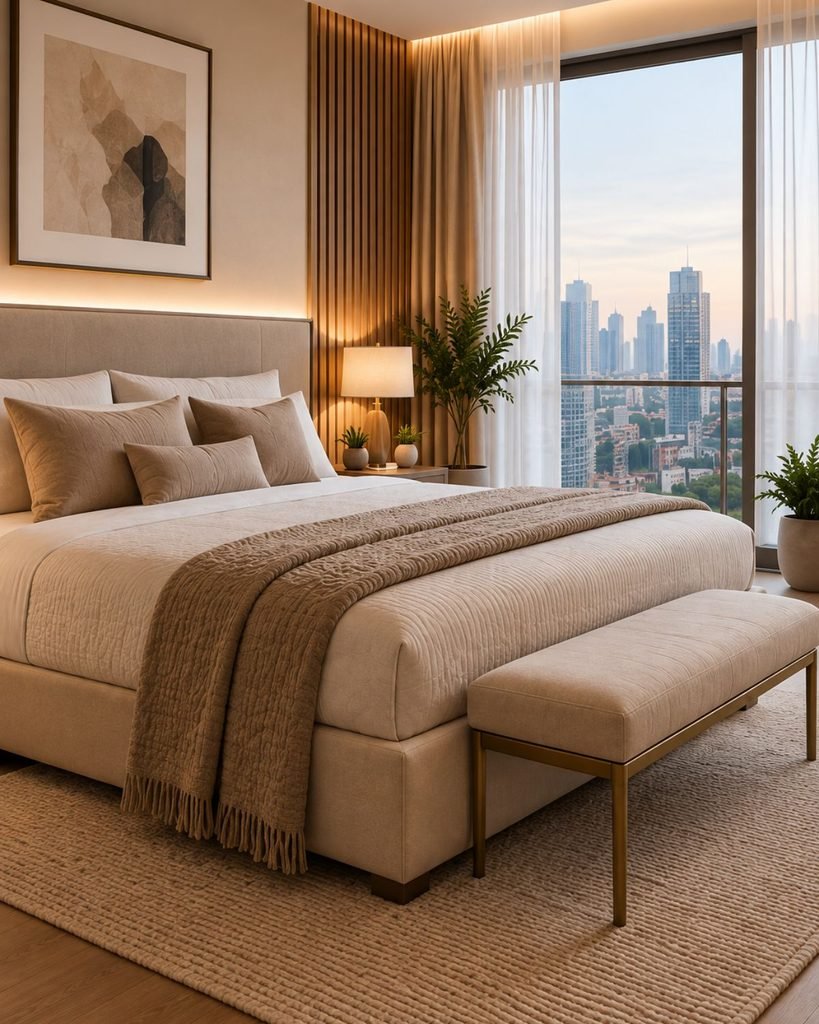
Minimalist bedrooms can easily become too severe because the usual response to clutter is to remove everything.
A better approach is to concentrate visual richness around the bed.
Use layered bedding, a substantial upholstered or timber headboard, a rug large enough to visually ground the bed and warm bedside lighting. Curtains can soften a large wall and improve the room’s sense of enclosure.
Then reduce smaller objects.
The contrast is important: generous textiles, restrained accessories.
A bed with several tactile layers and two carefully chosen bedside lamps usually feels more resolved than a bare bed surrounded by numerous decorative objects.
Treat storage as part of the design
Luxury minimalism depends heavily on what you don’t see.
Everyday life produces cables, chargers, paperwork, toiletries, kitchen equipment, cleaning supplies and dozens of small objects. A photographed minimalist apartment can hide these temporarily; a functional home needs somewhere for them to go.
Closed storage is therefore not separate from the aesthetic. It helps make the aesthetic possible.
Built-in cabinetry is useful where available, but freestanding furniture can accomplish the same objective. Look for media units with concealed storage, bedside tables with drawers, sideboards, beds with integrated storage and wardrobes that use vertical space efficiently.
For compact homes, our broader small space ideas guide covers ways to improve storage without making rooms feel more crowded.
Give the bathroom one strong material story
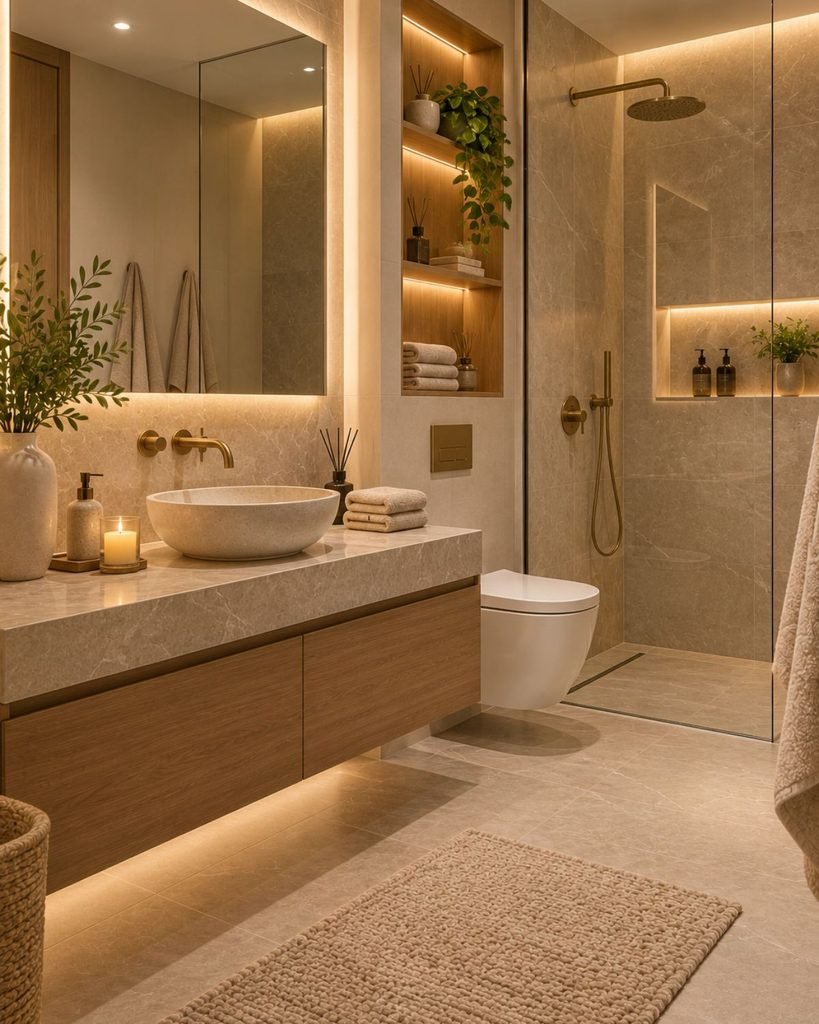
Bathrooms are particularly suited to luxury minimalism because they already contain relatively few furniture elements.
Instead of introducing numerous decorative details, establish one strong material relationship.
That might be warm wood cabinetry against pale stone, a large-format tile with restrained veining, or brushed metal fixtures against a matte neutral wall.
A large mirror can increase reflected light while maintaining visual simplicity. Integrated storage keeps toiletries from becoming the dominant visual element.
Again, luxury comes from resolution rather than quantity.
Don’t forget the entryway
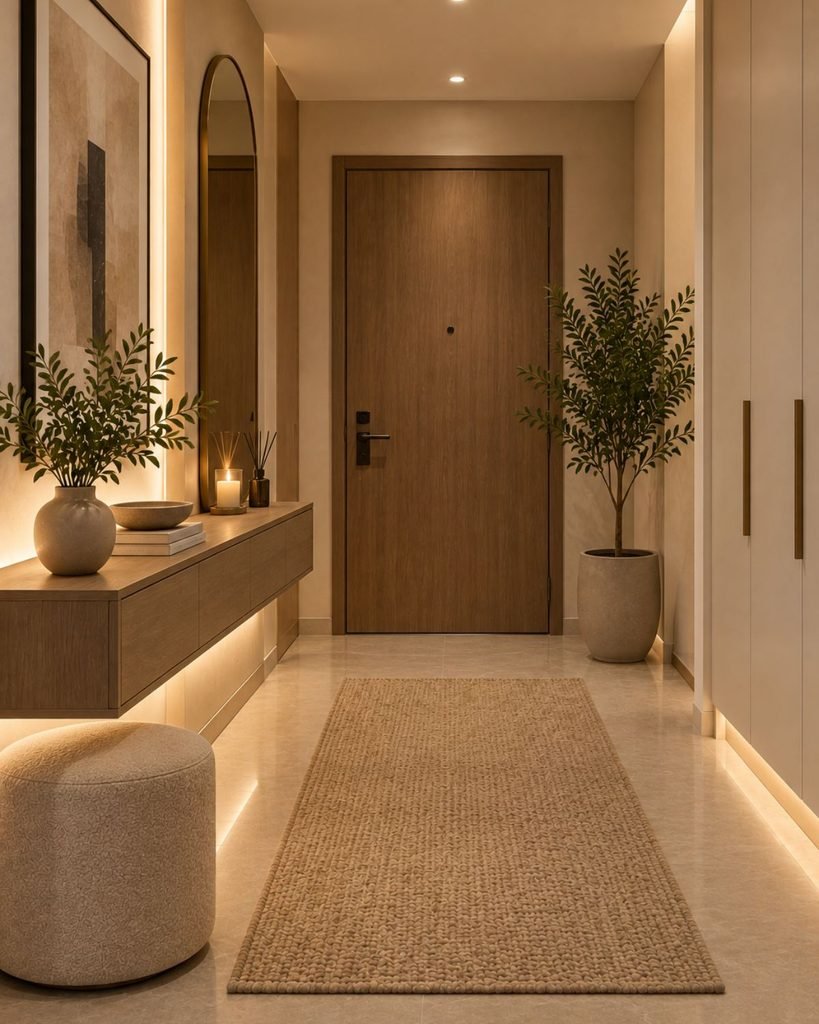
The entry is often small, but it establishes the apartment’s visual language before the main room is visible.
A luxury minimalist entryway may need only a slim console or floating drawer, one mirror or artwork, a concealed place for everyday items and a carefully chosen light.
Avoid turning the console into a display shelf.
A bowl for keys and one sculptural object can be enough when the furniture, wall treatment and lighting already provide visual interest.
Use one statement rather than several competing ones
Minimalism doesn’t mean a room cannot have a focal point.
It means the focal point should have enough breathing room to matter.
A large abstract artwork above a sofa can work. So can a sculptural pendant over a dining table, a beautifully veined stone island or an unusually shaped lounge chair.
Problems begin when all four compete within the same sightline.
Choose where you want attention to land first, then allow surrounding pieces to play quieter roles.
This creates hierarchy—the same reason a well-designed editorial page doesn’t make every line of text a headline.
Make a small luxury apartment feel intentional
A smaller apartment does not need miniature versions of every piece found in a large luxury home.
In fact, that approach often produces clutter.
Instead, decide what the room genuinely needs and give those functions adequate space. A comfortable sofa may deserve more floor area than an additional accent chair. A proper dining table may be more useful than several occasional surfaces.
Use full-height curtains where appropriate, keep sightlines reasonably clear and allow some floor and wall area to remain visible.
Reflective surfaces can help distribute light, but don’t use mirrors merely because the room is small. Their placement should improve either light, view or perceived depth.
The luxury-minimalist objective is not to make the apartment pretend to be larger.
It is to make the available space feel deliberate and resolved.
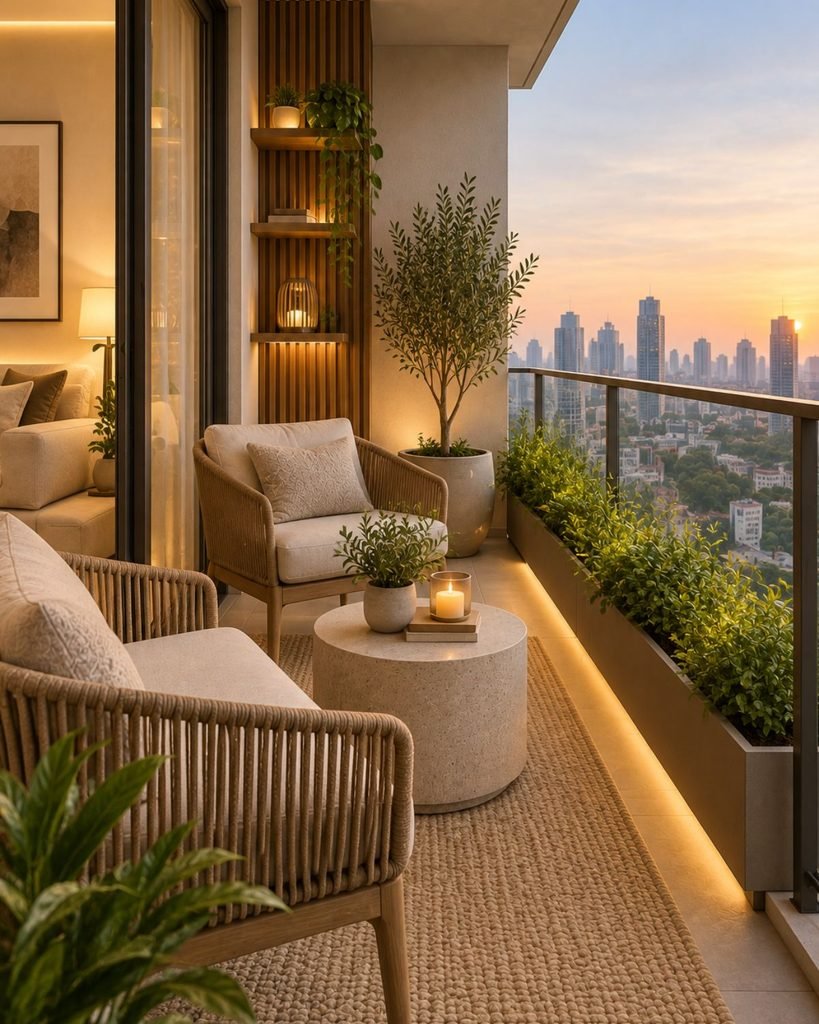
Luxury minimalist balcony
A balcony can follow the same luxury minimalist logic as the interior without becoming another space to fill with décor. Start with one comfortable seating arrangement, then use a limited material palette that connects naturally with the apartment — warm wood, woven upholstery, stone, and restrained metal details work particularly well.
Keep the floor area and sightlines relatively open. One compact table, a few substantial plants, and soft evening lighting can provide enough detail without making a narrow balcony feel crowded. Repeating one or two tones from the living room also helps the indoor and outdoor areas read as a continuous space when the balcony is visible through large windows or sliding doors.
For a more polished result, prioritize scale and material quality over the number of objects. A well-proportioned chair, tactile outdoor rug, architectural planter, and warm light source usually contribute more to the luxury effect than numerous small accessories.
Add warmth with textiles
Hard surfaces are common in modern apartments: glass, plaster, metal, stone, engineered flooring and cabinetry.
Without softer counterpoints, the interior can become acoustically and visually hard.
A textured rug, upholstered seating, full-length curtains and one substantial throw can change that without compromising minimalism.
Choose textiles for contrast rather than quantity.
If the sofa is smooth, introduce a more tactile rug. If the flooring has strong grain, quieter curtains may provide balance. If everything is pale, a slightly deeper taupe, camel or muted brown textile can give the eye somewhere to settle.
This is how a restrained apartment becomes comfortable without becoming decorated for decoration’s sake.
Luxury minimalist apartment mistakes to avoid
The style becomes less convincing when minimalism is interpreted simply as removing things or luxury as adding expensive-looking finishes.
Watch for these recurring problems:
- Making everything the same beige. A limited palette still needs differences in value, texture and material.
- Using too many “luxury” finishes. Marble, brass, fluted wood, mirrored surfaces and dramatic lighting don’t all need to compete in one room.
- Buying undersized furniture. Too many small pieces can create more visual clutter than a few appropriately scaled ones.
- Using integrated lighting everywhere. Highlight architecture selectively instead of outlining every cabinet and ceiling edge.
- Leaving the room under-furnished. Negative space should look intentional, not accidental.
- Displaying too many small accessories. A few larger objects generally create a calmer visual hierarchy.
- Ignoring storage. Minimalism is difficult to maintain when ordinary possessions have nowhere to go.
A simple way to build the look
If you’re starting with an existing apartment rather than an empty shell, don’t replace everything at once.
First identify the largest visual elements you cannot or don’t want to change—usually the floor, walls, cabinetry and major furniture. Build the palette around those.
Then improve the room in this order:
- Correct furniture scale and placement.
- Simplify the core palette.
- Introduce one or two stronger natural materials.
- Improve lighting at multiple heights.
- Add enough textile texture to soften hard surfaces.
- Solve visible storage.
- Remove accessories that don’t contribute to the composition.
Only then decide whether the room actually needs anything else.
That final editing stage is where minimalism becomes useful. Instead of asking, “What should I add?” ask, “What is this room still missing?”
Sometimes the answer is an object. Often it is better light, stronger texture, improved proportion or simply more breathing room.
Where this leaves you
The strongest luxury minimalist apartment ideas don’t depend on filling a home with premium-looking objects. They depend on making fewer decisions more carefully.
Start with proportion. Keep the palette controlled. Allow natural materials to provide variation. Repeat finishes between adjoining spaces. Layer the lighting. Give everyday possessions somewhere to disappear. Then leave enough negative space for the decisions you’ve made to remain visible.
A luxury minimalist apartment should feel calm because it is resolved—not because it is empty.
Luxury minimalist apartment ideas FAQs
How do I make a minimalist apartment look luxurious?
Focus on proportion, material quality, lighting and consistency before adding decoration. A few well-scaled furniture pieces, natural-looking materials, tactile textiles and layered lighting generally create a more refined result than numerous decorative accessories.
What colors work best in a luxury minimalist apartment?
Warm whites, cream, oatmeal, greige, taupe and muted browns create an easy foundation, but luxury minimalism isn’t limited to beige. Dark wood, charcoal, muted green or black can provide contrast while keeping the overall palette restrained.
How do I keep a luxury minimalist apartment from looking boring?
Create variation through texture, material and value rather than continually introducing new colors. Wood grain, stone veining, woven textiles, metal and soft lighting can create depth within a very limited palette.
Can luxury minimalism work in a small apartment?
Yes. It can be particularly effective because fewer, properly scaled pieces reduce visual congestion. Prioritize circulation, concealed storage and furniture that performs a clear function rather than trying to fit every conventional living-room or bedroom piece into the available space.
Does luxury minimalist design have to be expensive?
No. The visual effect depends heavily on proportion, restraint, consistency and lighting, none of which inherently requires luxury-brand furniture. Spend selectively on elements with high visual impact or heavy everyday use, and avoid trying to make every object look expensive.
About the author
Lauren Johnson writes about interior design, home décor, color, and practical room styling for Wallsaide. She focuses on helping readers understand why design choices work and how to recreate beautiful, functional spaces at home.