
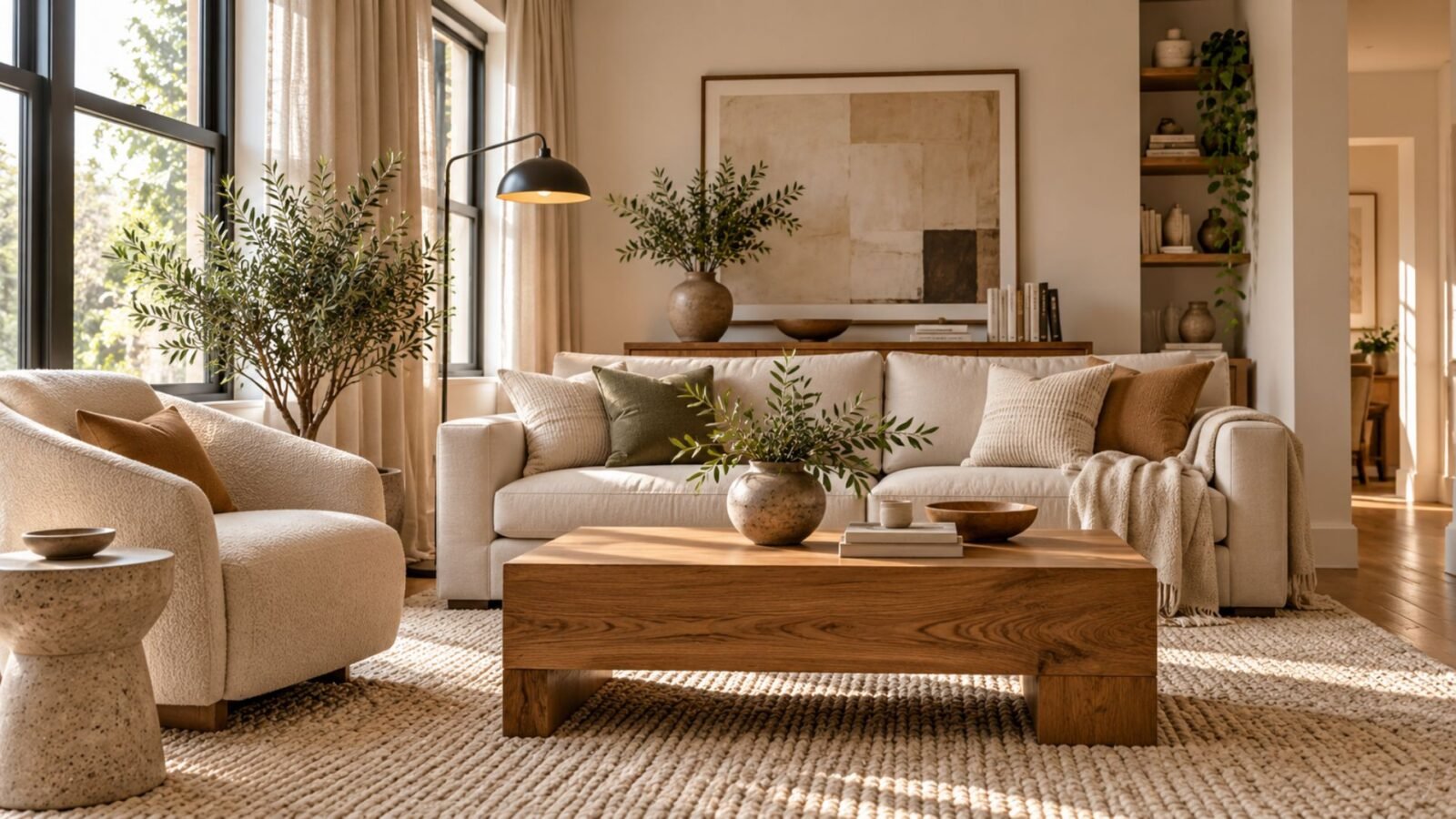

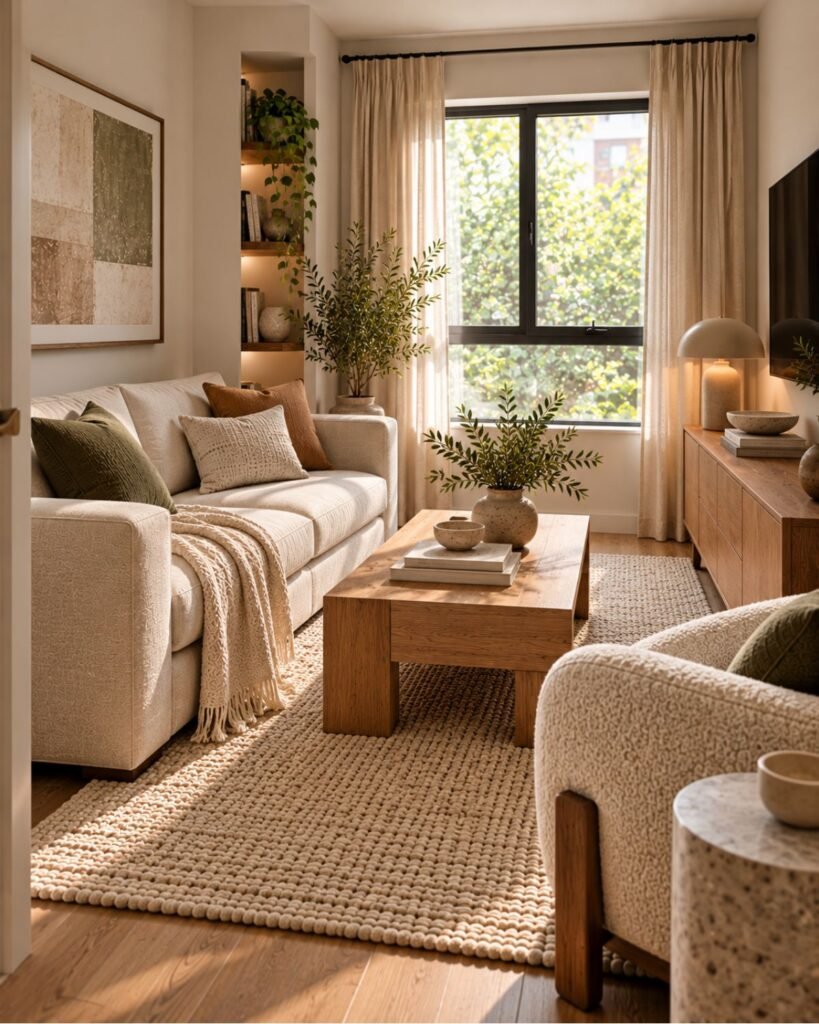
Organic modern works when clean contemporary forms provide structure and natural materials provide variation, warmth, and texture.
An organic modern living room isn’t simply a beige room filled with wood and plants. Its character comes from contrast: relatively clean, restrained furniture and architecture on one side, then wood grain, stone variation, woven textiles, matte ceramics, and softer forms on the other.
If everything becomes smooth and precise, the room reads as conventional modern. If every surface becomes raw, distressed, woven, or irregular, it starts moving toward rustic territory. The useful design decision is how to hold those two sides together.
What actually makes a living room Organic Modern?
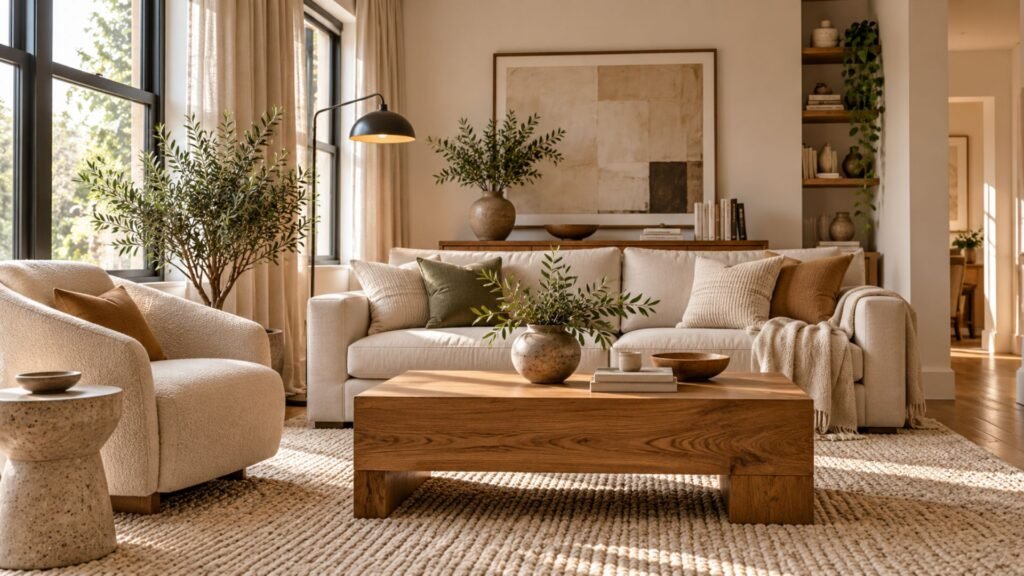
Organic Modern is a loose contemporary design label rather than a tightly standardized historical style. Current design coverage consistently describes it as combining modern or minimalist restraint with natural materials, tactile surfaces, organic shapes, and warmer, nature-referencing colors.
That distinction matters because the furniture does not have to look rustic. A clean rectangular sofa can sit beside visibly grained wood; a precise black lamp can stand over an irregular stone table; a simple wall can provide quiet space around a heavily textured wool rug.
The modern side gives the room structure. The organic side prevents that structure from becoming visually hard or sterile.
That relationship is more useful than trying to assemble a checklist of required objects.
Organic Modern vs. modern, minimalist, and Japandi
These styles overlap, which is why photographs alone can make the boundaries look less clear than they really are.
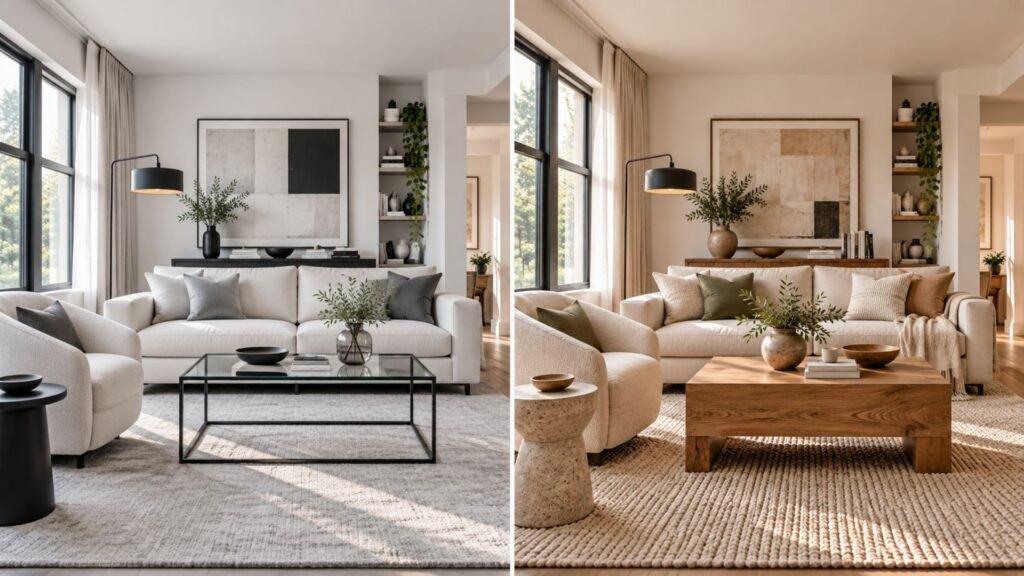
Modern design can use wood and other natural materials, but it does not depend on tactile natural variation to establish its identity. Organic Modern deliberately makes that variation more prominent while retaining contemporary restraint.
Minimalism is principally concerned with reduction and restraint. An Organic Modern room can be minimalist, but it doesn’t have to be extremely sparse. The important relationship here is between controlled modern form and natural material character, not simply owning fewer things.
Japandi overlaps substantially in its use of wood, natural textiles, simple forms, and restraint. Its distinction is its explicit synthesis of Japanese and Scandinavian design influences. Organic Modern is a broader contemporary label and doesn’t require that cultural or design lineage.
For general contemporary styling rather than this material relationship, our modern living room guide covers the broader problem in more depth.
Start with structure, then introduce variation
A useful way to build the room is to let the largest forms remain relatively quiet.
That might mean a straightforward sofa silhouette, uncomplicated curtains, a simple media unit, and walls without excessive architectural decoration. Against that controlled foundation, material variation becomes easier to see.
Wood grain, veining in stone, irregular ceramic surfaces, wool, linen, leather, jute, and woven fibers don’t need to appear simultaneously. Two or three convincing materials can establish the organic side more clearly than filling the room with every natural-looking texture available.
This is also where restraint protects the style from turning rustic. A heavily grained table can be the irregular element precisely because the sofa, lighting, and surrounding architecture remain simpler.
The materials that do the real work
Wood provides visible variation
Wood is especially useful because its grain prevents a large furniture surface from reading as completely uniform. A simple oak coffee table can therefore introduce organic variation without requiring an elaborate shape.
The finish matters visually. Highly distressed wood pushes harder toward rustic character, while cleaner joinery and simpler silhouettes preserve the modern side even when the grain remains obvious.
Stone adds variation without softness
Stone performs a different job. It can introduce irregular veining, tonal shifts, or a tactile matte surface while still reading as visually substantial.
That makes it useful when the room already contains plenty of soft textile. A stone side table beside a linen sofa gives the scheme another natural material without simply adding another woven texture.
Linen and wool soften precise furniture
Natural-looking woven textiles break up large upholstered surfaces through their visible texture. Linen curtains, wool rugs, and tactile upholstery can make a geometrically simple piece feel less severe without changing its basic form.
The point isn’t that every textile must be natural fiber. The visual principle is that some surfaces should have enough weave, nap, or irregularity to prevent the room from becoming uniformly smooth.
Ceramic and handmade objects add controlled irregularity
A handmade-looking vessel or lamp can introduce asymmetry at a much smaller scale than a sofa or table.
This is useful because Organic Modern doesn’t require every major furniture piece to curve or become sculptural. Often one irregular object is more effective against a restrained background than several competing statement pieces.
You can mix wood tones without matching everything
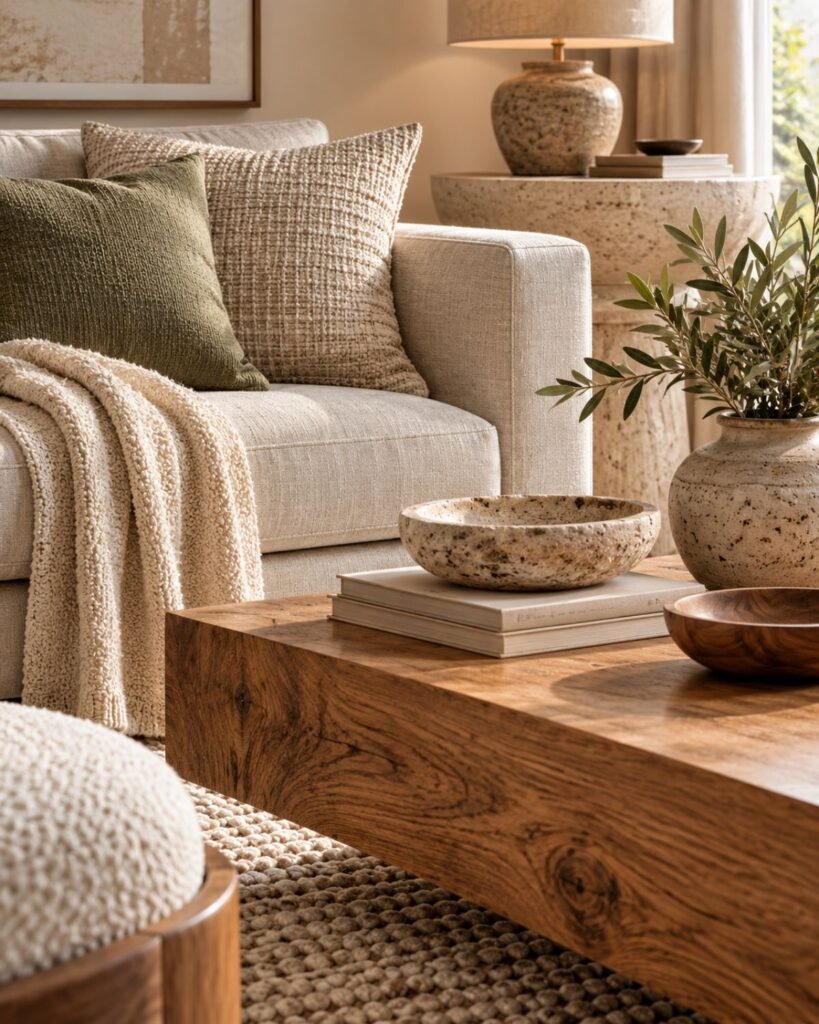
Organic Modern doesn’t require every wooden surface to match. In fact, exact matching can make a room feel more like a furniture set than a collection of materials.
The safer approach is to repeat enough visual information for the woods to relate. A pale oak floor and oak coffee table can establish one dominant family, while a darker walnut chair or cabinet becomes deliberate contrast rather than an accidental mismatch.
What usually causes trouble isn’t the presence of two wood tones. It’s several unrelated woods of similar visual importance competing across the floor, storage, tables, chairs, and decorative objects.
Keep one wood family visually dominant, then let a second appear selectively.
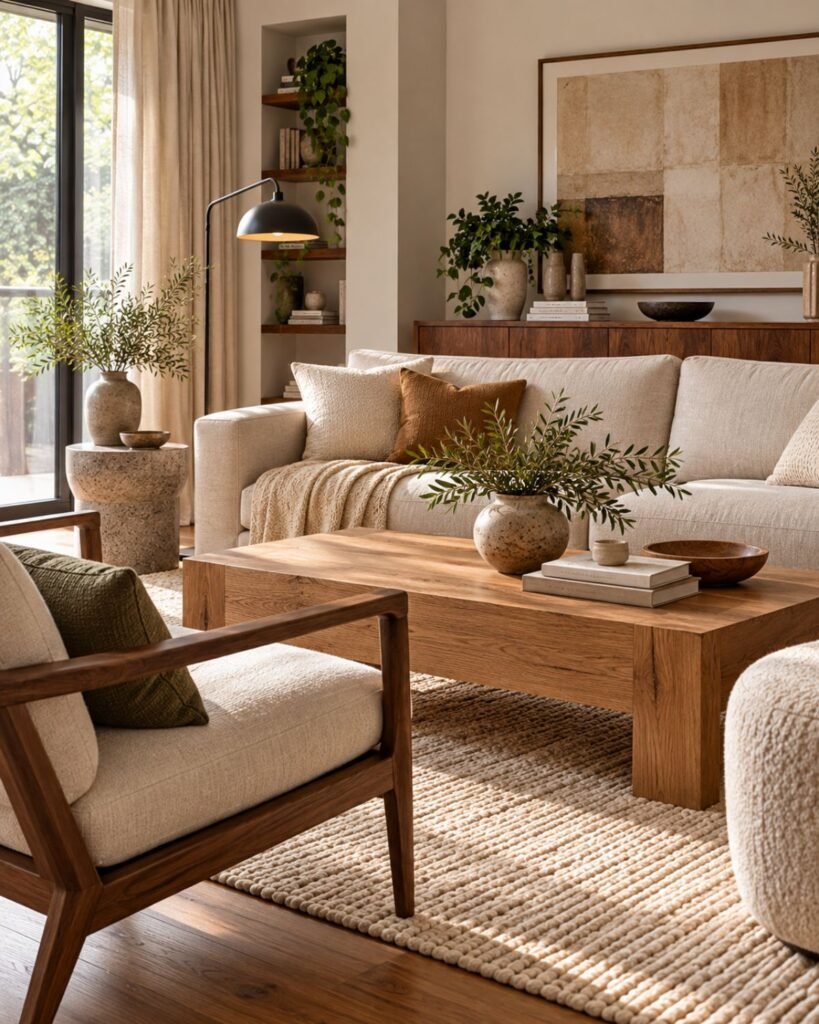
Does Organic Modern have to be beige?
No. Beige, cream, taupe, warm white, and brown appear frequently because they allow natural material variation to remain prominent, but the style isn’t dependent on an all-beige palette.
Muted olive, earthy green, terracotta, charcoal, dusty blue, and deeper brown can all coexist with the same material logic. Current designer guidance on modern-organic color schemes extends beyond neutrals into muted greens, earthy ruddy tones, blue, warm browns, and soft grays.
The key is not eliminating color. It’s keeping color from competing with every material simultaneously.
If a muted olive chair becomes the strongest color in the room, the surrounding wood, stone, linen, and quieter walls can continue doing their respective jobs without the scheme losing its restraint.
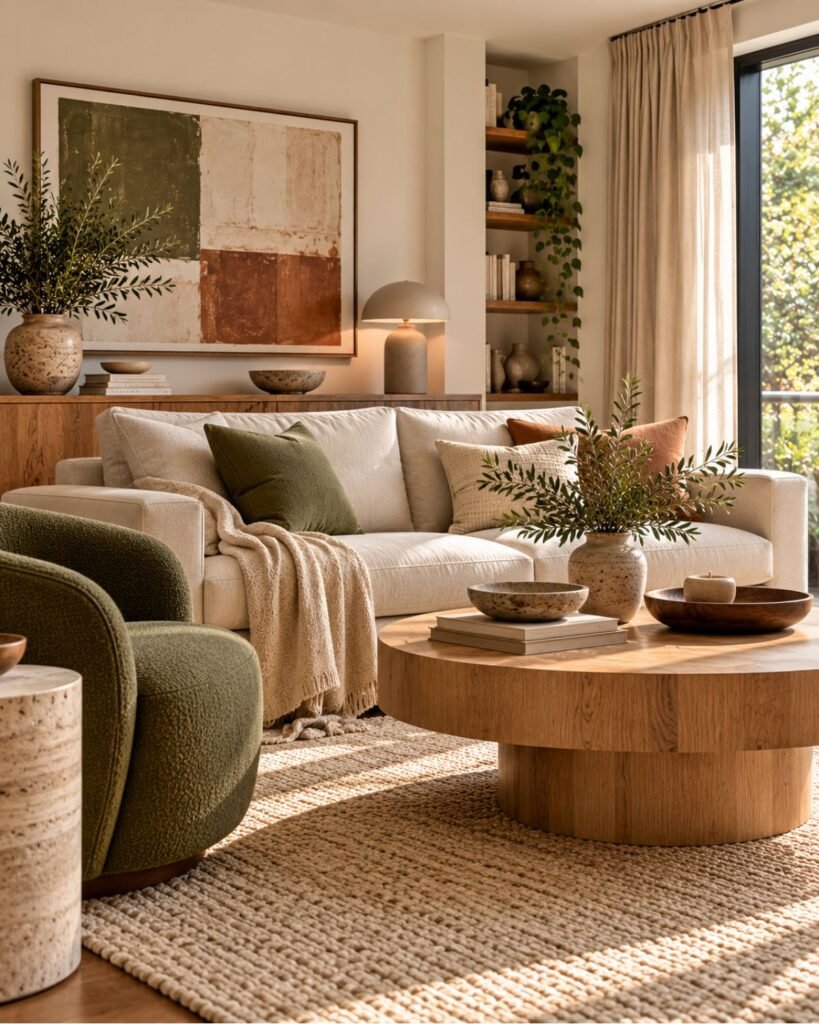
Four Organic Modern directions to build from
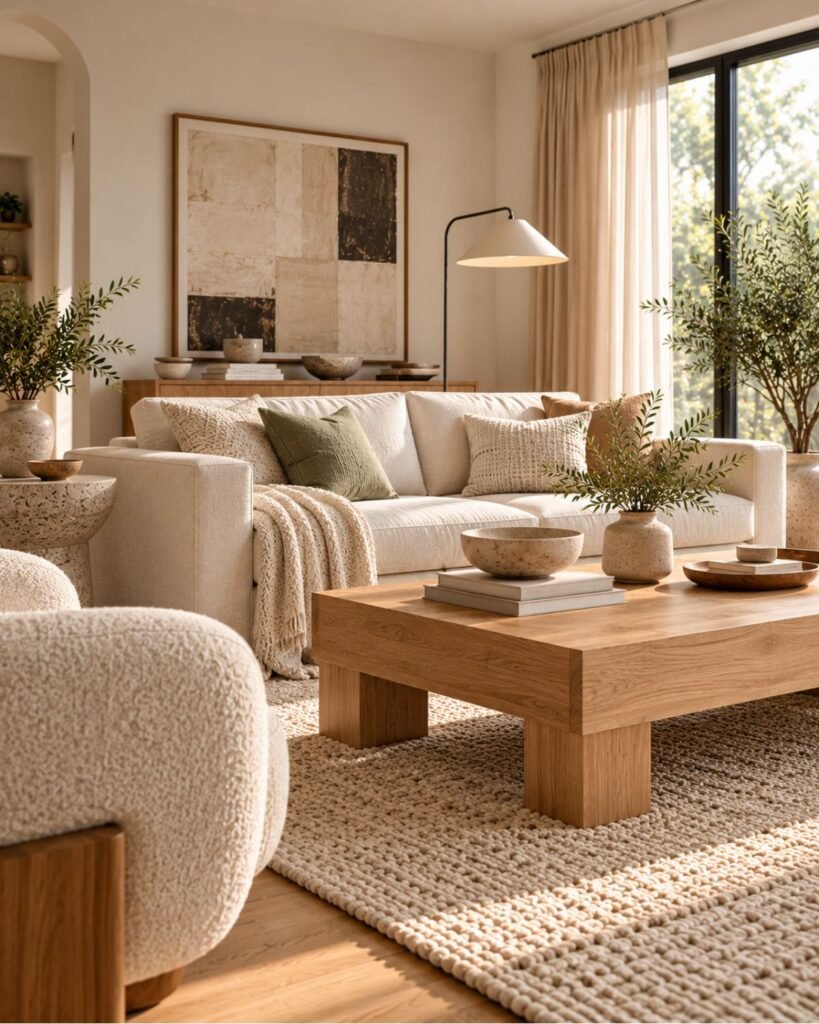
Light: warm white, pale oak, and wool
This is the lightest interpretation, but it shouldn’t become a blank pale room. Pale oak provides visible grain while wool and linen separate surfaces that might otherwise collapse into the same warm-white value.
Keep the furniture silhouettes clean and introduce only a small amount of irregularity through ceramics, stone, or one softly curved piece.
What can go wrong: when walls, sofa, rug, curtains, and accessories all sit at almost the same pale value, natural materials alone may not provide enough separation.
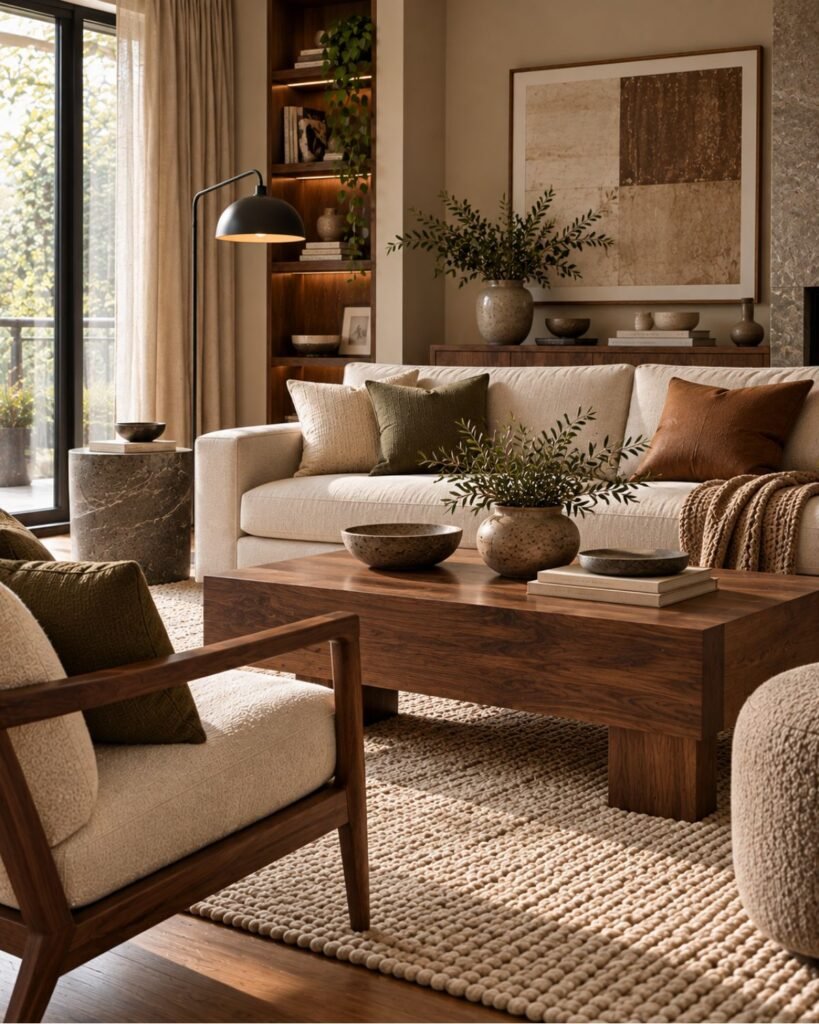
Grounded: walnut, stone, and cream
Organic Modern can move considerably darker without losing its identity.
Walnut gives the room more visual weight than pale oak, while cream upholstery prevents the scheme from becoming uniformly dark. Stone adds another natural material without requiring additional brown wood.
The modern side should become even clearer here: simple furniture profiles and restrained decoration prevent darker wood from pulling the room toward traditional or rustic styling.
What can go wrong: dark wood across the floor, walls, tables, storage, and seating frames can overwhelm the cleaner modern structure.
Earthy: terracotta, oak, and linen
A controlled earthy color can make Organic Modern feel less formulaic.
Use terracotta as a contained element, such as one chair, cushion group, or artwork, rather than automatically spreading it across every wall and textile. Oak and linen keep the natural-material language intact while cleaner furniture shapes maintain the contemporary structure.
What can go wrong: stacking terracotta with orange wood, tan leather, rust textiles, and warm brown walls can collapse the scheme into one undifferentiated warm palette.
For deeper terracotta decisions, our terracotta living room guide covers how to reinforce or interrupt that warmth.
Compact: fewer materials, not miniature style
A small room doesn’t need a diluted version of Organic Modern. It needs fewer competing material statements.
One visibly grained wood, one substantial textile texture, and one stone or ceramic accent may be enough. Keep the larger furniture relatively simple so the material changes remain readable rather than busy.
Generic furniture scale and circulation still belong to our small living room guide; the Organic Modern decision here is simply how much material variation a compact room can carry at once.
Why Organic Modern living rooms go wrong
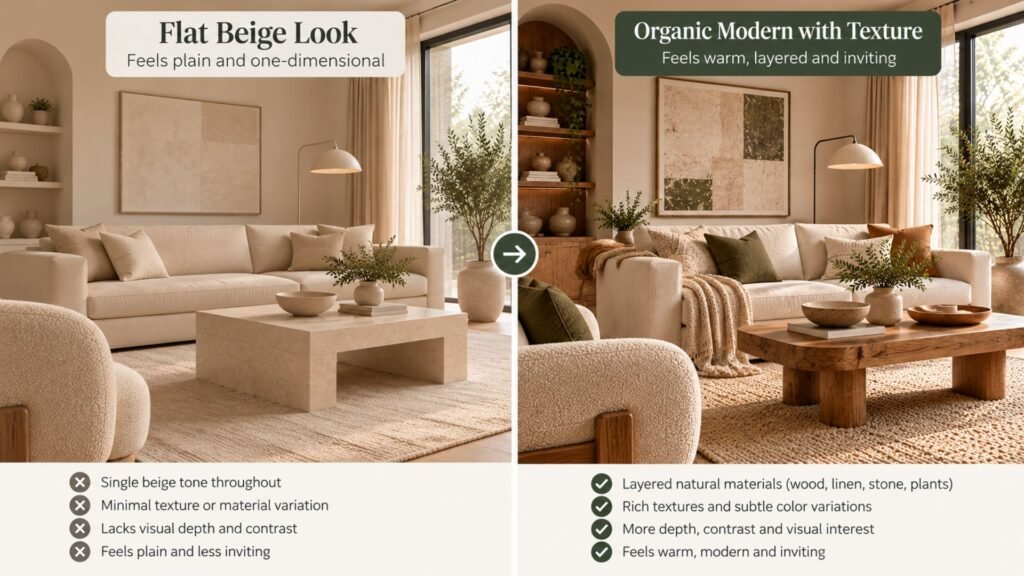
Too beige
The problem isn’t beige itself. It’s several large surfaces sharing almost identical color, value, and texture.
If the walls, sofa, rug, curtains, and stone all merge into one pale field, the natural-material story becomes difficult to see. Introduce value difference, stronger grain, darker contrast, or a restrained color rather than simply adding another beige object.
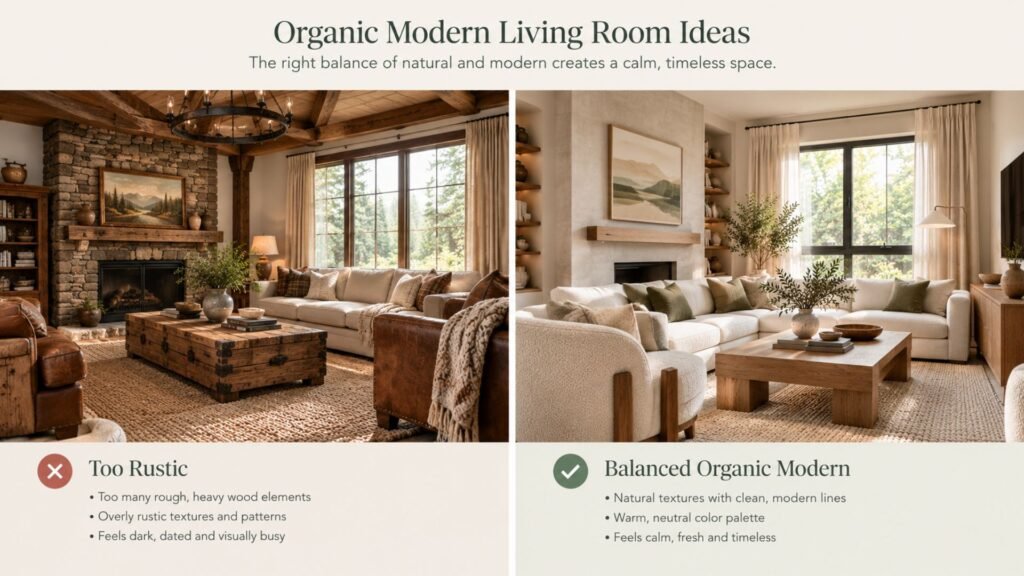
Too rustic
Raw wood is not automatically more organic.
Heavily distressed timber, live edges, woven baskets, rough stone, exposed beams, and rustic ceramics can each work individually. Stack all of them together and the room’s clean modern structure starts disappearing.
Let one or two materials carry obvious irregularity while surrounding forms remain quieter.
Too polished
The opposite failure happens when everything becomes smooth: polished table, smooth upholstery, glass, glossy cabinetry, precise metalwork, and little visible material variation.
The room may still be attractive, but the organic component has largely disappeared. One substantial natural surface can often correct this more effectively than several small decorative accessories.
Too many curves
Curves appear frequently in current Organic Modern interiors, but a curved sofa, blob-shaped table, arched cabinet, round rug, sculptural chair, and irregular mirror all competing together can turn a useful contrast into a theme.
A curved piece works best when there’s something straighter nearby for it to contrast against.
Too many “natural” accessories
Plants, baskets, branches, ceramics, wood bowls, stone objects, and woven accessories don’t compensate for furniture and surfaces that lack a coherent material relationship.
Start with the room’s major surfaces. Accessories should reinforce the design, not manufacture it afterward.
How to recreate Organic Modern without replacing everything
Don’t begin by replacing the sofa because it isn’t curved enough.
First identify the largest surfaces already working in your favor. A simple contemporary sofa may already provide exactly the modern structure the room needs. A wood floor may already provide substantial organic variation.
Then identify what’s missing.
If the room feels too polished, replace or add one meaningful material surface: a wool rug, visibly grained wood table, linen curtain, stone side table, or tactile upholstery.
If it already feels rustic, don’t add more texture. Introduce something cleaner: a simpler lamp, less distressed table, quieter curtain, or more restrained accessory arrangement.
If it feels flat, examine value and material before adding more décor.
This approach is more useful than buying a coordinated collection marketed as “Organic Modern.” The style depends on relationships between objects, not on a product label.
Are plants necessary?
No.
Plants can reinforce the connection with nature and appear frequently in Organic Modern rooms, but the style can be established through wood, stone, linen, wool, ceramic, natural light, and organic form without a single houseplant.
That distinction matters because otherwise “organic” becomes literal rather than structural. A plant cannot rescue a room whose furniture, surfaces, and material relationships tell a completely different story.
Use greenery because it works for the room and its available light, not because the style supposedly requires a fiddle-leaf fig.
Where this leaves you
Start with the relationship rather than the shopping list.
Keep enough of the room clean-lined and restrained that its modern structure remains obvious. Then introduce natural variation through a limited number of substantial materials: visible wood grain, stone, woven textile, ceramic, or another tactile surface.
You don’t need an entirely beige palette. You don’t need every piece to curve. You don’t need matching wood, and you don’t need plants.
If the room becomes too polished, strengthen the material variation. If it becomes too rustic, simplify the forms. Organic Modern works in the space between those two outcomes.
Organic Modern living room FAQ
What is an Organic Modern living room?
An Organic Modern living room combines relatively clean, restrained contemporary forms with natural materials, tactile texture, and some softer or irregular elements. The exact definition varies across the design industry, so it is more useful to treat it as a contemporary design direction than a rigid historical style.
What colors work in an Organic Modern living room?
Warm white, cream, beige, taupe, brown, and other neutrals are common, but they aren’t mandatory. Muted olive, earthy green, terracotta, charcoal, dusty blue, and other restrained colors can work when the overall material palette remains controlled.
What’s the difference between Organic Modern and Japandi?
They overlap in their use of natural materials, simple forms, and restrained palettes. Japandi specifically draws on Japanese and Scandinavian design influences, while Organic Modern is a broader contemporary approach combining modern restraint with natural material and organic variation.
Does Organic Modern have to be beige?
No. Beige is common because it creates a quiet backdrop for wood, stone, and textile variation, but Organic Modern can include controlled earthy or muted color without losing its character.
Can you use dark wood in Organic Modern design?
Yes. Walnut and other darker woods can create a more grounded interpretation. Keep surrounding furniture relatively simple and use lighter surfaces where necessary so dark wood doesn’t overwhelm the room.
Can you mix wood tones in an Organic Modern living room?
Yes. Exact matching isn’t required. It is usually easier to make the combination feel intentional when one wood family remains dominant and a second tone appears selectively as contrast.
Are plants necessary for Organic Modern design?
No. Plants can support the nature connection, but wood, stone, tactile textiles, ceramics, and organic forms can establish the design language without greenery.
References
- Homes & Gardens. “7 Organic Modern Living Room Ideas That Balance Comfort and Style.”
https://www.homesandgardens.com/interior-design/organic-modern-living-room-ideas - Homes & Gardens. “Is Modern Organic Still on Trend? We Ask Designers. https://www.homesandgardens.com/interior-design/is-modern-organic-still-on-trend
- Livingetc. “Japandi Style in Interior Design Explained.” https://www.livingetc.com/features/japandi-style
About the author
Emma Carter writes about interior color, home décor, and practical styling for Wallsaide. She focuses on helping readers combine colors, materials, textiles, and decorative elements into rooms that feel balanced and cohesive.