
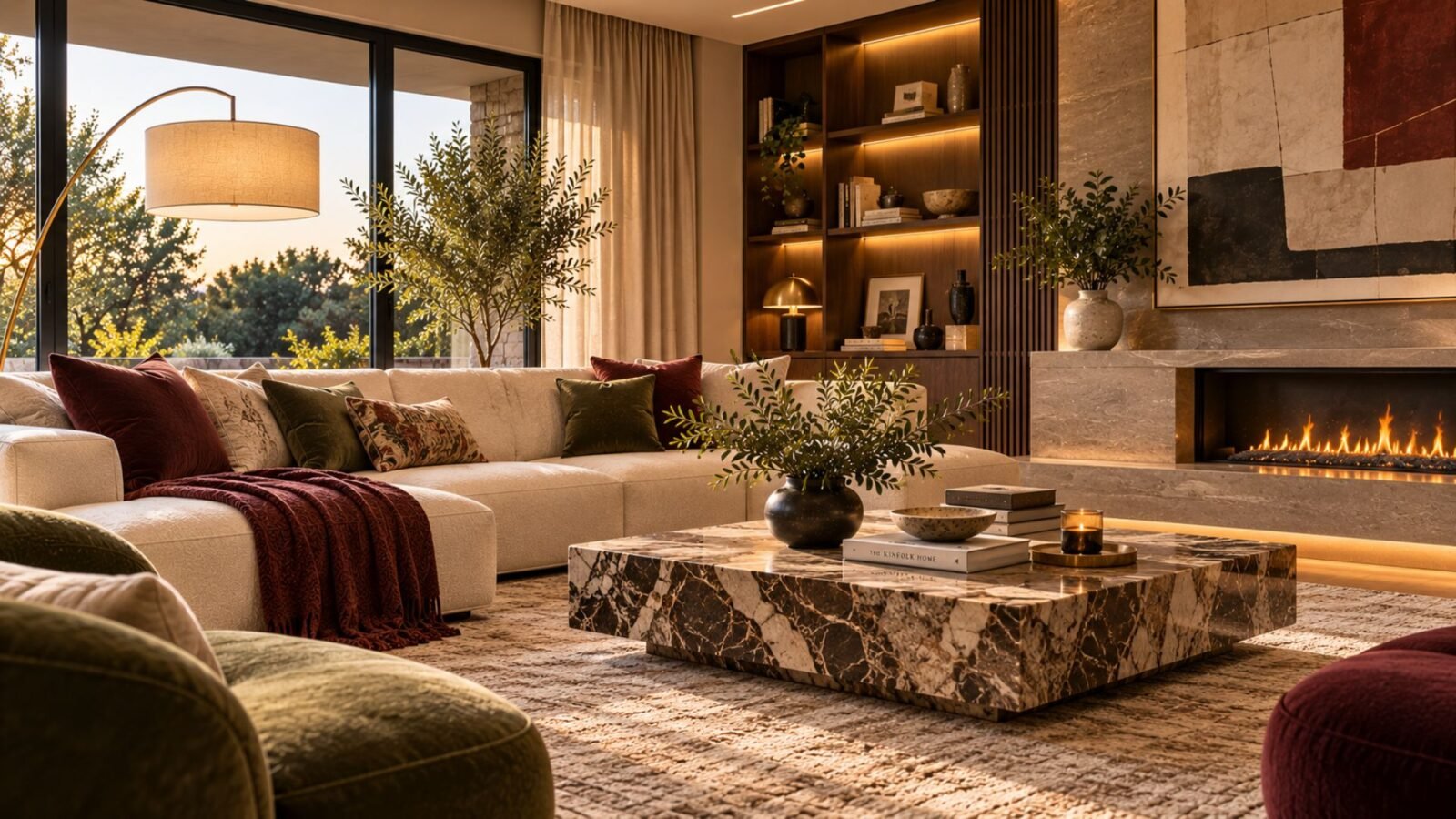

The strongest luxury living rooms don’t make every surface look expensive. They concentrate attention on proportion, materials, lighting and a few decisions that make the whole room feel considered.
The best luxury living room ideas are not really about adding more signs of luxury. Marble, velvet, brass, statement lighting and designer furniture can all be beautiful, but putting them together does not automatically produce a sophisticated room.
A convincing luxury living room usually feels resolved before it feels expensive. Furniture fits the architecture. Materials have enough presence to matter. Lighting gives the room depth. Window treatments look intentional. Decorative objects support the composition instead of competing with it.
That creates a more useful goal: don’t make everything special. Decide what deserves to be special.
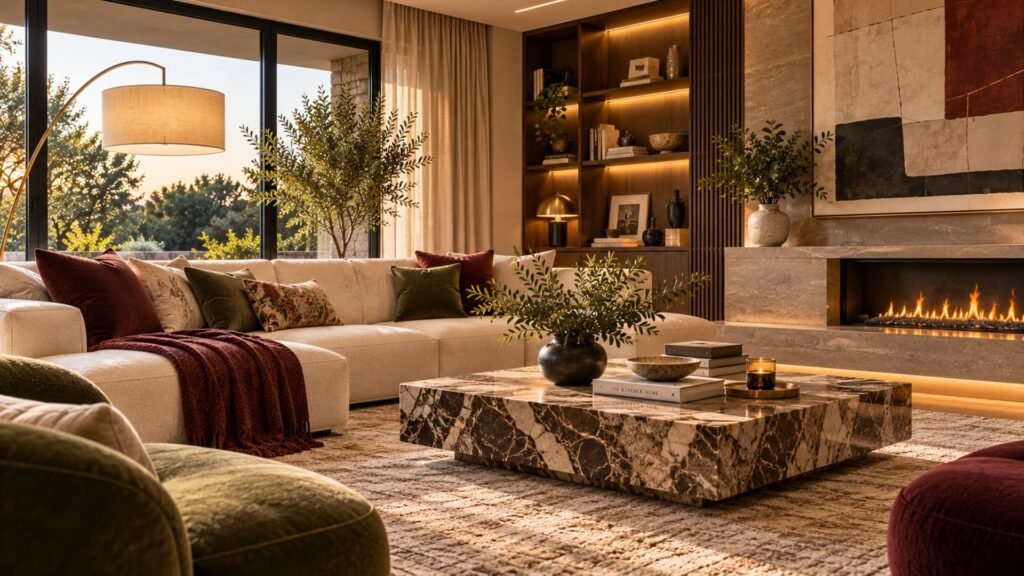
What actually makes a living room feel luxurious?
A luxurious living room feels considered at several scales at once.
From across the room, you notice proportion, layout and the relationship between major furniture pieces. Move closer and upholstery, joinery, stone, timber, metalwork and textiles begin to matter. At night, lighting changes which surfaces and architectural features receive attention.
This is why price alone is unreliable.
An expensive sofa can still look wrong if it is too small for the wall behind it. A beautiful stone table can disappear on an undersized rug. An elaborate chandelier cannot compensate for flat lighting throughout the rest of the room.
Scale and proportion are fundamental to balanced rooms, as designers have also emphasized in Architectural Digest’s guidance on mastering scale and proportion.
So before shopping for “luxury” pieces, solve the relationships between the pieces you already need.
Fix proportion before buying more decoration
One of the most useful luxury living room ideas costs nothing at the beginning: evaluate scale before adding anything.
Look at the sofa relative to the wall. Look at the coffee table relative to the seating. Check whether the rug visually connects the furniture or floats underneath the table like an island. Then consider lamps, artwork and other large elements relative to the architecture around them.
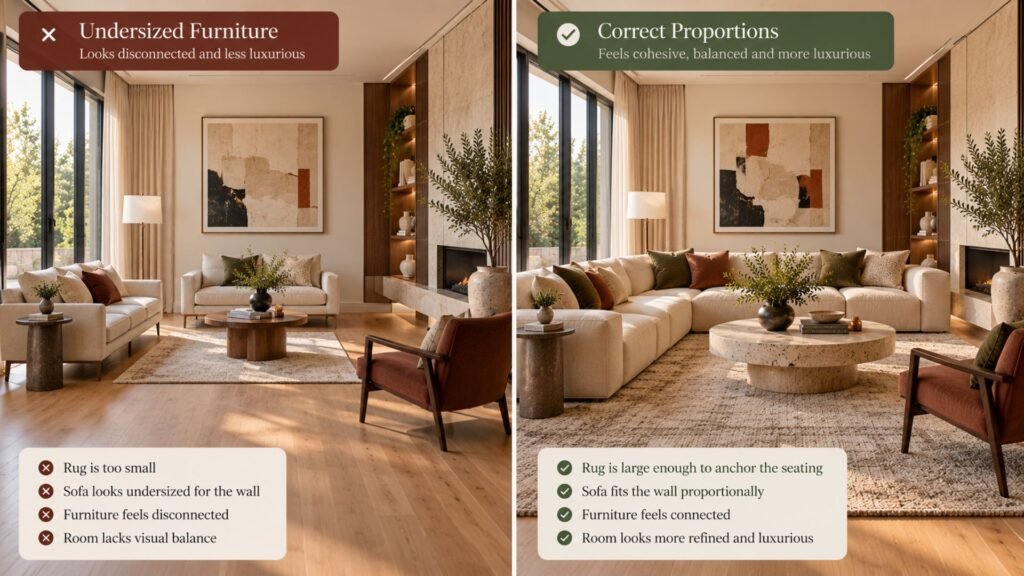
Large rooms are particularly unforgiving of undersized furniture. Several small pieces scattered across a generous floor plan can make the architecture feel unresolved even when each piece is expensive.
Small rooms have the opposite danger. Overscaling everything can destroy circulation.
The answer isn’t “buy bigger.” It is to make furniture feel proportionate to both the room and the pieces beside it.
This distinction is important enough that detailed compact-room planning belongs in our small living room ideas guide rather than being reduced to a luxury styling trick.
Choose where the luxury belongs
Imagine two rooms with the same decorating budget.
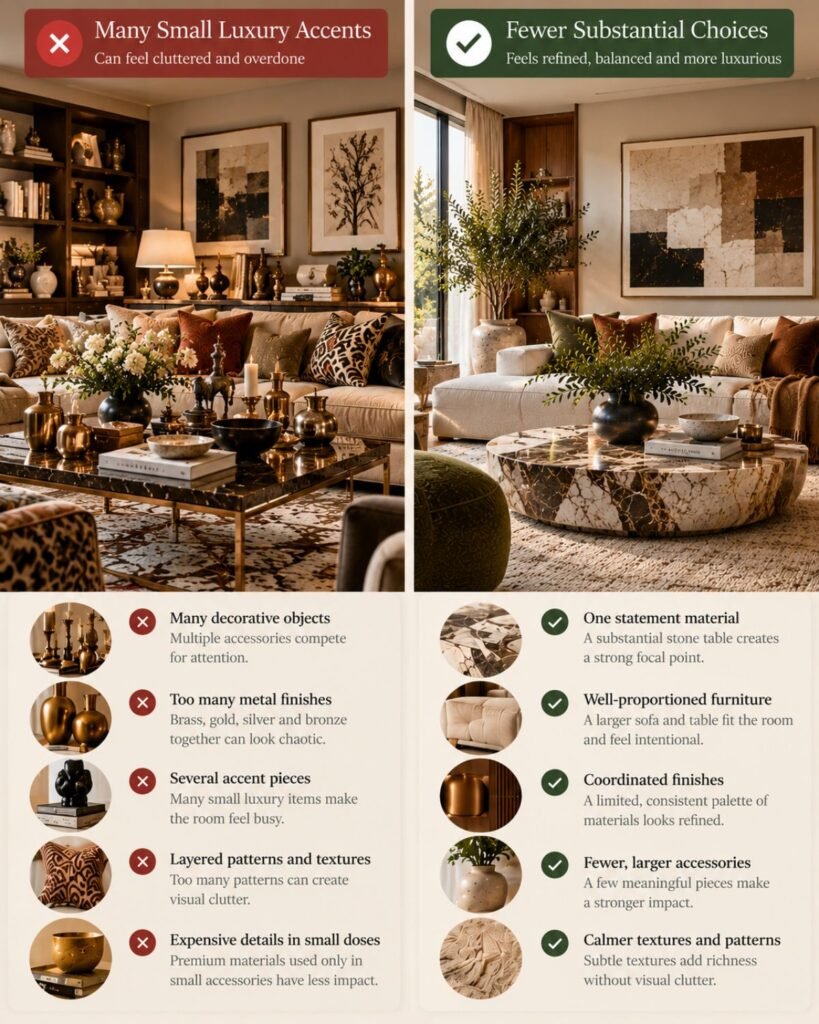
The first spreads that money across a marble tray, metallic accessories, decorative cushions, sculptural ornaments, designer-look lamps and numerous smaller upgrades.
The second concentrates more of the budget into a well-proportioned sofa, substantial curtains and one visually important material or object.
The second approach can create a stronger room because the investment appears at the scale at which you actually experience the space.
That doesn’t mean everyone should spend heavily on a sofa or curtains. Your priorities depend on what the room already has and how you use it.
The better question is:
Where will improved proportion, material, construction or finish be most visible in this particular room?
If you already own an excellent sofa but have thin curtains and weak lighting, another expensive chair may accomplish very little.
If your architecture is strong but the furniture feels temporary, furnishings may deserve the investment instead.
Luxury becomes more convincing when spending follows the room’s weaknesses rather than a generic shopping list.
Let one strong material have enough presence
Stone, timber, metal, glass, lacquer and richly woven textiles can all contribute to a luxury living room design.
The mistake is assuming you need all of them.
A substantial stone fireplace or coffee table has enough visual presence to establish a material story. It doesn’t necessarily need marble trays, stone lamps, metallic ornaments and several other “luxury” finishes surrounding it.
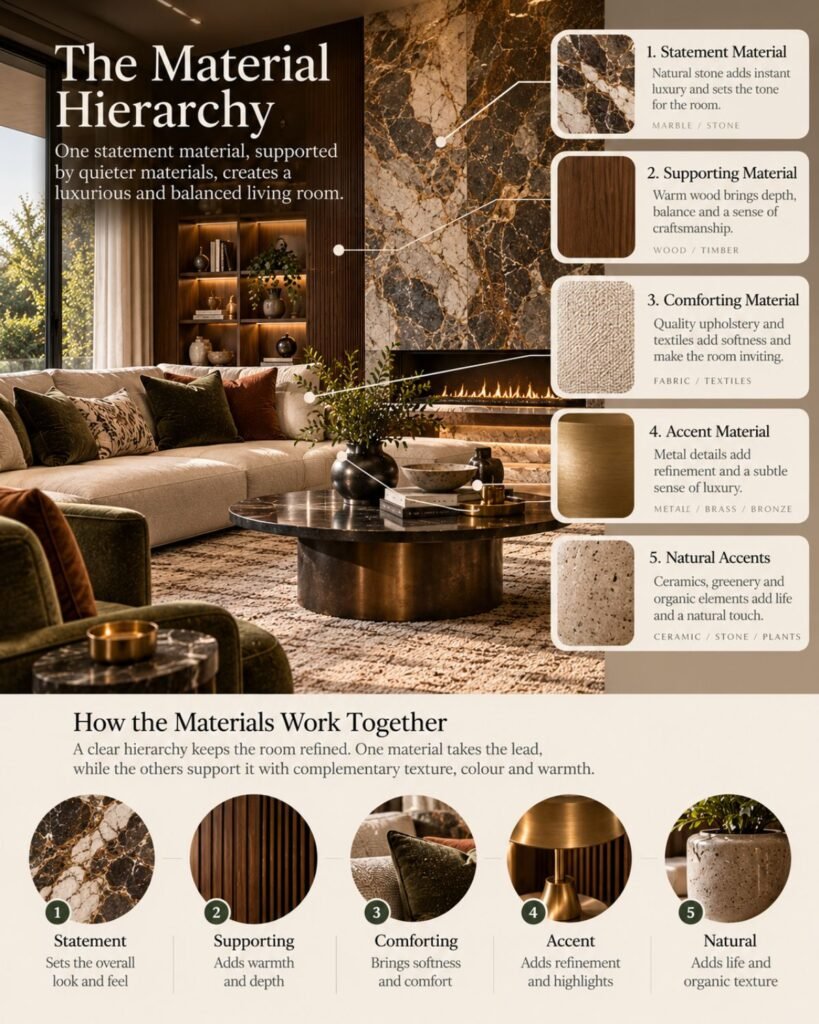
Think in terms of a material hierarchy.
One material can lead. A few can support it. Others can remain almost invisible.
This approach also makes affordable substitutions easier. If the dominant feature is convincing, every secondary object doesn’t need to announce its price.
Current luxury interiors demonstrate how varied that dominant material can be. It might be colored stone in one room, dark walnut in another, lacquered joinery in another, or beautifully handled textile rather than a hard surface at all.
Luxury does not have a mandatory material palette.
Expensive and well designed are not the same thing
This distinction protects the entire room.
An expensive object has a price. A well-designed composition gives that object a reason to be where it is.
A handmade chair may be exceptional, but placing it beside an equally assertive sofa, sculptural table, dramatic lamp, patterned rug and oversized artwork forces six strong decisions to compete.
This is where some luxury rooms become overdone.
The solution is not necessarily minimalism. Our minimalist living room ideas guide deliberately focuses on visual editing and reducing competition. A luxury room can be considerably more layered, colorful and decorative.
It still needs hierarchy.
If the rug is extraordinary, the coffee table may be quieter. If the fireplace is architectural, the wall above it may need less intervention. If a sofa has an unusual silhouette, the chairs beside it don’t both need to make another statement.
Luxury can tolerate richness. It struggles with indecision.
Make lighting part of the architecture of the room
A chandelier can be spectacular. It is not a lighting plan.
A sophisticated living room usually benefits from several types of light performing different jobs. General illumination lets you use the room. Task lighting supports reading or other activities. Accent and decorative lighting can draw attention toward artwork, joinery, material texture or architectural features.
Livingetc similarly recommends layering living room lighting rather than relying on one expensive central fixture.
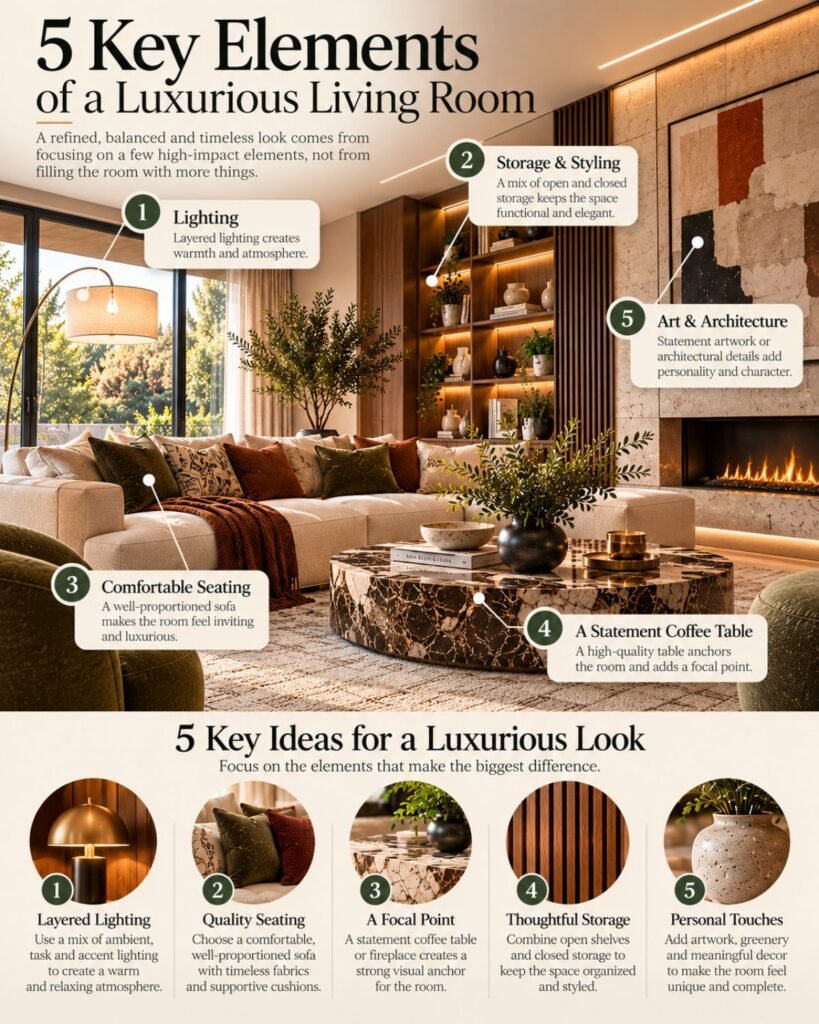
This becomes particularly important after dark.
A beautifully textured wall can disappear under flat illumination. Timber may lose depth. Artwork can become visually detached from the room. Corners can turn into dark voids while one bright ceiling fixture dominates everything.
Think about what you are lighting, not merely which fixture you are buying.
A floor lamp beside a chair can create intimacy. A picture light can establish an artwork as a focal point. Integrated shelf lighting can reveal depth within joinery. A table lamp can make a secondary corner participate in the composition.
Recent Livingetc coverage has taken this even further by examining the effect of lighting the edges of a room rather than concentrating all illumination in its center.
The broader lesson is useful: distribute attention through light instead of expecting one fixture to carry the room.
Treat curtains as part of the room, not an afterthought
Window treatments occupy a surprisingly large visual area.
When curtains are open, they still frame the architecture. When closed, they can become one of the largest uninterrupted textile surfaces in the living room.
That makes them more important than another handful of decorative accessories.
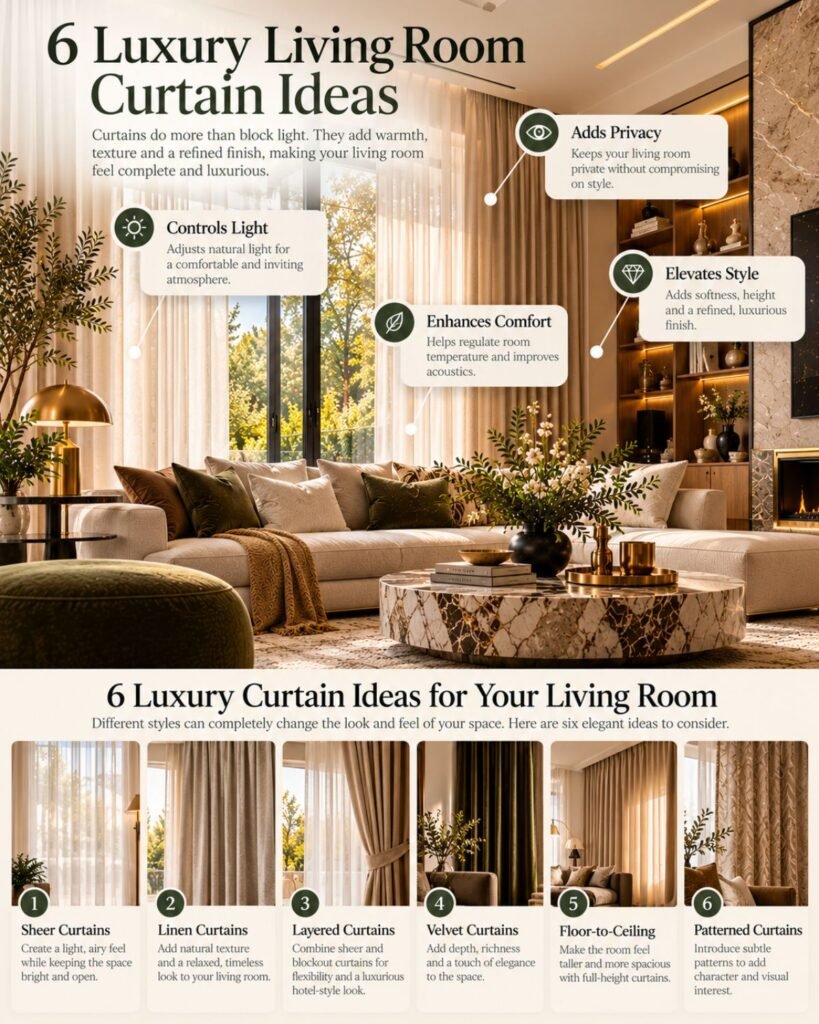
Material, length, volume, heading style, hardware and mounting position all influence how finished the result feels. Homes & Gardens’ guidance on making curtains look more expensive similarly emphasizes details including hardware, length and decorative treatment.
Avoid turning this into a rigid formula.
Not every room needs curtains mounted at the ceiling. Not every fabric needs to pool on the floor. A contemporary apartment, Georgian sitting room and low-ceilinged cottage present different architectural conditions.
The objective is to make the window treatment look deliberately related to the window and the room around it.
Architectural luxury and decorative luxury are different
Some of the most impressive living rooms derive much of their character from architecture.
Built-in joinery, wall paneling, plasterwork, fireplace surrounds, ceiling details, integrated lighting and substantial openings can give a room depth before furniture arrives.
That is architectural luxury.
Furniture, rugs, textiles, lamps, artwork and objects create decorative luxury.
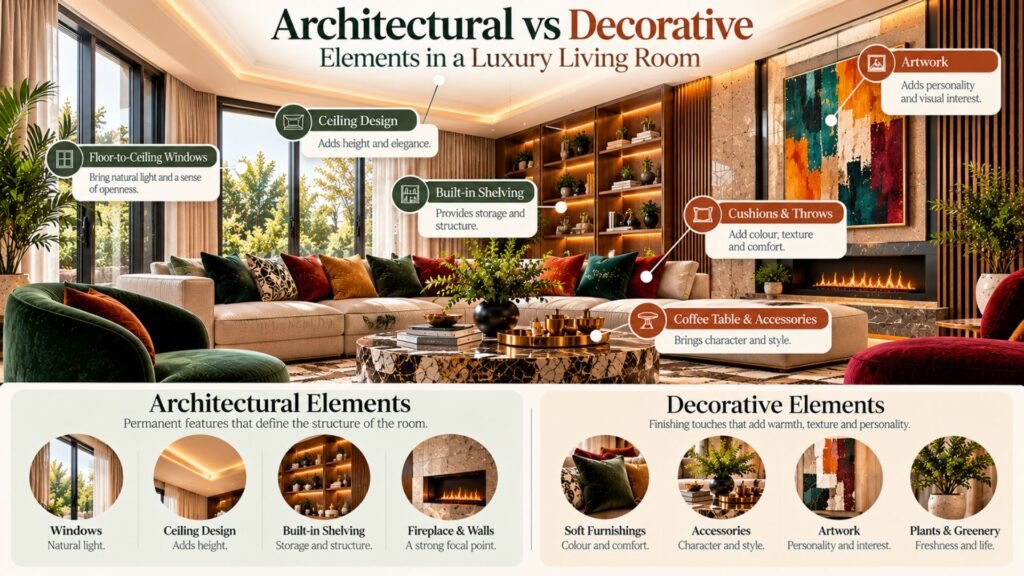
Knowing which one your room already has prevents unnecessary decoration.
If the architecture is strong, allow it to breathe.
If you’re starting with a plain rental or a simple rectangular room, don’t assume you need expensive renovation. Decorative elements can create hierarchy without pretending the architecture is something it isn’t.
A large artwork, correctly scaled furniture, a substantial rug, considered lighting and well-handled windows can do far more than applying decorative moulding simply because moulding appears in expensive homes.
Luxury doesn’t have to be beige
Neutral rooms dominate much luxury imagery because restrained palettes make materials and silhouettes easy to read.
But neutrality is not a requirement.
Deep burgundy, tobacco, olive, muted blue, aubergine, rust, chocolate and stronger combinations can all produce sophisticated rooms when the color relationships are deliberate.
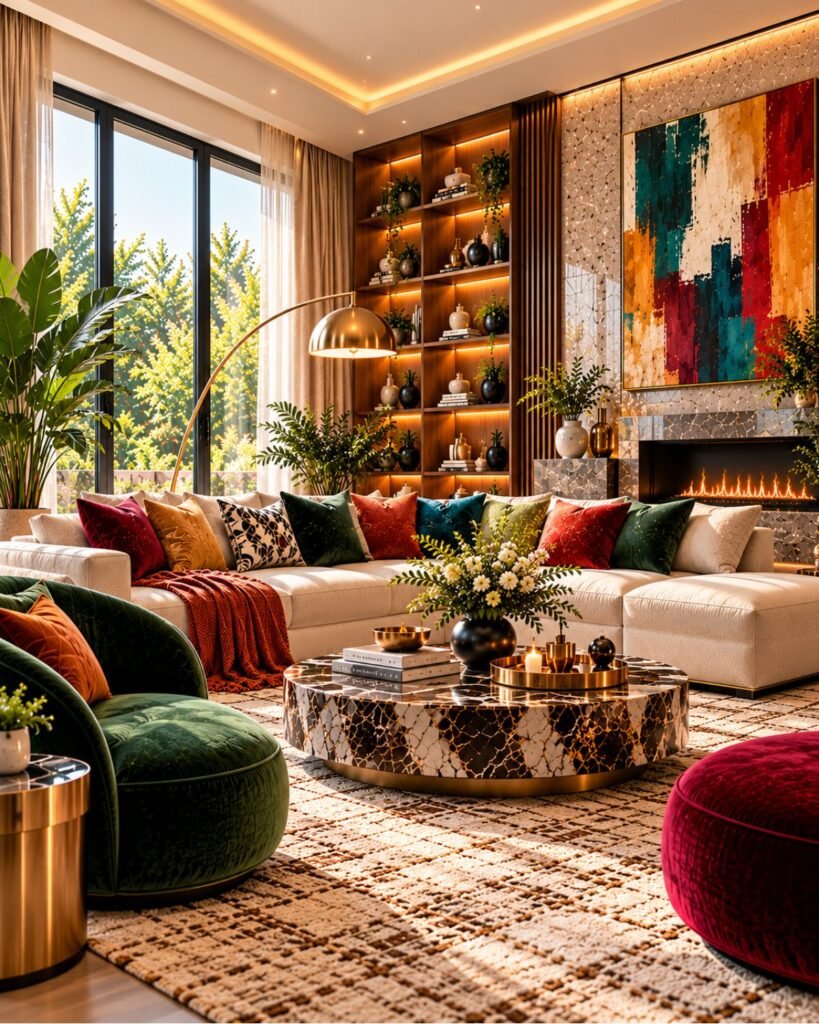
One useful strategy is to let color occupy meaningful areas rather than scattering numerous unrelated accents around the room.
A deep blue sofa has presence. A burgundy wall or substantial curtain establishes atmosphere. Strong artwork can organize several colors into one focal point.
Twenty tiny colorful accessories produce a different effect.
If you prefer a darker foundation, our black living room ideas guide explores how dark surfaces interact with light, material and contrast in much greater depth.
Metallic finishes work better when they have a relationship
Brass is not inherently luxurious.
Neither are bronze, chrome or nickel.
Their effect depends on where they appear and what surrounds them.
A room with brass table legs, chrome lamps, blackened-steel shelving, silver accessories and gold frames can work, but doing so successfully requires more control than simply buying objects labeled “luxury.”
Start with the dominant finish already present in difficult-to-change elements such as architectural hardware or major furniture. Then decide whether other metals should repeat it, quietly complement it or deliberately contrast with it.
Mixing metals can look sophisticated.
Accidentally accumulating metals looks different.
Custom-looking doesn’t always require custom-made
Bespoke joinery can make a room feel deeply integrated because dimensions, storage and architecture have been resolved together.
But the underlying lesson isn’t “hire a cabinetmaker.”
It is reduce the signs of accidental fit.
A freestanding bookcase leaving an awkward narrow gap beside a wall may look temporary. Several unrelated storage units can fragment a long elevation. Visible cables around a media unit can weaken an otherwise sophisticated composition.
Sometimes custom joinery is the right solution. Sometimes painting existing storage to relate to the wall, aligning units more deliberately, improving cable management or removing one unnecessary piece solves enough of the problem.
Spend on bespoke work when bespoke work solves something meaningful.
Comfort is part of luxury
A room can photograph beautifully and still fail the person living there.
The sofa can be too shallow or too upright. Side tables can sit beyond comfortable reach. Lighting can look dramatic but make reading difficult. A precious rug can make everyone nervous about using the room.
That isn’t a trivial problem.
Livingetc’s broader discussion of luxury living room ideas similarly notes that a luxurious room should remain comfortable rather than functioning only as a visual display.
Real luxury includes ease.
Choose upholstery for how the furniture will actually be used. Give people somewhere convenient to place a drink. Make sure conversation works across the seating arrangement. Allow enough light for evening activities.
A living room should not require its occupants to behave like museum visitors.
Where should you spend more?
There is no universal list because every room starts from a different position.
However, spending deserves more scrutiny when an element is large, frequently used, visually dominant or difficult to replace.
That can make a sofa worth greater consideration than a decorative side table. Curtains covering a large wall may justify more attention than small accessories. A rug anchoring the entire seating group can matter more than objects sitting on top of the coffee table.
Current designer commentary reported by Homes & Gardens similarly recommends selective investment rather than spending equally across the room, with sofas among the pieces designers may prioritize.
But don’t turn that into a rule.
If you already have a durable, comfortable sofa, replacing it to achieve a more prestigious label makes little sense. Invest where your existing room is weakest.
Where can you save?
Small, easily replaceable objects are usually safer places to experiment with budget.
Side tables, trays, cushion covers, decorative objects and some secondary lighting can often be sourced without turning price into the main criterion.
Vintage and secondhand pieces complicate the high-price-equals-high-quality assumption further. An older table with good proportions can contribute more character than a new piece purchased simply because it belongs to a luxury collection.
This is another reason not to decorate by price category.
Spend for consequence, not status.
The harder an element is to replace, the more often you use it and the more visual territory it occupies, the more carefully its quality deserves consideration.
Can a small living room feel luxurious?
Yes, but adding more “luxury” details is usually the wrong approach.
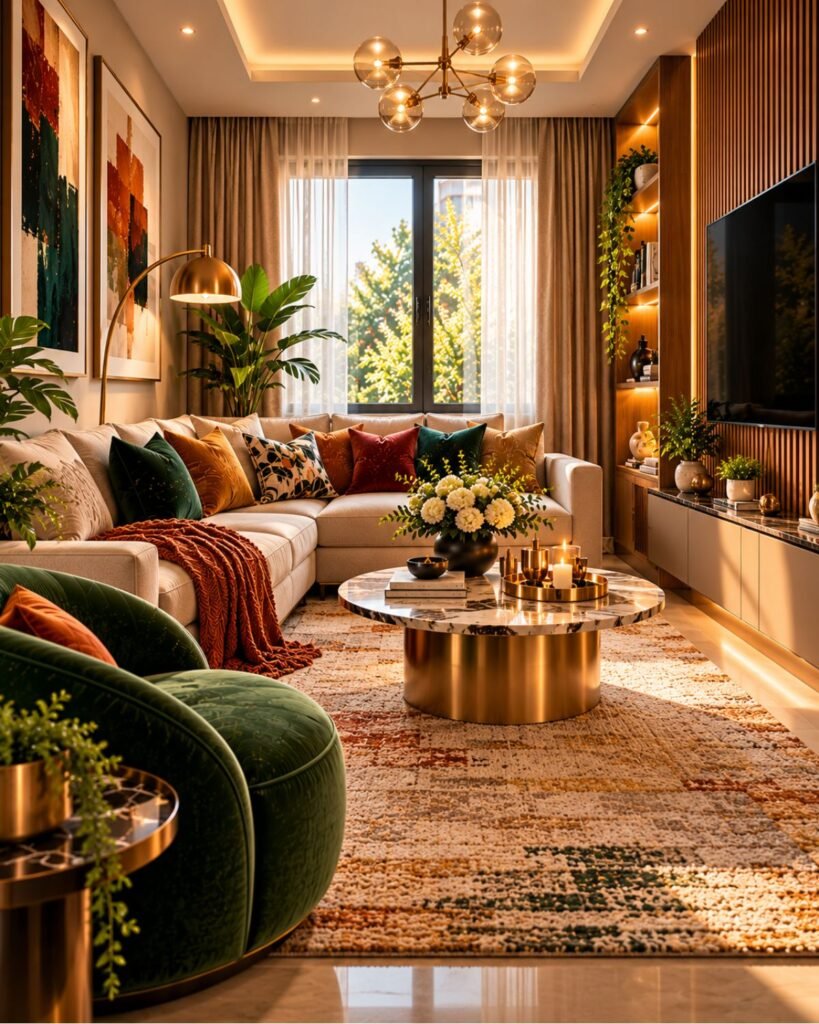
In a smaller room, every object occupies a greater proportion of the visual field. One strong material, properly scaled seating, well-resolved curtains and thoughtful lighting can therefore have considerable impact.
Avoid shrinking everything automatically.
A tiny sofa, miniature rug, small artwork and several little tables can make a room feel fragmented. One comfortable sofa and fewer appropriately scaled supporting pieces may produce a stronger result.
For the layout itself, use our small living room ideas guide. The luxury layer should come after circulation and function work.
Nine luxury living room mistakes worth avoiding
The most common failures aren’t caused by choosing the “wrong” luxury style. They happen when too many individually reasonable decisions accumulate without hierarchy.
1. Making every piece a statement
If everything demands attention, nothing establishes priority.
2. Buying decoration before fixing scale
An undersized rug remains undersized after you add expensive accessories.
3. Using premium materials as tiny tokens
A collection of marble, brass and crystal accessories can communicate the idea of luxury more loudly than the quality of the room itself.
4. Relying on one dramatic ceiling light
A statement fixture can anchor a room, but it cannot illuminate every activity, surface and focal point effectively.
5. Ignoring window treatments
Large expanses of poorly resolved fabric or awkwardly fitted blinds can undermine an otherwise careful room.
6. Buying matching furniture sets
Coordination can help. Total uniformity can remove the variation that makes a room feel collected rather than purchased in one transaction.
7. Styling every available surface
Empty space around a beautiful object is part of its presentation.
8. Copying luxury trends without considering the architecture
Paneling, oversized pendants, heavy drapery or monumental furniture only work when the room can support them.
9. Forgetting comfort
A living room isn’t more luxurious because nobody wants to sit in it.
How to make your living room feel more luxurious with what you already own
Don’t begin with shopping.
Begin by photographing the room from the doorway. The photograph often makes scale problems and competing focal points easier to notice.
Then work through the room in this order.
Identify the strongest existing feature. It could be the fireplace, windows, sofa, artwork, bookcase or view. Give the composition somewhere to begin.
Fix the major proportions. Reposition furniture. Test the rug. Check artwork height and scale. Remove pieces that exist only because there was an empty corner.
Choose the material hierarchy. Decide which timber, stone, textile or metal deserves the most attention and quieten unnecessary competition around it.
Rework the lighting. Instead of switching everything on, decide which areas need general, task or accent light.
Resolve the windows. Even adjusting existing curtains, steaming fabric or improving how panels sit can change the finish of the room.
Edit small objects last. Keep pieces that carry meaning, function or enough visual interest to earn their space.
Then stop.
The last step matters because luxury living rooms often deteriorate not from one terrible purchase but from one more object, followed by one more, followed by one more.
A better way to think about luxury
The strongest luxury living room ideas don’t ask you to make every component expensive.
They ask you to make the important decisions visible.
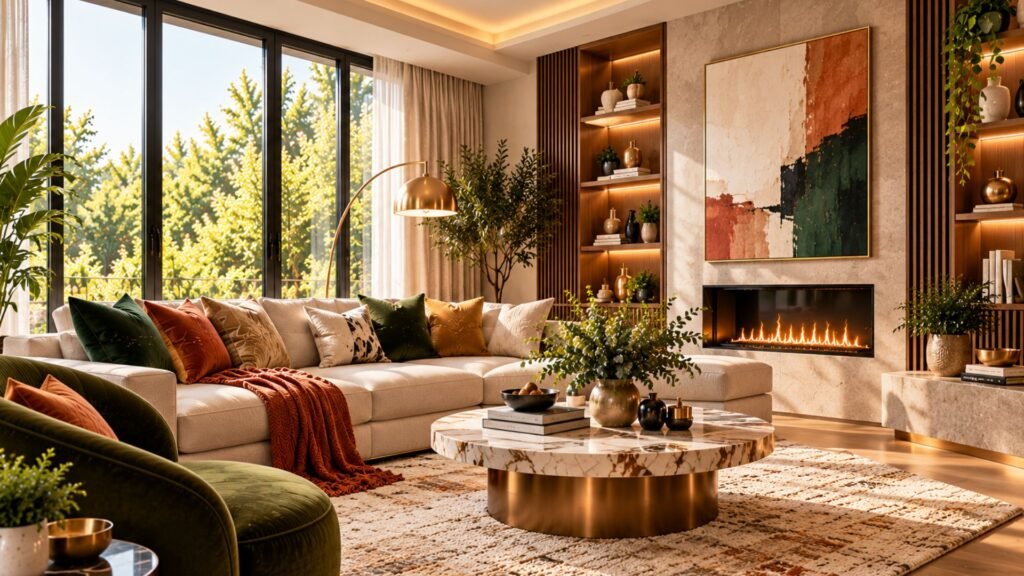
Get the proportions right before decorating. Let important materials appear at a meaningful scale. Use lighting to reveal the room rather than merely illuminate its center. Treat windows as part of the architecture. Spend more where quality will be seen, used or difficult to replace.
Then allow quieter pieces to do quieter jobs.
That is what keeps a luxurious room from becoming an exhibition of luxury signals.
If you’re designing the entire room rather than only its luxury layer, start with our broader living room ideas guide and build the composition before deciding where the exceptional moments belong.
Luxury living room FAQs
What makes a living room look luxurious?
Proportion, material quality, lighting, window treatments, furniture scale and visual hierarchy can all contribute. Expensive products alone don’t guarantee a luxurious result because those elements still need to work together as one composition.
How can I make my living room look expensive?
Start with scale and presentation rather than accessories. Reposition furniture, resolve the rug, improve lighting, refine window treatments and decide which existing feature deserves attention before buying decorative “luxury” objects.
What colors make a living room look luxurious?
There is no required luxury palette. Warm neutrals can work, but so can burgundy, blue, green, brown, black and more expressive combinations. Controlled relationships between colors matter more than selecting a supposedly luxurious color.
What should I spend more on in a living room?
Consider spending more carefully on elements that are frequently used, visually dominant, large or difficult to replace. Depending on the room, that could include the sofa, rug, curtains, lighting or major joinery. Existing pieces should be assessed before anything is replaced.
Can a small living room look luxurious?
Yes. Concentrating attention on proportion, one or two strong materials, good lighting and well-resolved window treatments can work particularly well in smaller rooms because each major decision has significant visual presence.
Does a luxury living room have to be neutral?
No. Neutral palettes are common in luxury interiors, but they are not a requirement. Color-rich rooms can feel equally sophisticated when color, material and furniture are deliberately coordinated.
What’s the difference between a luxury and minimalist living room?
Minimalism primarily reduces visual competition and emphasizes editing. Luxury is concerned here with refinement, material presence, proportion and where visual investment is concentrated. A room can be both, but neither style requires the other.
References
- Architectural Digest. “Master Scale and Proportion Like a Seasoned Decorator.” https://www.architecturaldigest.com/gallery/how-to-master-scale-design-proportion-like-a-decorato
- Homes & Gardens. “How Can I Make My Living Room Look Expensive?” https://www.homesandgardens.com/decor/living-room-furniture-worth-splurging-on
- Homes & Gardens. “How Do You Make Curtains Look Expensive?” https://www.homesandgardens.com/interior-design/how-do-you-make-curtains-look-expensive
- Livingetc. “Luxury Living Room Ideas — Sophisticated Spaces Filled With Elevated Details.” https://www.livingetc.com/ideas/luxury-living-room-ideas
- Livingetc. “How Do I Make My Living Room Look Expensive?” https://www.livingetc.com/advice/how-to-make-a-living-room-look-expensive
About the author
Emma Carter writes about interior color, home décor, and practical styling for Wallsaide. She focuses on helping readers combine colors, materials, textiles, and decorative elements into rooms that feel balanced and cohesive.