


A small living room doesn’t need less style than a large one. It needs more deliberate decisions. Every piece of furniture, every color choice, and every inch of floor space does more work in a compact room, which is why both good and poor choices become especially noticeable.
This guide builds on our complete living room design guide, focusing specifically on what changes when space is limited. Start with a look that suits your home, then work through the decisions that determine whether a small living room feels cramped, comfortable, or genuinely well resolved.
Small living room ideas: 6 directions to start from
There isn’t one aesthetic that works for every compact room. The useful starting point is choosing a clear direction, then selecting furniture, color, storage, and lighting that support it rather than competing for limited space.
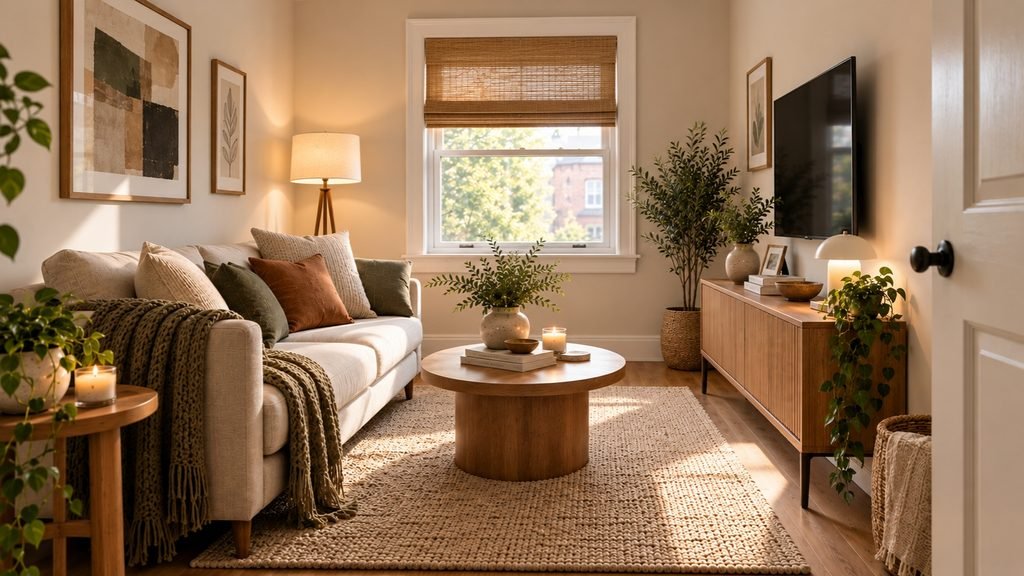
Warm neutral
The room above shows how this direction can work: soft beige tones, warm wood, restrained contrast, and furniture that doesn’t visually overwhelm the available space.
It’s an approachable starting point if you’re not sure which direction to take. The palette can stay quiet while differences in wood, upholstery, rugs, and other textures keep the room from feeling flat.
Cozy
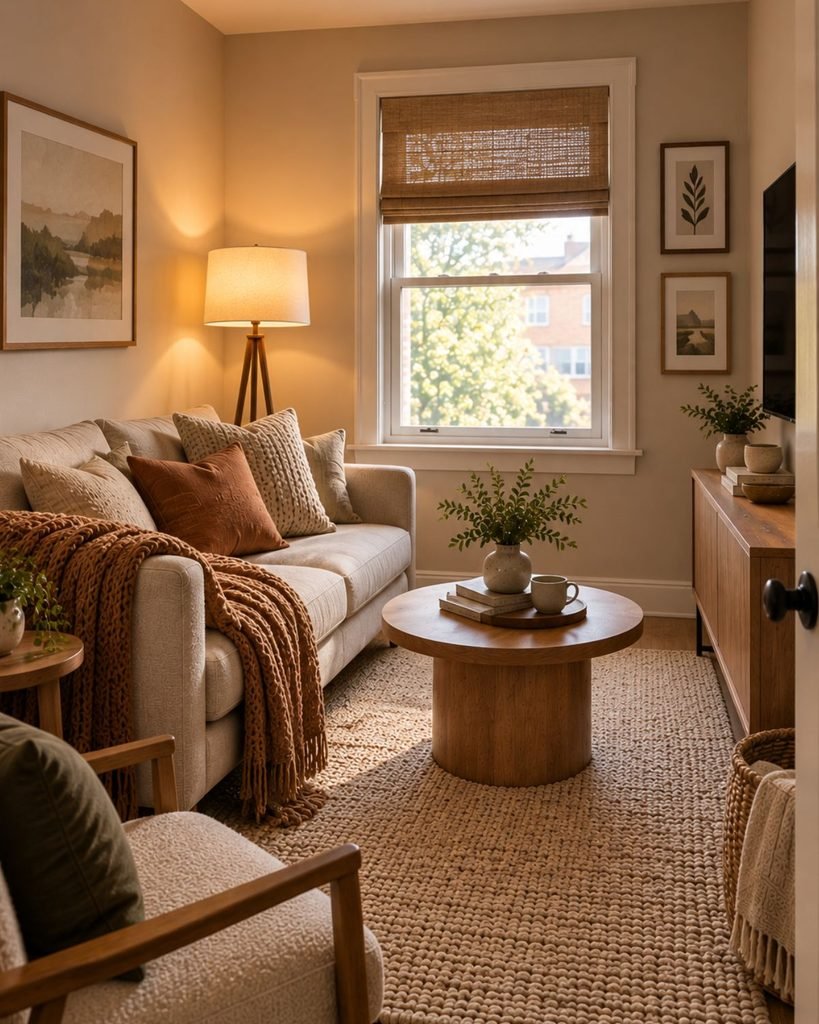
A cozy small living room doesn’t need to be filled with accessories. Texture can do much of the work.
A soft rug, tactile throw, comfortable cushions, curtains, and warm localized lighting can make the room feel inviting without sacrificing valuable floor space. Keeping the palette relatively controlled also allows those layers to add warmth without making the room visually hectic.
Modern
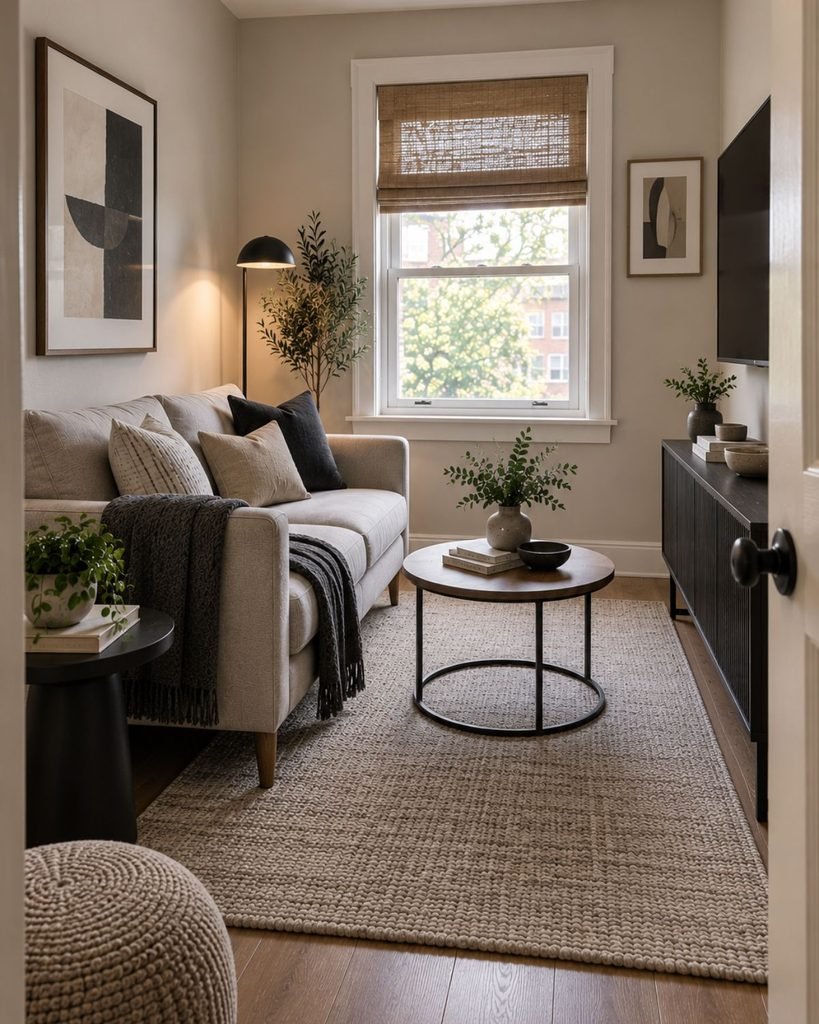
Clean lines are particularly useful when square footage is limited. Slim-profile furniture, visible legs, restrained colors, and fewer objects competing for attention can create a calmer composition.
Modern doesn’t have to mean stark. Wood, textured upholstery, a rug, and one or two carefully chosen decorative pieces can soften the room while preserving its visual simplicity.
Colorful
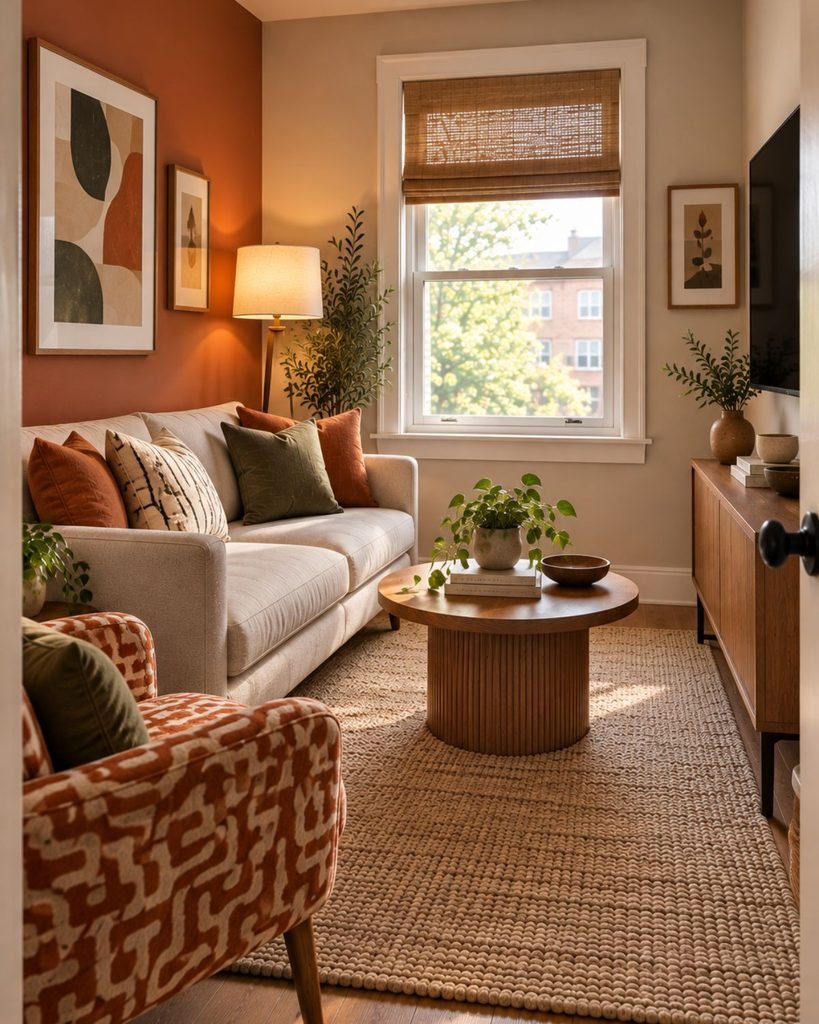
A small living room can carry strong color. The key is deciding where that color should have the greatest impact instead of spreading competing shades across every surface.
A terracotta wall, colorful chair, patterned rug, or concentrated group of textiles can establish the palette while quieter furniture and natural wood give it somewhere to rest.
This creates personality without requiring a large room to absorb many unrelated visual elements.
Multifunctional and storage-first
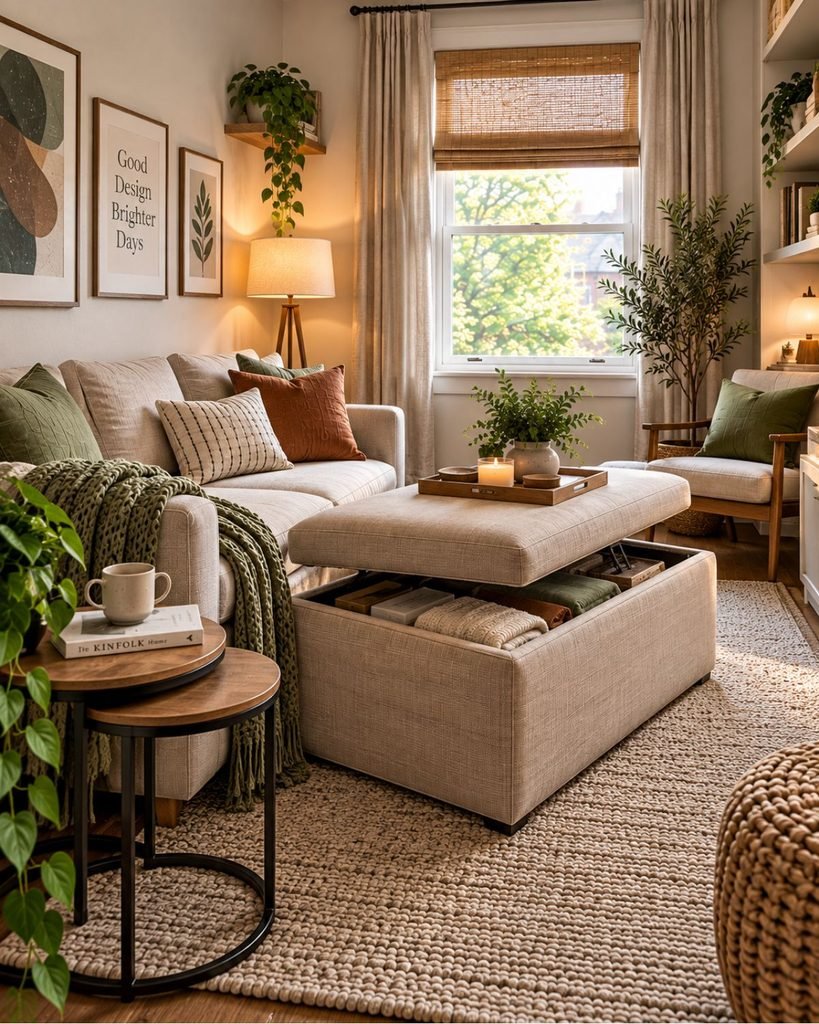
When space is scarce, furniture that performs more than one job can reduce the number of individual pieces the room needs.
A storage ottoman can replace a conventional coffee table. Nesting tables can expand when guests arrive and contract afterward. A bench can provide both seating and concealed storage.
The goal isn’t to make every object multifunctional. It’s to identify where one well-chosen piece can eliminate the need for another.
TV-focused
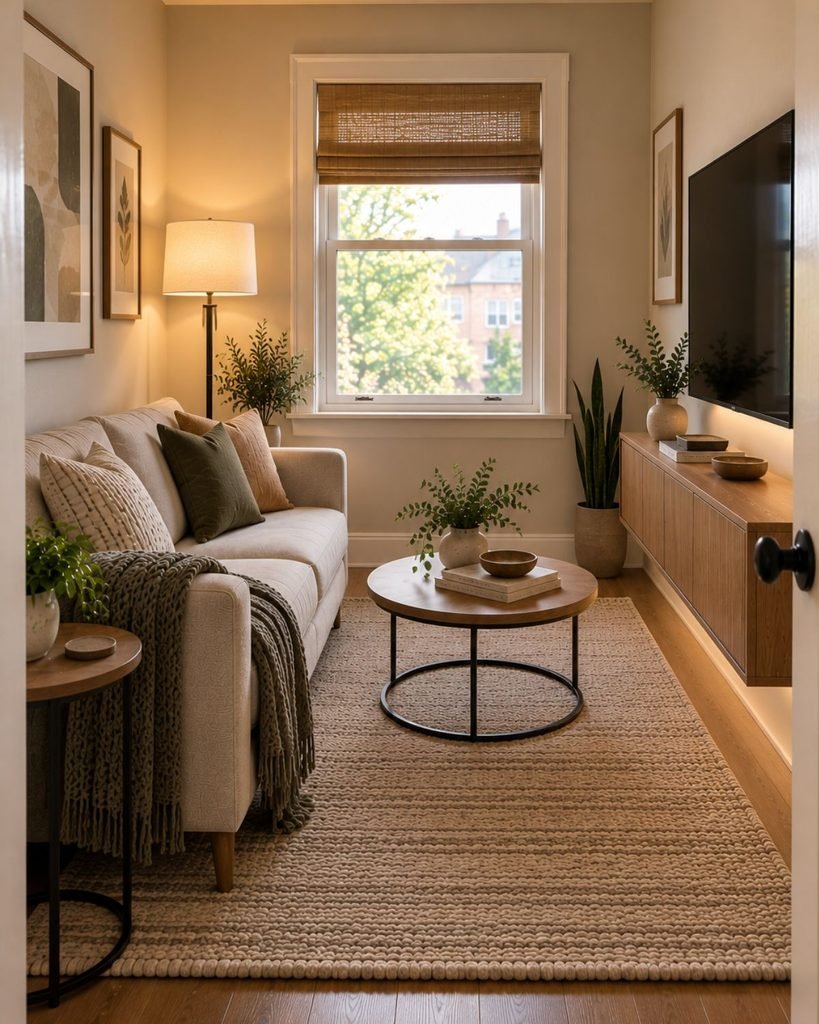
If watching TV is one of the room’s primary functions, acknowledge it early in the design rather than trying to disguise it after everything else is arranged.
A wall-mounted screen with a slim console can preserve more visible floor area than a deep media unit. Alternatively, a narrow console can provide useful closed storage while visually anchoring the screen.
The rest of the seating can then be organized around a comfortable sightline instead of forcing the television into whatever space remains.
The Wallsaide small-room priority order
Small-room advice is often presented as an unordered collection of tips. A more useful approach is to decide what matters first.
This is Wallsaide’s editorial framework rather than an industry standard, but it provides a practical order for working through a compact room:
- Protect circulation first. Decide where people need to walk before deciding where furniture should go.
- Define the primary function. Decide what the room needs to do most successfully.
- Scale the anchor furniture. Your sofa or sectional determines how much flexibility remains for everything around it.
- Connect the seating visually. Individual pieces don’t have to touch, but they should feel like part of the same arrangement.
- Use vertical space. Walls can provide useful storage without adding another piece of floor furniture.
- Keep storage visually light. Look at both capacity and how substantial the storage piece appears within the room.
- Layer the lighting. Use smaller light sources in addition to, or instead of relying entirely on, one central fixture.
- Add personality last. Once the functional structure works, introduce art, textiles, plants, books, and other personal details.
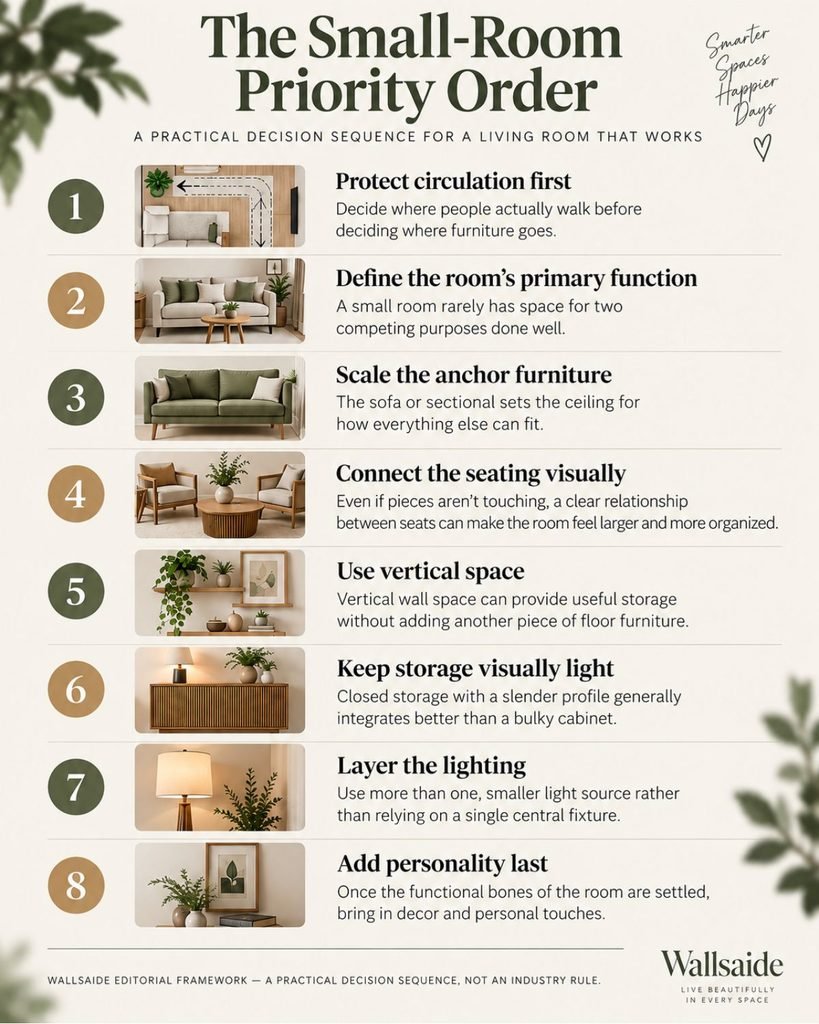
This order also makes decorating easier. Instead of buying individual pieces and trying to make them coexist afterward, you’re solving the largest spatial decisions before moving to the decorative ones.
Furniture scale and visual weight
Two pieces of furniture can occupy a similar amount of floor space yet feel very different once they’re inside a compact room.
One reason is visual weight.
A sofa raised on visible legs allows you to see some floor beneath it. A similarly sized sofa with a solid or skirted base creates a more continuous visual block.
That doesn’t mean furniture with visible legs objectively makes a room larger, nor does it mean solid-base furniture is wrong. It’s a visual effect that depends on the furniture, surrounding objects, colors, and room itself.
But when choosing between similarly sized pieces, showing more floor can make one option feel less visually imposing in a constrained space.
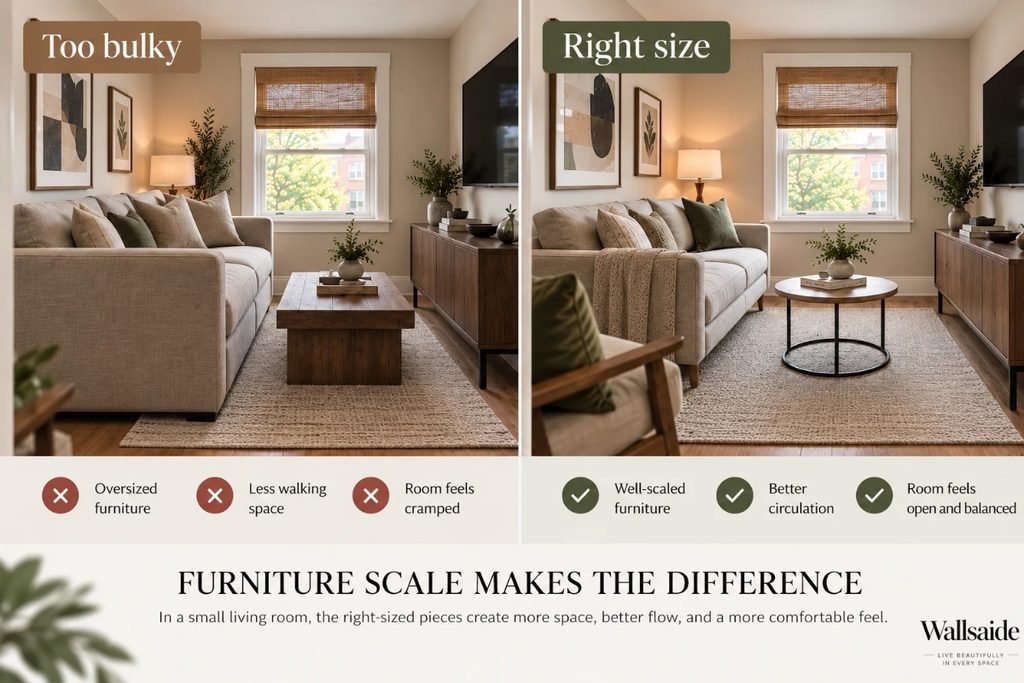
Physical dimensions still come first. Measure width and depth rather than relying on product labels such as “compact,” and consider how the furniture affects doorways and movement once other pieces are added.
Keep the seating visually connected
Pushing every piece of furniture against a wall can appear to create more open floor area, but it doesn’t automatically create a better layout.
The more important question is whether the seating feels connected.
Start with the room’s main walking path. Protect that route, then orient the seating toward a shared focal point such as the television, a window, or artwork.
Each seat should feel related to the others rather than stranded around the perimeter.
Different room shapes need different arrangements, so detailed layout configurations are best treated separately. In this broader guide, the useful principle is simple: protect movement first, then build a recognizable seating zone around it.
Small living room with a TV
Most small living rooms still need to accommodate everyday entertainment.
If a TV is important to the room, decide where it belongs before buying or positioning secondary furniture. A wall-mounted screen with a slim floating console can reduce the amount of floor occupied by media furniture, while a narrow conventional console may be more practical when closed storage is important.
Seating distance depends on screen size, resolution, room geometry, and personal preference, so there isn’t one universal measurement that works for every room.
Instead, prioritize a comfortable sightline and consider the television’s visual proportion relative to the wall and seating area.
Where a fireplace, prominent window, artwork, or television competes for attention, choosing one clear primary focal point can make the arrangement feel more intentional.
Use vertical space for storage
Vertical wall space can provide useful storage without adding another piece of floor furniture.
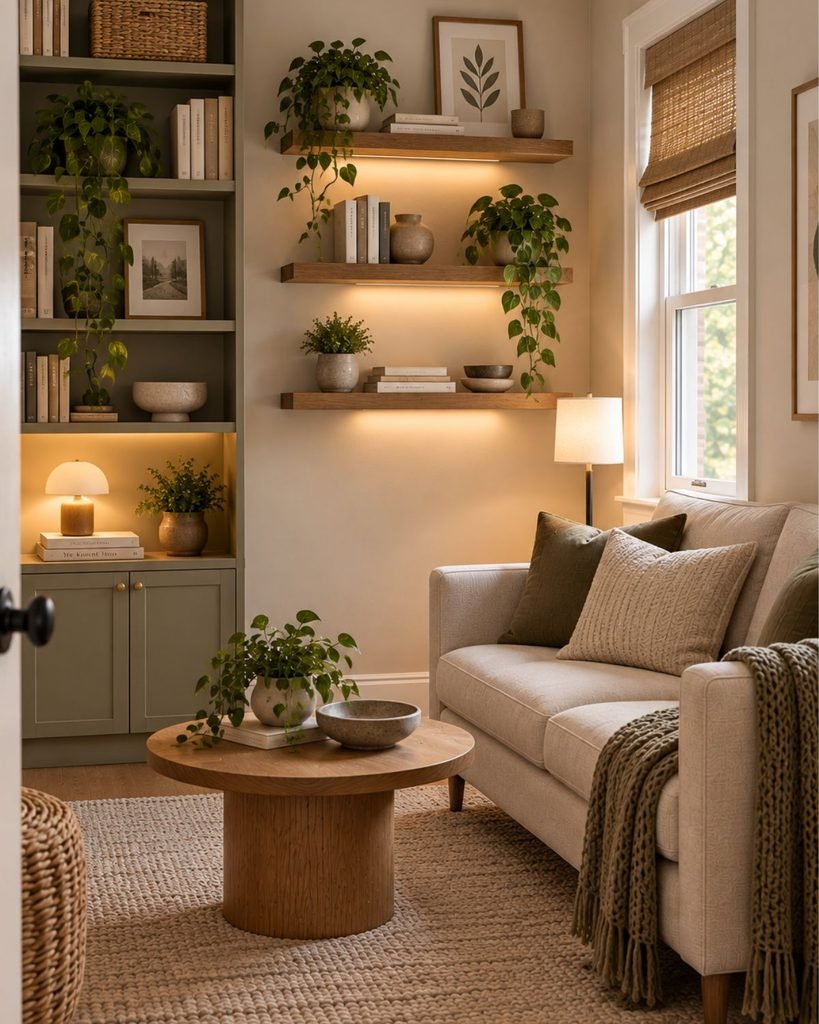
Tall, narrow bookcases can provide significant capacity using relatively little floor width. Floating shelves can hold books and decorative objects without requiring another cabinet, while a wall-mounted media console can preserve visible floor beneath it.
The goal isn’t simply to fill empty walls. Too many shelves can become another form of visual clutter.
Instead, use height where it solves a real storage or display problem.
Closed storage is useful for the less attractive parts of everyday life, but its visual profile matters too. Slender legs, an open base, restrained proportions, or a finish that works with the surrounding palette can make storage feel more integrated into a compact room.
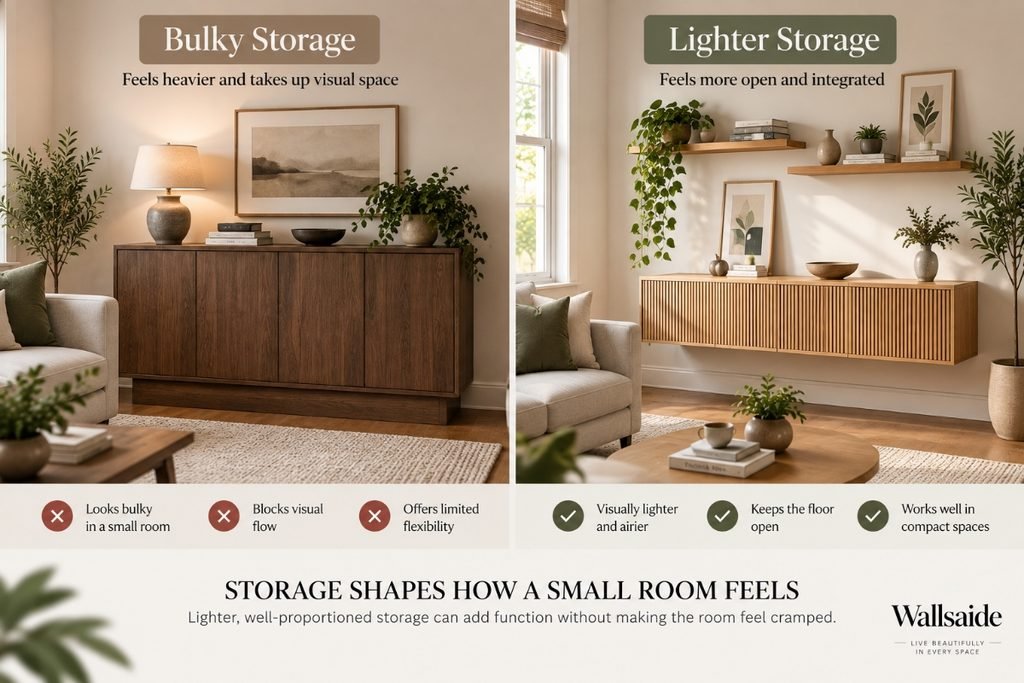
Think about storage as part of the room’s architecture rather than as something added after every other surface becomes full.
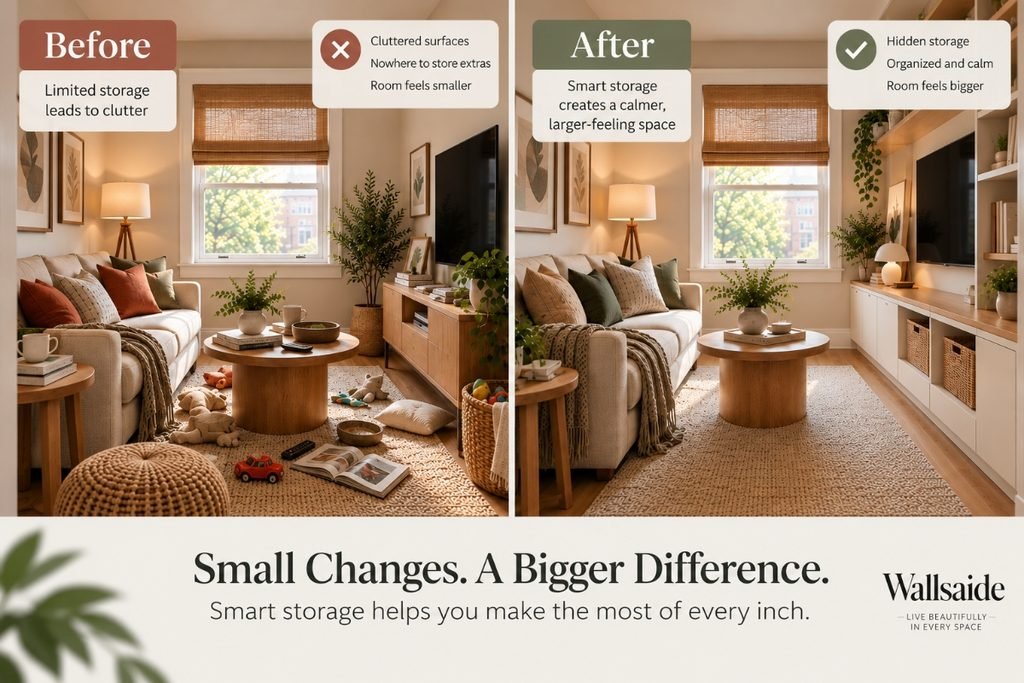
Choose multifunctional furniture selectively
Multifunctional furniture is useful because a small living room often has less tolerance for redundant pieces.
A storage ottoman can provide a surface, occasional seating, and concealed storage. Nesting tables can offer extra tabletop space only when it’s needed. A storage bench can provide seating without requiring a separate cabinet for blankets or other occasional items.
But multifunctional isn’t automatically better. A complicated piece that performs several jobs poorly can be less useful than one simple piece that performs its main function well.
Choose double-duty furniture where it genuinely removes another object from the room or solves a recurring problem.
Rugs in a small living room
The rug helps define how the seating relates to the floor around it.
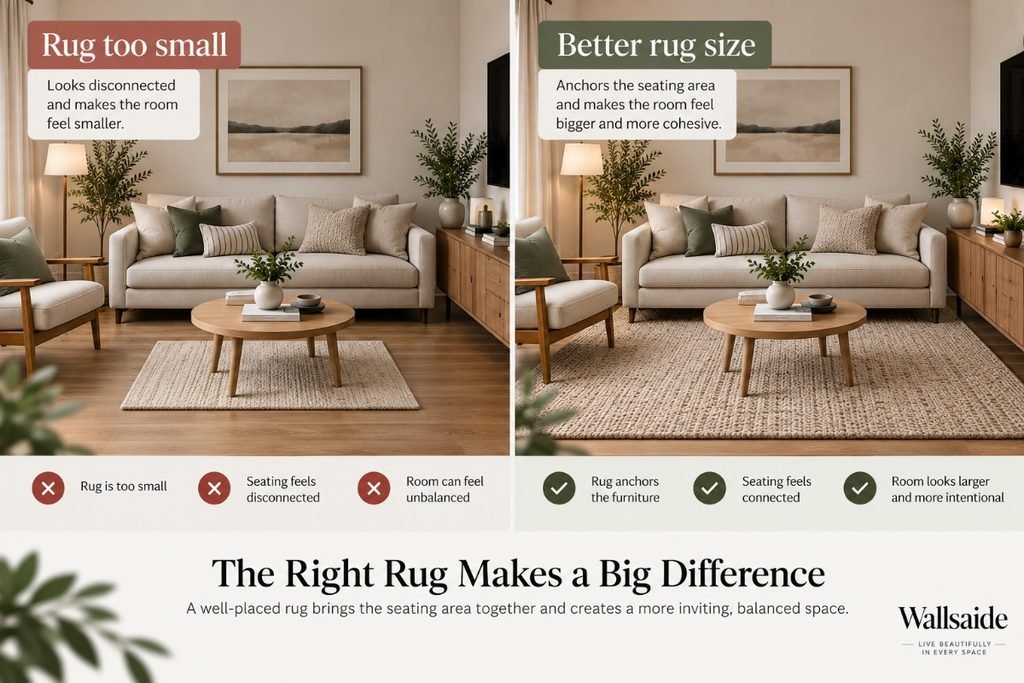
Where space allows, a rug that visually overlaps or relates clearly to the seating group usually creates a more unified zone than one floating independently in the middle of the floor.
That doesn’t mean every compact living room needs a large rug or that a smaller one is automatically wrong.
In an exceptionally tight room, a smaller rug can still work when its placement looks intentional rather than accidentally undersized. The useful question is whether the rug contributes to the seating composition or appears unrelated to it.
This is also why buying a rug based solely on the room’s total dimensions can be misleading. The relationship between the rug and the furniture matters as much as the amount of exposed floor.
Layer lighting instead of relying on one source
Relying only on a central overhead fixture can leave a small living room feeling visually flat.
Adding light at different heights gives you more control over how the room feels at different times of day. A floor lamp beside a chair can provide useful task lighting. A table lamp can create a softer pool of light in the evening. A wall-mounted fixture may provide illumination without taking up table or floor space.
You don’t need to fill a small room with lamps. The goal is simply to avoid asking one fixture to perform every lighting job.
Lighting can also help define areas within the room without adding physical dividers, which is particularly useful when floor space is limited.
Small living room mistakes to avoid
Some decorating decisions become much more noticeable when there isn’t much space around them.
Buying furniture because it technically fits. A sofa can fit between two walls and still dominate the room. Look at depth, height, visual weight, surrounding circulation, and what else must share the space.
Pushing everything to the perimeter. Open floor area isn’t automatically useful floor area. Prioritize circulation and a coherent seating relationship instead.
Ignoring visual weight. Two similarly sized pieces can feel very different depending on their bases, proportions, materials, and surrounding contrast.
Relying on one overhead light. A second localized light source can give the room more depth and flexibility.
Using only floor-level storage. When every storage solution consumes floor area, the room loses flexibility quickly. Use vertical space where it genuinely helps.
Adding decoration before solving the layout. Styling can’t compensate for furniture that blocks movement or overwhelms the room. Get the functional structure right first.
The goal isn’t to make a small living room look empty. It’s to make each piece justify the space it occupies.
Small living room ideas FAQ
What size sofa fits a small living room?
There’s no universal sofa size for a small living room. Start with the usable wall length, then account for the sofa’s full width and depth, doorway positions, circulation paths, and the other furniture the room needs. A compact two-seat sofa or loveseat can be a sensible option in a tight room, but measuring the actual layout matters more than following a generic size rule.
How do you arrange furniture in a small living room?
Protect the main walking path first, then identify the room’s primary focal point and organize the seating around it. Keep individual seats visually connected rather than automatically pushing every piece against a wall. The best configuration ultimately depends on the room’s shape, doors, windows, and primary function.
What makes a small living room feel bigger without renovating?
Reducing unnecessary visual weight can help. Furniture with visible floor beneath it may feel lighter than a similarly sized solid-base piece, while connected seating, deliberate rug placement, and lighting from more than one source can create a more coherent room. The goal is less about tricks and more about reducing visual competition.
Do small living rooms need a coffee table?
No. If a conventional coffee table interferes with movement or takes up space you need for another purpose, consider a storage ottoman, nesting tables, or a slim side table instead. Choose the surface based on how you actually use the room rather than treating a coffee table as mandatory.
About the author
Lauren Johnson writes about interior design, home décor, color, and practical room styling for Wallsaide. She focuses on helping readers understand why design choices work and how to recreate beautiful, functional spaces at home.